

The authors of a new review outline how AI can turn water quality management from a reactive, after-the-fact process into a proactive early warning and control system for harmful microbes, algal toxins, parasites, and antibiotic resistance genes in aquatic environments.
These living “biocontaminants” are highly dynamic, able to grow, evolve, and spread with changing temperature, nutrients, and hydrology, which makes them far harder to track than traditional chemical pollutants.
A shift towards using AI for this kind of monitoring could better protect ecosystems and public health, says the authors, in a paper published in the open access journal Biocontaminant.
“Our work shows that artificial intelligence has the potential to serve as an intelligent nervous system for aquatic environments, sensing subtle biological changes, learning from them, and triggering timely responses before risks escalate,” said lead author Qinling Wang from the School of Environment at Nanjing University. “The ultimate goal is to move from passively discovering problems in water bodies to actively preventing ecological and health crises.”
From static snapshots to real-time sensing
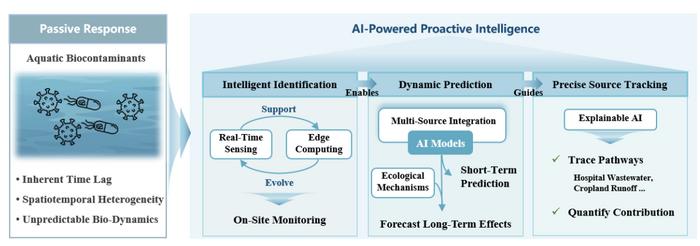
Conventional monitoring of microbial and algal contamination often depends on periodic sampling and lab analysis, which can miss fast developing events like harmful algal blooms or pathogen outbreaks. The review describes how new intelligent sensors combined with edge computing and embedded machine learning models can now analyze signals directly in the field for near-real-time water quality assessment.
By integrating AI models into fluorescence, electrochemical, and Raman spectroscopy based sensors, devices evolve from simple data collectors into on site diagnostic terminals that recognize characteristic “fingerprints” of contaminants. In pilot studies, such AI enhanced sensing systems have been able to rapidly identify multiple pathogens or discriminate harmful algal species with high accuracy while operating on low cost, low power chips positioned directly at monitoring sites.
Forecasting blooms and outbreaks before they strike
Beyond detecting what is currently in the water, AI is also being used to forecast when and where biological hazards are likely to appear. According to the review, models such as deep neural networks, recurrent networks, and gradient boosting trees can learn complex relationships between environmental drivers for example temperature, nutrients, turbidity, and weather and the growth of algae, bacteria, and viruses.
These models have already been applied to predict harmful algal blooms days to months in advance, estimate pathogen concentrations in drinking water sources, and identify threshold conditions under which contamination risks rise sharply. When coupled with explainable AI techniques that highlight which factors matter most, such forecasts can guide practical decisions like reservoir operation, beach closures, or adjustments in water treatment.
Tracing invisible sources and pathways
A third frontier covered in the article involves using machine learning to trace where biocontaminants come from and how they move through interconnected water, sediment, biofilm, and infrastructure networks. By analyzing “microbial fingerprints” from high throughput DNA sequencing, AI based microbial source tracking tools can estimate how much of the contamination in a river or reservoir originates from sources such as human sewage, livestock, or wildlife.
The review also highlights AI studies that map the spread of antibiotic resistance genes across multiple environmental media, identify key microbial hosts, and reveal how stressors like microplastics or industrial chemicals can accelerate horizontal gene transfer. When combined with hydrological, land use, and wastewater data, spatiotemporal models can reconstruct contamination events and support wastewater based epidemiology for tracking community disease trends.
Promise, pitfalls, and the path ahead
Despite the promise, the authors emphasize that AI is not a magic solution. Biocontaminants are living, evolving systems, and high quality data on rare pathogens, emerging resistance genes, and long term ecological change are still scarce, which can limit model reliability.
Another major challenge is that many powerful AI models behave as black boxes, providing little insight into the underlying biology and offering few guarantees when conditions change beyond the range of past data. The review argues that future research should focus on adaptive sensing systems that continuously learn from new observations, hybrid models that embed ecological mechanisms such as growth and competition into neural networks, and dynamic network based risk assessment that considers whole ecosystems instead of single pollutants in isolation.
“AI systems for water management must be as adaptive as the ecosystems they monitor,” said senior author Bing Wu of the State Key Laboratory of Water Pollution Control and Green Resource Recycling at Nanjing University. “By integrating real time monitoring, ecological theory, and machine learning, we can move toward truly predictive management of aquatic health and safeguard both biodiversity and public health in a changing world.”