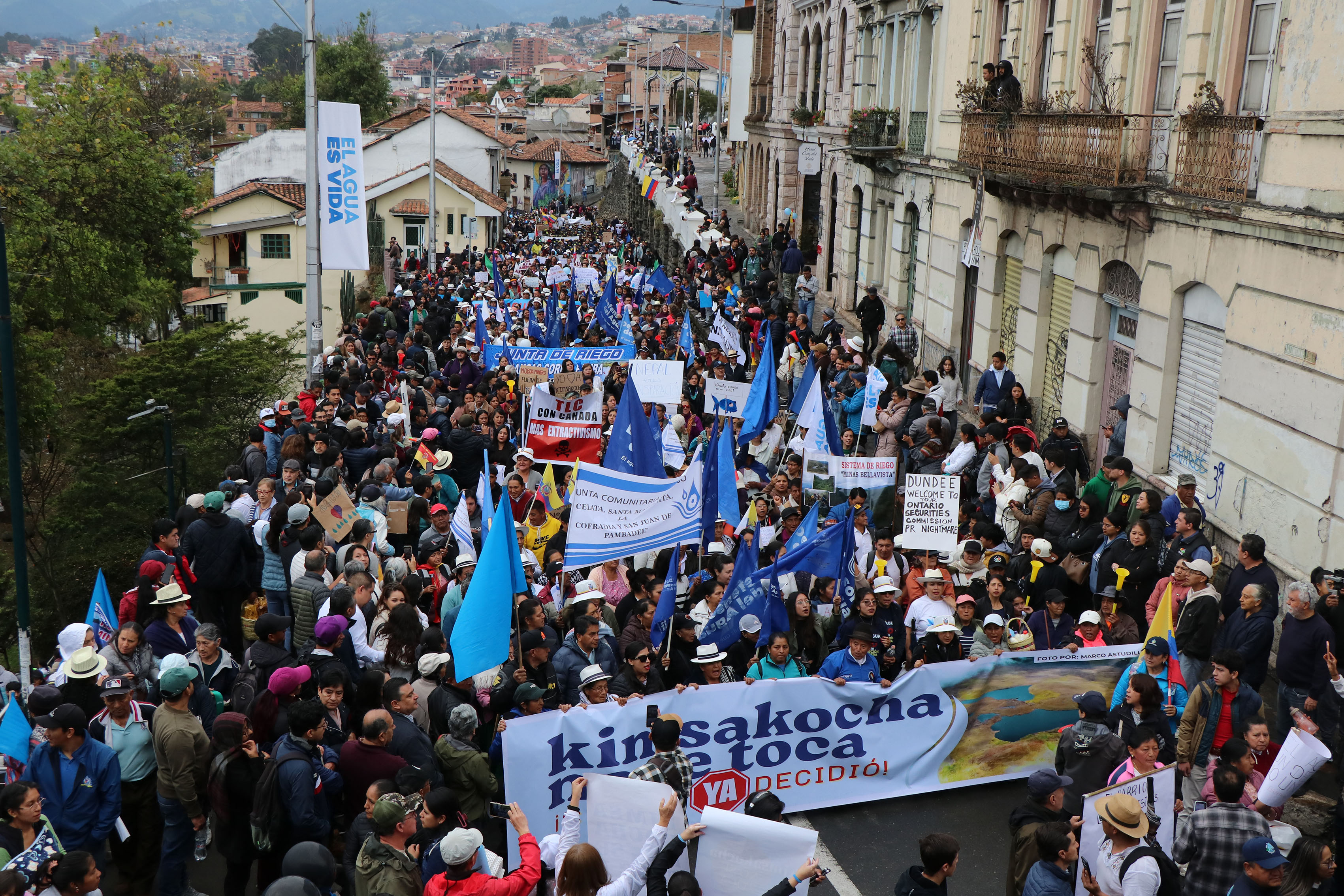


Leaders of Indigenous, Afro-descendant and disenfranchised groups living in rural and forested regions around the world see the upcoming United Nations climate summit in Belém, Brazil, as a pivotal moment.
For the first time, more than 1,000 accredited representatives of these groups will have access to the so-called Blue Zone, the primary venue for U.N. Framework Convention on Climate Change (UNFCCC) negotiations.
Keepers of ancient knowledge are preparing to reshape the global conversation on climate rights and justice, said frontline leaders of climate action in Africa, Asia and Latin America. They spoke at a press briefing hosted Thursday by the Rights and Resources Initiative (RRI), a global coalition of more than 200 organizations dedicated to advancing the land, forest and resource rights of Indigenous and Afro-descendant peoples as well as diverse groups in local communities.
Many are calling COP30 in Belém “the Indigenous People’s COP,” said Solange Bandiaky-Badji, president of RRI.
“COP30 is a pivotal moment, not only because it will take place in the heart of the Amazon Basin,” Bandiaky-Badji said, “but because it offers a chance to finally align global climate ambition with justice and inclusion.”
The Brazilian presidency, as the host of COP30, has committed to ensuring “unprecedented indigenous participation,” said Bandiaky-Badji.
For the “historically marginalized, displaced, or unheard,” COP30 President Designate André Aranha Corrêa do Lago said in an August letter to the international community, “COP30 should be the turning point in which you are recognized as both essential actors and rights-holders in the global climate response.”
Toward that end, it is critical to ensure direct financing to shift power and resources to these historically marginalized groups, and to elevate the long-neglected voices of youth, women and Afro-descendants, Bandiaky-Badji said.
Indigenous peoples, Afro-descendant peoples and local communities collectively manage more than half of the world’s land, much of it holding vital forests and biodiversity, but have ownership or legal rights to only 11 percent of that land, she said.
Just as countries recognized Afro-descendant communities as stakeholders for the first time at the Convention on Biodiversity in Colombia last year, Bandiaky-Badji said, “we want to make sure that also the UNFCCC sees Afro-descendant people as key actors.”
Leaders at the briefing outlined what meaningful progress at COP30 would look like to them.
Critical goals include legal recognition and direct financing of community land rights, truly inclusive participation in the talks and the incorporation of territorial rights in countries’ climate action plans, or Nationally Determined Contributions (NDCs). Direct financing of community land rights was outlined in the Brazzaville Declaration drafted at the First Global Congress of Indigenous Peoples and Local Communities from Forest Basins in the runup to COP30.
An RRI analysis found that only 40 percent of NDCs mention land or territorial rights in their mitigation mechanisms.
For example, most of the critical minerals needed for clean energy technologies are in or near Indigenous lands. But NDCs that mention the importance of these minerals typically fail to address the social and environmental impacts of mining on communities.
An obvious solution to this oversight is to create an Indigenous NDC at COP30, said Ginny Alba, a member of the Indigenous Piratapuyo Amazonian tribe who works with the National Organization of the Indigenous Peoples of the Colombian Amazon.
Alba has been working “nation to nation,” representing Indigenous groups in talks with the Colombian government, to ensure that the perspectives of Indigenous people are incorporated into Colombia’s NDCs, with an eye toward a broader mission.
“Our main goal is to be able to eventually talk about an Indigenous NDC,” Alba said. She wants to ensure that any agreements crafted at the local or national level don’t fall apart when they reach COP30 because Indigenous and other leaders are excluded from international negotiations.
As holders of knowledge, Indigenous people and communities know how to conserve nature and identify solutions to environmental problems because that’s their way of life, said Prescilia Monireh, who works in the Congo Basin with REPALEAC, which represents more than 200 Indigenous organizations in Central Africa.
“We are experts in conservation through our knowledge, our practices, our traditions,” Monireh said.
Yet these communities face ongoing displacement, predation of natural resources by extractive companies, loss of traditional practices and reduction of ancestral knowledge, said Miguel Pereira of the International Coalition of Afro-descendant Lands and Territories.
Safeguarding ancestral territories depends on ensuring the active participation of Afro-descendant peoples and recognizing their traditional collective property rights, he said.
Sabba Maharjan, a young Newar activist from Nepal, said empowering youth empowers the Earth itself.
“For young people from Indigenous communities like me, who live at the forefront of the climate crisis, participating in these kinds of international discussions like COP30 is no longer a choice for us,” said Maharjan. “It is a necessity, and whatever happens at that negotiation table, it deeply affects our grassroot community.”
Youth climate activists around the world are ready to lead on land and climate justice at COP30,
said Maharjan, who will be participating in side events at COP30 that promote youth-led perspectives in global priorities for land, climate and rights.
“We are actually inheriting a world where ecosystems are degraded, our communities are uprooted, we are losing our land to drought, to erratic rains and floods,” she said. “We are seeing our people suffering from climate-related diseases. We are being displaced by extractive development.”
Even so, she said, her people still protect the forests, they still protect the rivers.
She hopes the world hears her message: “Listen to the youth, learn from the elders and act for the future generations to come.”
About This Story
Perhaps you noticed: This story, like all the news we publish, is free to read. That’s because Inside Climate News is a 501c3 nonprofit organization. We do not charge a subscription fee, lock our news behind a paywall, or clutter our website with ads. We make our news on climate and the environment freely available to you and anyone who wants it.
That’s not all. We also share our news for free with scores of other media organizations around the country. Many of them can’t afford to do environmental journalism of their own. We’ve built bureaus from coast to coast to report local stories, collaborate with local newsrooms and co-publish articles so that this vital work is shared as widely as possible.
Two of us launched ICN in 2007. Six years later we earned a Pulitzer Prize for National Reporting, and now we run the oldest and largest dedicated climate newsroom in the nation. We tell the story in all its complexity. We hold polluters accountable. We expose environmental injustice. We debunk misinformation. We scrutinize solutions and inspire action.
Donations from readers like you fund every aspect of what we do. If you don’t already, will you support our ongoing work, our reporting on the biggest crisis facing our planet, and help us reach even more readers in more places?
Please take a moment to make a tax-deductible donation. Every one of them makes a difference.
Thank you,

Liza Gross
Reporter, California
Liza Gross is a reporter for Inside Climate News based in Northern California. She is the author of The Science Writers’ Investigative Reporting Handbook and a contributor to The Science Writers’ Handbook, both funded by National Association of Science Writers’ Peggy Girshman Idea Grants. She has long covered science, conservation, agriculture, public and environmental health and justice with a focus on the misuse of science for private gain. Prior to joining ICN, she worked as a part-time magazine editor for the open-access journal PLOS Biology, a reporter for the Food & Environment Reporting Network and produced freelance stories for numerous national outlets, including The New York Times, The Washington Post, Discover and Mother Jones. Her work has won awards from the Association of Health Care Journalists, American Society of Journalists and Authors, Society of Professional Journalists NorCal and Association of Food Journalists.