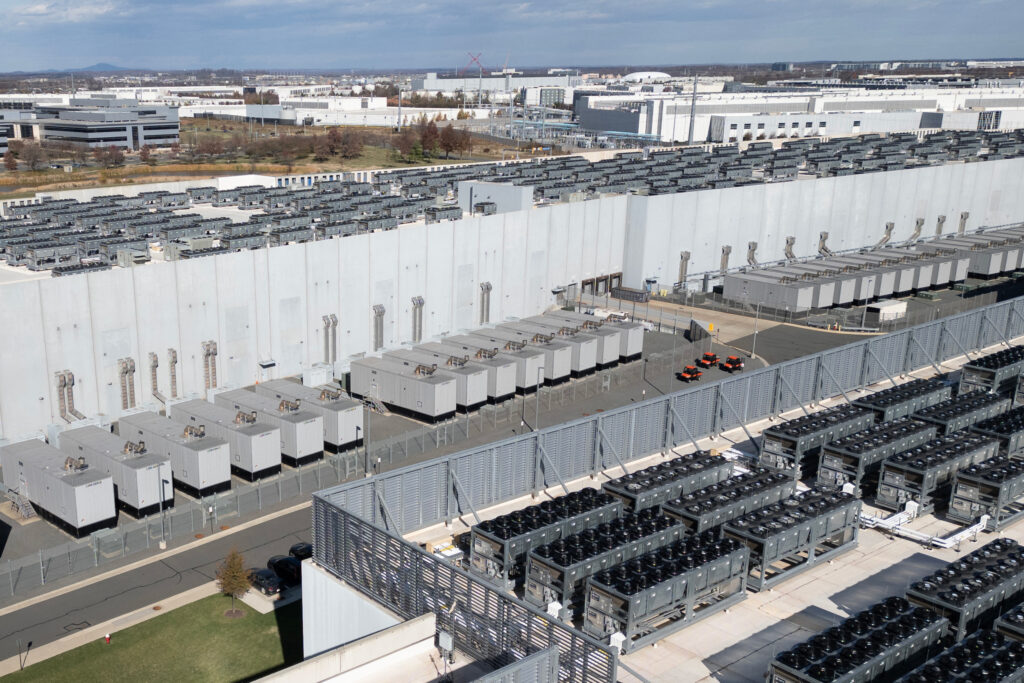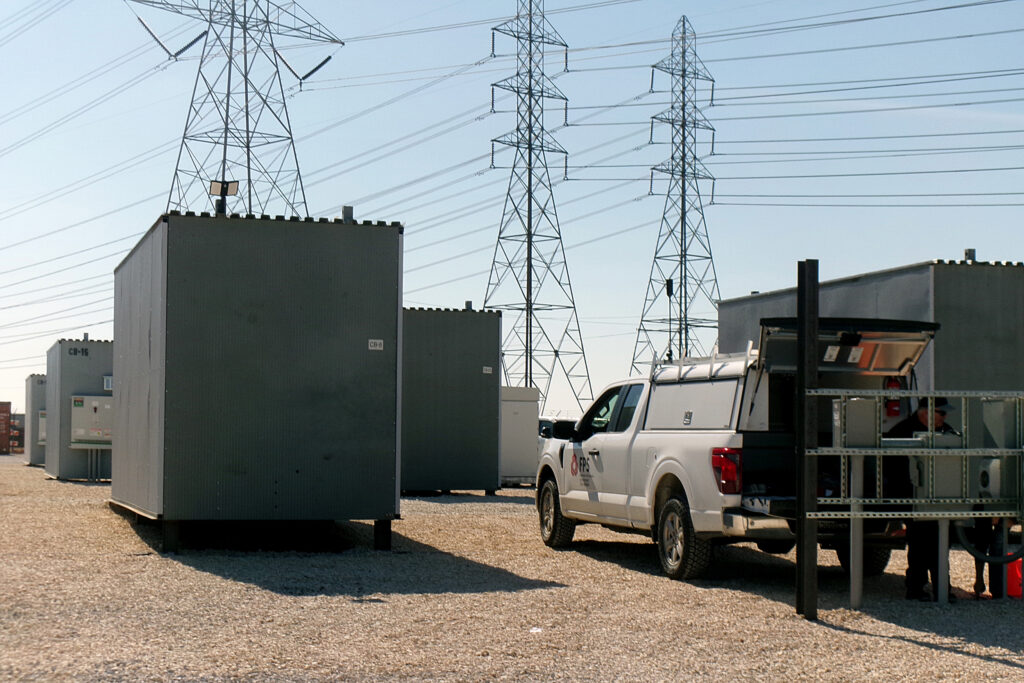


This past summer, a fire at an electrical substation forced data centers in Loudoun County to rely on backup diesel generators as their power source.
Grid failures like this happen often, but this time, shoppers in a nearby Walmart parking lot heard the noisy generators start up and reported smelling diesel fumes.
“People were like, ‘What is going on?’” said Julie Bolthouse, the director of land use for the Piedmont Environmental Council, an environmental nonprofit fighting data center sprawl. “This sounds like planes landing constantly for over 24 hours.”
Loudoun County Supervisor Mike Turner, who represents the Ashburn region known as “Data Center Alley” because it is home to the world’s largest concentration of the facilities, said email complaints flooded his inbox during the incident.
“Frankly, they’re filthy,” Turner said of the diesel generators that had to run for four or five days. “As soon as they start running their backup generators, we start getting complaints.”
Now, new guidance from the state’s Department of Environmental Quality (DEQ) may expand the circumstances under which data centers could use their backup diesel generators next year, raising concerns among residents and environmentalists about air and noise pollution.
“Any increase in how often they’re running is going to cause corresponding localized air pollution,” said Tyler Demetriou, an associate attorney with the Southern Environmental Law Center.
The DEQ guidance surfaced in a Sept. 30 memo from Mike Dowd, director of the Air and Renewable Energy Division, to Director Michael Rolband. It expands the definition of an emergency, allowing for the use of the diesel generators, known as Tier II generators.
Currently, Virginia’s regulations allow Tier II generators to operate only in emergencies, generally defined as “sudden and reasonably unforeseeable” events, including power outages or natural disasters. Cleaner-burning generators, known as Tier IV generators, can run outside of emergencies, but their emission-control technology is more costly.
The new guidance would add a “planned outage” scheduled by a utility to the list of emergencies when dirtier, cheaper Tier II generators could run. DEQ uses a scenario in which notice of an outage is provided within 14 days or less.
“In light of this analysis, DEQ considers that an electric outage may sometimes be a ‘sudden and reasonably unforeseeable’ event, even if the electricity service provider has ‘scheduled’ or “planned” the outage and given notice to a source in advance,” Dowd wrote in his memo to Rolband.
Dominion Energy, Virginia’s largest utility, did not respond to requests for comment on the DEQ guidance.
But the Data Center Coalition, an industry group representing data center developers and many of the world’s wealthiest big-tech corporations, supports the new definition, given data centers’ need for guaranteed, continuous power.
Despite its support, the coalition deferred questions about the guidance to DEQ, which told Inside Climate News that interested parties had requested the guidance.
“DEQ is unable to speculate on the timing or duration of potential future outages,” a DEQ spokesperson said. “However, each data center will need to comply with their permitted emission limits.”
There are about 9,000 generators in Virginia, with about 4,700 in Loudoun County. Of the total, around 8,000 are Tier II, Bolthouse said. A recent report from Virginia’s legislative research arm noted that data center operators want to use backup generators for days-long outages. “But in practice, the generators are rarely run for prolonged periods,” the report said. “Most [data center] operators reported experiencing zero to two minor outages per site in the last two years, with nearly all outages being between one and five hours long.”
Currently, Tier II generators have limits on how many hours they can run and the amount of pollutants they can emit. From a local health perspective, diesel generators produce many harmful pollutants, including those that contribute to ground‑level ozone formation and particulate matter.
Among those substances: air pollutants such as particulate matter (PM2.5), nitrogen oxides, carbon monoxide, sulfur dioxide and ozone precursors; toxic air contaminants, such as black carbon, polycyclic aromatic hydrocarbons, benzene, formaldehyde and aldehydes, and the greenhouse gases carbon dioxide (CO₂) and methane.
These pollutants have been associated with cardiopulmonary death, hospitalizations for cardiovascular and respiratory disease and emergency room visits for asthma, among other health effects.
The Virginia legislative research report determined that, in a worst-case scenario, data centers’ backup generators could release 9,000 tons of nitrogen oxides in the region. “That is equal to about half of what has typically been emitted annually in Northern Virginia by all sources,” the report said.
One factor driving the desire for greater flexibility in diesel generator use in Virginia is the state’s need for upgrades to grid transmission lines, over 100 of which are planned to deliver more power to energy-guzzling data centers. These upgrades involve cutting existing lines before adding new ones, which often necessitates temporary outages for grid users.
Waiting for transmission upgrades prompted an earlier attempt by DEQ in 2023 to grant a broader variance from emission controls for diesel generators. Patrick Fanning, Virginia staff attorney with the Chesapeake Bay Foundation, sees this guidance memo as another attempt.
“I think the whole concept is that you plan ahead for the outage, not treat it as an emergency,” said Fanning. “I don’t see it as beneficial to the public or Dominion (Energy), more so as beneficial to the data centers themselves, so that they can ensure no power interruption, which seems to be sort of like their golden standard—never having a power disruption.”
Questions about exactly when diesel generators could be used, and pollution concerns, point to flaws in DEQ’s efforts to “shoehorn these planned outages into its existing definition of an emergency, where they don’t really fit,” SELC’s Demetriou said. “If it wants to expand that definition to cover this sort of thing, it has the regulatory power to do that, but it needs to go through the full notice and comment rulemaking process to amend the regulation.”
The Northern Virginia area just east of Loudoun remains under an ozone “non-attainment” designation for failing to meet air quality standards due to heavy car use in the region. DEQ’s Dowd and local government officials recently celebrated findings showing attainment has been achieved, but a formal plan to maintain attainment needs to be devised by the agency and approved by the EPA before the designation is lifted.
This story is funded by readers like you.
Our nonprofit newsroom provides award-winning climate coverage free of charge and advertising. We rely on donations from readers like you to keep going. Please donate now to support our work.
Donate Now
The increased use of diesel generators may have an impact, particularly on hot days when air quality worsens, said Jeff King, director of climate, energy, and air programs with the Metropolitan Washington Council of Governments. But it’s not clear if it would affect attainment measures, he said.
“Without having all the emissions data, and all the understanding of how much are we really talking about, it’s hard to know for sure,” said King.
But recent reports indicate that ratepayer savings could be realized by avoiding grid investments if data centers use less grid energy, which worries Bolthouse, of the Piedmont Environmental Council. Bolthouse is concerned that onsite generator use will happen more often. Data center developers are now often trying to “bring their own power capacity” to be plugged into the grid faster, without disruption or delay.
At the same time, the U.S. Department of Energy under President Donald Trump wants to eliminate emissions controls to enable faster data centers connectivity. The Trump administration’s Speed to Power Initiative, a related effort, includes 17.6 gigawatts of planned data center capacity across five Virginia counties.
“Of course, the Trump administration is trying to dismantle the Clean Air Act,” Bolthouse said, raising the possibility that Trump might in the future favor diesel generator use more broadly, beyond emergencies.
Battery storage systems are available to help power data centers during grid outages, the Sierra Club pointed out in comments submitted to DEQ. But Bolthouse noted those systems take up land space. Turner, the Loudoun County supervisor, noted that traditional battery systems provide power for only four hours before they need to be recharged.
“I am not that surprised,” Turner said of DEQ’s guidance memo. “All these forces are operating right now simultaneously. We have a constrained grid in Loudoun County. It makes perfect sense for DEQ to widen the aperture of what constitutes an emergency, to allow the data centers to use the backup generators … I don’t know if I agree with it.”
All this has led environmental groups to request a 30-day extension to comment on the guidance. Under Virginia rules, DEQ must grant it, which would mean the change would still be under review when governor-elect Abigail Spanberger, a moderate Democrat, takes office in January.
Where she will come down on diesel generators isn’t clear. For now, a Spanberger spokesperson declined to comment.
About This Story
Perhaps you noticed: This story, like all the news we publish, is free to read. That’s because Inside Climate News is a 501c3 nonprofit organization. We do not charge a subscription fee, lock our news behind a paywall, or clutter our website with ads. We make our news on climate and the environment freely available to you and anyone who wants it.
That’s not all. We also share our news for free with scores of other media organizations around the country. Many of them can’t afford to do environmental journalism of their own. We’ve built bureaus from coast to coast to report local stories, collaborate with local newsrooms and co-publish articles so that this vital work is shared as widely as possible.
Two of us launched ICN in 2007. Six years later we earned a Pulitzer Prize for National Reporting, and now we run the oldest and largest dedicated climate newsroom in the nation. We tell the story in all its complexity. We hold polluters accountable. We expose environmental injustice. We debunk misinformation. We scrutinize solutions and inspire action.
Donations from readers like you fund every aspect of what we do. If you don’t already, will you support our ongoing work, our reporting on the biggest crisis facing our planet, and help us reach even more readers in more places?
Please take a moment to make a tax-deductible donation. Every one of them makes a difference.
Thank you,

Charles Paullin
Virginia Correspondent
Charles Paullin is a Richmond, Virginia-based reporter focusing on energy and environment issues. He’s won several awards for his previous work covering state policy with the Virginia Mercury and local news with the Northern Virginia Daily in the Northern Shenandoah Valley. His first reporting gig was with the New Britain Herald in Connecticut, a couple years after attending the University of Hartford, where he first studied sports journalism.