

This story is a collaboration between Inside Climate News and Sentient Media.
Over half a century ago, Larry Stone moved to northeast Iowa, drawn by the abundant wildlife and the crisp, spring-fed streams that carve through rocky bluffs. More than half a century later, those waterways have increasingly come under threat.
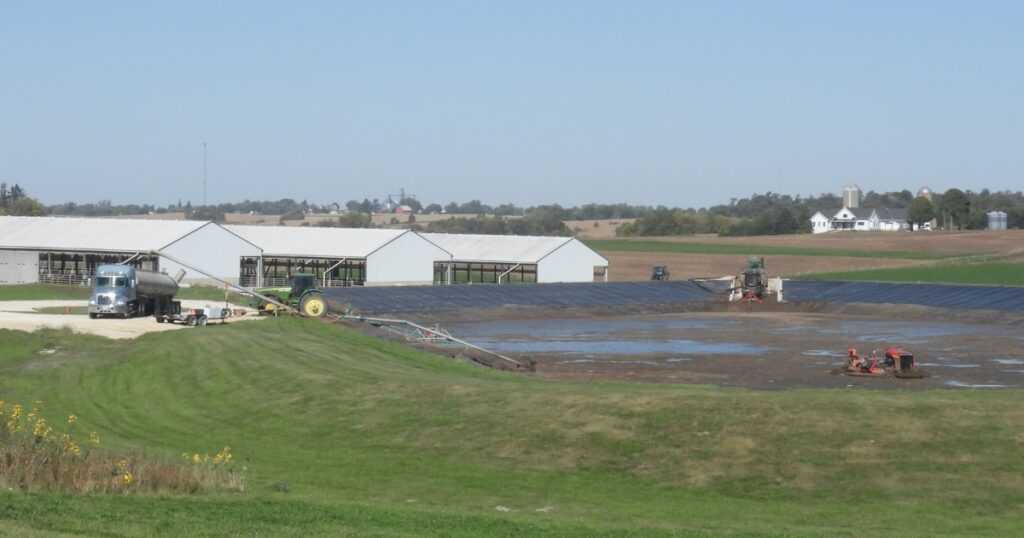
In 2017, a 10,000-head cattle feedlot was built in a nearby town at the headwaters of Bloody Run Creek after a protracted battle with citizen and environmental groups. Ever since, Stone has spent what he estimates to be hundreds of hours focusing on the Supreme Beef LLC facility and its effect on one of Iowa’s “outstanding waterways.”
In October, Stone drove by the operation and saw what appeared to be manure resting atop the surface of a nearby field. He sent a photo to a friend and fellow northeast Iowa resident, who then sent the picture and a complaint to the Iowa Department of Natural Resources.
The department wrote back, telling them it was “legally permissible” for the livestock facility to apply manure to the surface of fields without incorporating it, so long as the method was in Supreme Beef’s nutrient management plan—a form required by the state for dictating how and where manure is distributed — and had been signed off on by the plan’s reviewers.
Although Supreme Beef is, according to the department, following the rules, those guidelines could be causing problems for Iowans and their water quality. A heavy rain event can wash the manure resting on fields elsewhere, clouding waterways and poisoning wildlife. The same goes for those living along the Mississippi River, as the waste travels downstream to the Gulf of Mexico. Jared Walz, an owner of Supreme Beef, did not respond to requests for comment.
And not everyone adheres to the rules. Illegal manure spills at livestock facilities or during transportation are a persistent problem in Iowa. The Department of Natural Resources (DNR) recorded 179 instances of manure discharge into waterways between 2013 and 2023, according to an analysis from environmental watchdog group Food & Water Watch.
The department — which is responsible for regulating thousands of concentrated animal feeding operations (CAFOs) and their waste — could be doing much more, critics and researchers argue. Additional funding and oversight of where the manure goes and how it is applied, they note, could help.
Stone’s concerns about manure over-application come amid Iowa’s ongoing water quality crisis. The amount of manure in the state has increased along with the number of industrial animal farms. A 2018 study found that nitrogen from synthetic and manure-based fertilizer entering Iowa waterways rose nearly 50% over a two-decade period.
When soil microbes break down that nitrogen, the element links with oxygen to form nitrate. Exposure to nitrate pollution in drinking water is linked to a number of long-term health conditions, such as increased cancer risk in adults and acute life-threatening illnesses for children, including methemoglobinemia, also known as blue baby syndrome. Animal waste also contains pathogens such as E. coli that can lead to deadly disease outbreaks.
Manure management plans are designed to limit pollution from overapplication of fertilizer in Iowa. The state requires livestock producers to denote the exact fields for manure spreading, and also demonstrate that the nutrients in the manure won’t exceed the needs of crops. But review and enforcement of those plans is spotty, and a closer look at the type of fines levied reveals why.
Sentient and Inside Climate News analyzed data from January 1, 2020, to December 31, 2025, and found that the state has fined medium and large CAFO owners roughly $570,000 for violations related to manure management plans. But over half of these fines were for administrative violations rather than for illegal spills or other potential pollution events.
Late plans accounted for $282,250 of the fines, and $47,250 were issued for hiring manure applicators with expired certifications.
To fill the gap, residents serve as unofficial watchdogs, alerting the DNR to potential overapplication and manure spills. When Stone sees manure atop fields, he worries that rain will cause runoff into Bloody Run Creek and other waterways. The only way to tell would be for someone to investigate each complaint immediately after it occurs. Stone and other community members often take on that task, but it’s too great a responsibility for just a few volunteers.
“There’s been some times when I said, ‘Well, should I go take a water sample?’” Stone said, but he wonders what the point is, if “nobody’s going to pay any attention” to what he finds.
In a statement, the department wrote that it maintains a 24/7 hotline and responds to environmental complaints in a “timely manner.”
How Iowa Manages its Manure
Most manure produced by Iowa livestock is recycled as a high-quality fertilizer, enough to spread across one-third of the state’s 13 million acres of nitrogen-hungry corn fields — an area the size of Massachusetts and Vermont combined.
Manure doesn’t just contain the essential plant nutrients of nitrogen, phosphorus and potassium; it is also rich in microbial life and micronutrients that support plant growth and soil health, says Daniel Andersen, an Iowa State University researcher specializing in manure management and water quality.
But too much manure in any one field poses serious consequences for surrounding surface water quality, Andersen says. Nutrients not absorbed by plants leach into waterways through soil erosion and rainwater runoff, fueling nitrate pollution and algal blooms that deplete oxygen in the water.
Nitrate pollution has caused issues for municipal water utilities and private well owners throughout the state. Half a million dollars in statewide fines over five years is minimal compared to the $1 million per year cost of nitrate removal at the Des Moines Water Works, for example.
The DNR animal feeding operations budget has remained stagnant despite growing concerns in the state over water pollution from manure. The budget has stalled at $1.32 million since 2016, while inflation eats away at its spending power and the number of CAFOs continues to grow.
Few People in the Field
While it is difficult to measure the actual cost of water pollution to Iowans’ pocketbooks and health, Silvia Secchi, a natural resource economist at the University of Iowa, argues that the fines levied on violators are insufficient.
“The fines are incredibly low, and the probability of being caught is incredibly low—and it’s incredibly low because the DNR really doesn’t monitor any of these applications,” Secchi says.
Former DNR animal feeding operation coordinator Gene Tinker expressed similar concerns. He previously told Sentient and Inside Climate News that the department does not collect records of where and how much manure is actually spread.
Secchi, who has researched water pollution in Iowa for 25 years, believes there are places where manure is over-applied, despite appearances on paper.
“They don’t have anybody in the field. They just have somebody sitting in an office in Des Moines, and that person sees, ‘Oh, it’s late, so I’m going to send the fine.’ But there’s nobody out there actually checking the congruence of the plan with the actual activities,” she says.
Agents in the field might be able to trace a manure spill back to its source. But as it stands now, Secchi says, “it might take them days” to investigate.
By that point, it’s often too late. “Unless there’s been a fish kill, or some other clear manifestation of that inappropriate application,” Secchi says, “there’s nothing that can be done.”
Violations related to spills accounted for 25% of fines related to manure management plans from 2020-2025, with an average fine of just under $5,900.
Some fines do include a fish kill fee, which can put the total amount owed to the agency over $30,000.
This was the case for a manure spill at Roorda Dairy in Paullina, Iowa, a 4,200-head dairy cattle operation. The department determined that approximately 107,373 fish were killed as a result of the spill, triggering $27,913 in fines. Combined with investigation costs, Roorda ended up owing the department $30,79 plus an $8,000 administrative penalty.
But fines of this magnitude are the exception, not the rule.
Even if producers are caught overapplying or spilling manure in violation of the law, there is no guarantee they will be fined. Records indicate that two spills between 2020 and 2025 received no penalty at all, for example.
In a statement, DNR officials wrote that manure spills that reach state waterways require a plan to ensure the spill does not happen again. Situations “where there were no documented water quality violations or the manure entered a dry creek and the manure was removed” may not result in an administrative or consent order, they wrote, which often includes a fine. In general, they wrote, the size of a fine is determined by “economic benefit, gravity, and culpability,” as outlined in state law.
This story is funded by readers like you.
Our nonprofit newsroom provides award-winning climate coverage free of charge and advertising. We rely on donations from readers like you to keep going. Please donate now to support our work.
Donate Now
Tinker believes the motivation to pursue late fees over other violations is clear: “Because a check comes in with them,” he says.
Tinker points out that late fees are easy to track. It’s a simple, clear-cut violation — either the plan is late or not — and it requires little staff effort to enforce.
A late plan means the department is missing out on an immediate and straightforward revenue source. In contrast, revenue from a fish kill or another environmental violation does not go directly to the department.
Better Education and Enforcement Could Help
For now, the DNR, which oversees 8,000 CAFOs, no longer has a statewide coordinator for these industrial operations.
Many employees join the department because they care about the environment, Tinker says. They end up surprised to find that time spent in the field — documenting spills and environmental pollution — is limited.
Tinker believes expanding overtime pay would allow employees to investigate more complaints outside of regular working hours.
Unannounced inspections could also help, Secchi and Stone say.
When “a friend calls and says, ‘Hey, I’m coming to your house for a visit,’” Stone says, the first thing he does is clean up the mess on the table. It makes sense that CAFO operators would do the same when they have notice.
DNA testing could also be used to identify the source of manure pollution, Secchi says. Treating manure applications “as point sources of pollution” would allow for stricter enforcement rules under the Clean Water Act and Clean Air Act, she adds.
Iowa Gov. Kim Reynolds cut funding for a state water sensor network in 2023, an important tool for monitoring water pollution levels in Bloody Run Creek and other water bodies. Polk County, the most populous county in the state, recently announced that it plans to foot the bill and continue sensor operations. On Dec. 8, 2025, nitrate in Bloody Run Creek measured at 20.7 milligrams per liter of water, the highest level detected by any sensor in the state that day.
At a state Natural Resource Commission meeting in October, with DNR Director Kayla Lyon in attendance, Stone encouraged the state officials to drive by Supreme Beef to smell and see it themselves.
They said they didn’t have time, Stone recalls.
“So, keep your fingers crossed for the health of our water, I guess,” Stone says.
About This Story
Perhaps you noticed: This story, like all the news we publish, is free to read. That’s because Inside Climate News is a 501c3 nonprofit organization. We do not charge a subscription fee, lock our news behind a paywall, or clutter our website with ads. We make our news on climate and the environment freely available to you and anyone who wants it.
That’s not all. We also share our news for free with scores of other media organizations around the country. Many of them can’t afford to do environmental journalism of their own. We’ve built bureaus from coast to coast to report local stories, collaborate with local newsrooms and co-publish articles so that this vital work is shared as widely as possible.
Two of us launched ICN in 2007. Six years later we earned a Pulitzer Prize for National Reporting, and now we run the oldest and largest dedicated climate newsroom in the nation. We tell the story in all its complexity. We hold polluters accountable. We expose environmental injustice. We debunk misinformation. We scrutinize solutions and inspire action.
Donations from readers like you fund every aspect of what we do. If you don’t already, will you support our ongoing work, our reporting on the biggest crisis facing our planet, and help us reach even more readers in more places?
Please take a moment to make a tax-deductible donation. Every one of them makes a difference.
Thank you,

Nina B. Elkadi
Contributor
Nina B. Elkadi is an editor-at-large at Sentient. Her investigative reporting explores corporate influence within the agricultural industry, the environmental impacts of factory farming and how negligence impacts consumers and workers. Her work also appears in National Geographic, Civil Eats, High Country News, Ambrook Research, JSTOR Daily, Barn Raiser and more. She splits her time between Washington, D.C. and her hometown of Iowa City.

Anika Jane Beamer
Reporter, Iowa
Anika Jane Beamer covers the environment and climate change in Iowa, with a particular focus on water, soil and CAFOs. A lifelong Midwesterner, she writes about changing ecosystems from one of the most transformed landscapes on the continent. She holds a master’s degree in science writing from the Massachusetts Institute of Technology as well as a bachelor’s degree in biology and Spanish from Grinnell College. She is a former Outrider Fellow at Inside Climate News and was named a Taylor-Blakeslee Graduate Fellow by the Council for the Advancement of Science Writing.