

In the waning days of Governor Phil Murphy’s tenure, state officials unveiled an updated Energy Master Plan that calls for 100 percent clean electricity by 2035 and steep reductions in climate pollution by midcentury. Since 2019, the state has used the first version of the plan as the backbone of its climate strategy, promising reliable, affordable and clean power.
The blueprint lands at a moment when delivering on all three goals is increasingly in doubt.
While a second Trump administration rolls back federal clean-energy support, PJM Interconnection, the regional grid operator that serves New Jersey and a dozen other states, struggles to manage surging electricity demand from artificial-intelligence data centers.
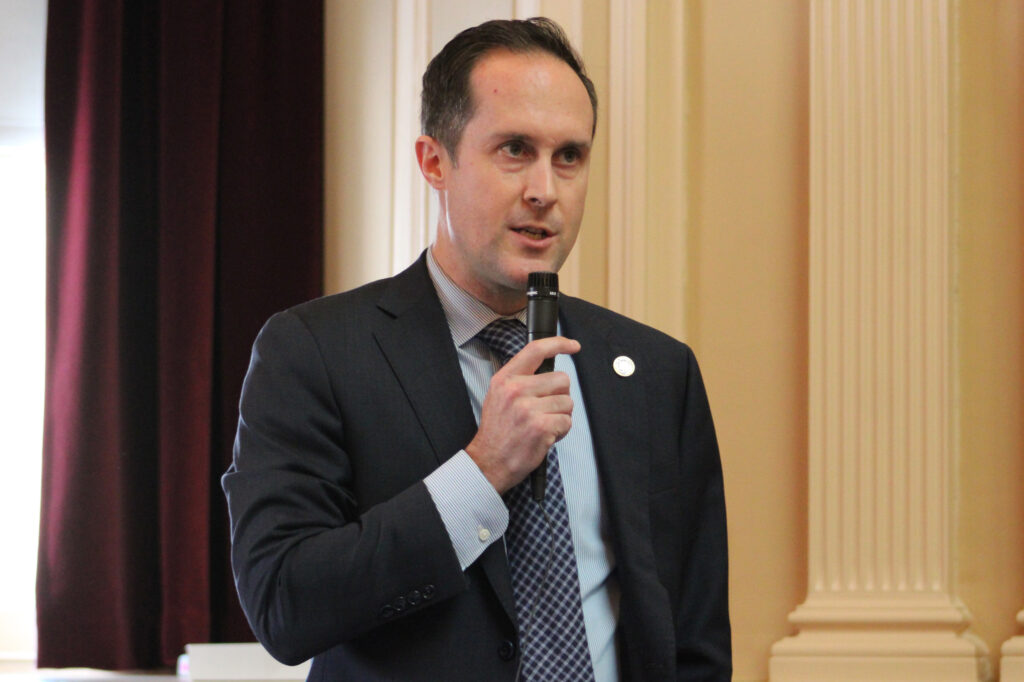
“The Energy Master Plan is a statutorily required report to chart out New Jersey’s energy future,” said Eric Miller, who leads the Governor’s Office of Climate Action and the Green Economy. While not binding, it is the state’s official roadmap to attain its climate goals.
Miller’s office and the state Board of Public Utilities developed the plan with public input and help from outside consultants.
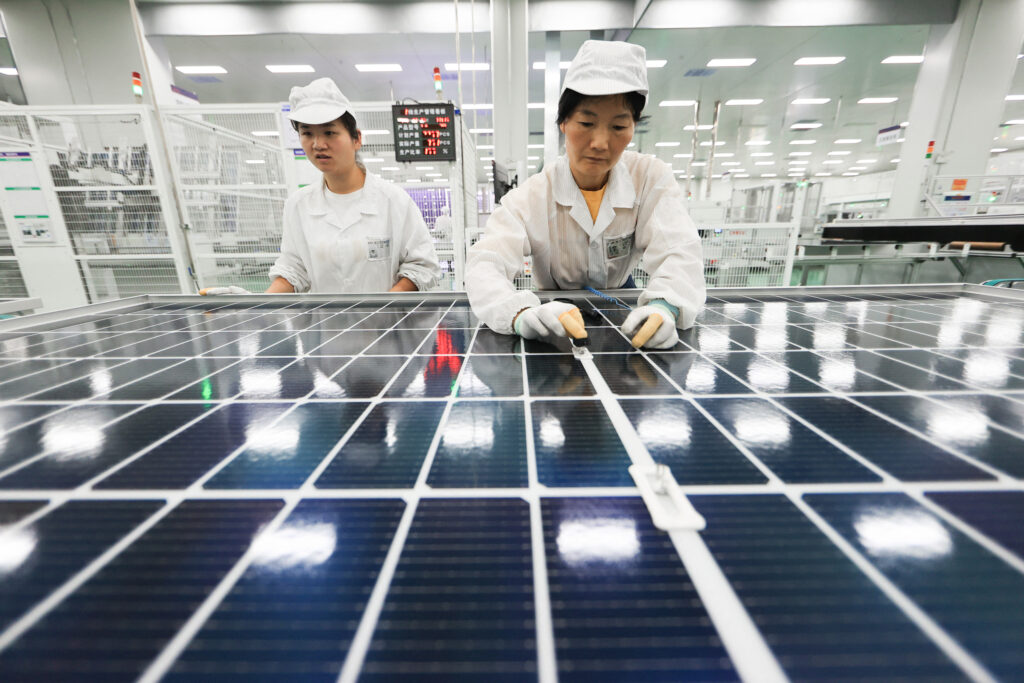
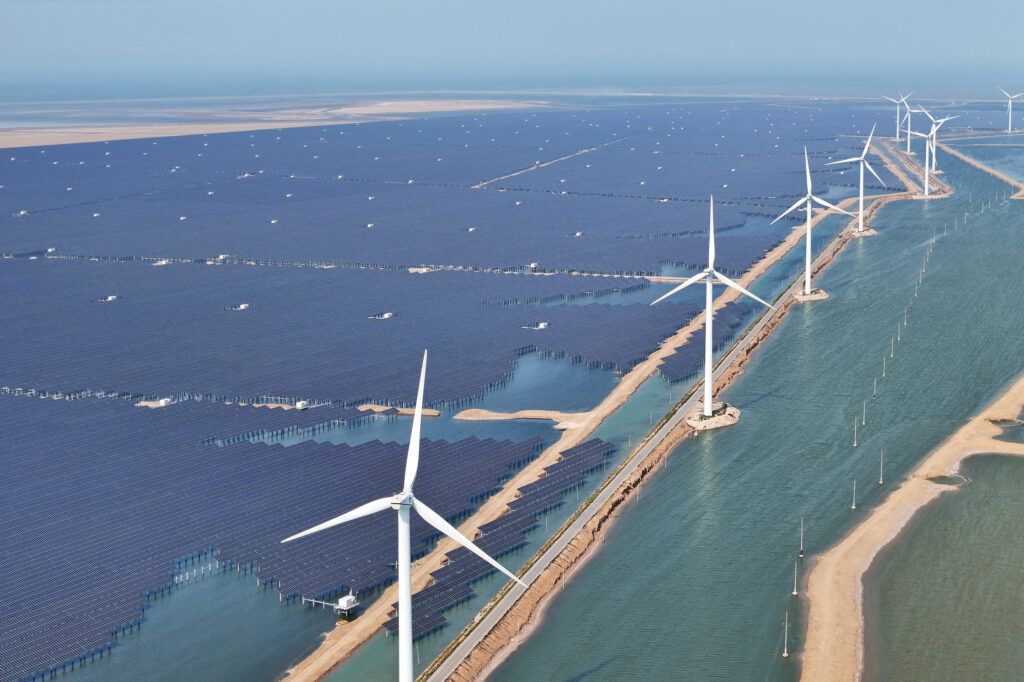
Under the plan, New Jersey is betting heavily on utility-scale solar and battery storage. State modeling envisions total solar capacity climbing to about 22 gigawatts by 2050 which is four times today’s roughly 5 gigawatts of installed solar. On paper, it would be enough to supply nearly all of the state’s current households over a year. To get there, the plan assumes adding about 750 megawatts of new solar each year from 2026, roughly double the pace of solar construction in 2024.
The plan’s release follows a governor’s race in which energy costs dominated, and voters chose U.S. Rep. Mikie Sherrill, a Democrat who campaigned on preserving Murphy-era climate targets, over Jack Ciattarelli, a Republican who argued for a slower transition.
“Voters sent a clear message that clean energy is the most cost-effective path forward and the smartest long-term investment,” said Ed Potosnak, head of the New Jersey League of Conservation Voters and a local council member in Franklin Township.
A Grid Tested By Data Centers
The plan lands as New Jersey enters what Miller calls the “load growth era.”
For roughly two decades, electricity demand in PJM’s footprint, which stretches from New Jersey to Illinois, was flat or falling as aging power plants retired and efficiency improved. That trend has flipped because of data centers.
“What we saw in 2024 into ’25, and I think what we’re going to see for the next 15 years, is a scenario where demand on the electric grid is growing,” Miller said.
For years, New Jersey spent billions subsidizing hundreds of thousands of electric vehicles and thousands of buildings to electrify. Now, Miller said, “some of the techniques for greenhouse gas reductions are going to have to kind of meet the moment,” by taking a more proactive role in engaging with PJM, or by filling in the dearth in clean energy incentives caused by the Trump administration.
The recent PJM capacity auctions have added billions of dollars in costs for customers across the region. This showed up as a 20 percent jump in summer electricity bills in New Jersey this year, which became a hot campaign issue during its recent gubernatorial race.
“The wholesale price of electricity is determined by PJM and federal policy, and then also the price of natural gas,” said Frank Felder, an energy economist who has advised regulators. “New Jersey can’t do much about that.”
Participating in a fast-track rulemaking process that PJM initiated to address data center-driven demand, outgoing governor Murphy joined other governors in proposing that data center developers bring their own power generators in exchange for quicker permit processing.
PJM seeks to decide which proposals to pursue this month and file them with the Federal Energy Regulatory Commission by the end of the year.
Federal Headwinds and Stalled Offshore Wind
Layered on top of PJM’s turmoil are decisions coming from Washington.
Experts repeatedly pointed to President Trump’s second-term moves to strip away clean-energy tax incentives from the Inflation Reduction Act and to impose new tariffs on imported solar panels and wind equipment. They say those steps have raised costs and driven off developers.
Potosnak called it “Trump’s clean energy ban” and said the administration’s opposition to offshore wind “derailed the best chance we had to get massive amounts of offshore wind going that would have begun lowering our utility rates this year.” Several major Atlantic projects, including those planned off New Jersey’s coast, have been canceled or delayed.
Offshore wind “was a big piece of trying to get to 100 percent clean electricity by 2035,” Felder said. With new contracts unlikely for several years, he warned New Jersey could be “back at basically square one” by the end of the decade.
Even so, Felder and others urged caution against writing off renewables entirely. Robert Mieth, a Rutgers University researcher who studies power systems, noted that offshore wind is well established in Europe and that, with or without U.S. manufacturing, “there will be access to competitive and affordable renewable technology from other countries.”
In the meantime, state officials point to progress in areas they can influence more directly.
This story is funded by readers like you.
Our nonprofit newsroom provides award-winning climate coverage free of charge and advertising. We rely on donations from readers like you to keep going. Please donate now to support our work.
Donate Now
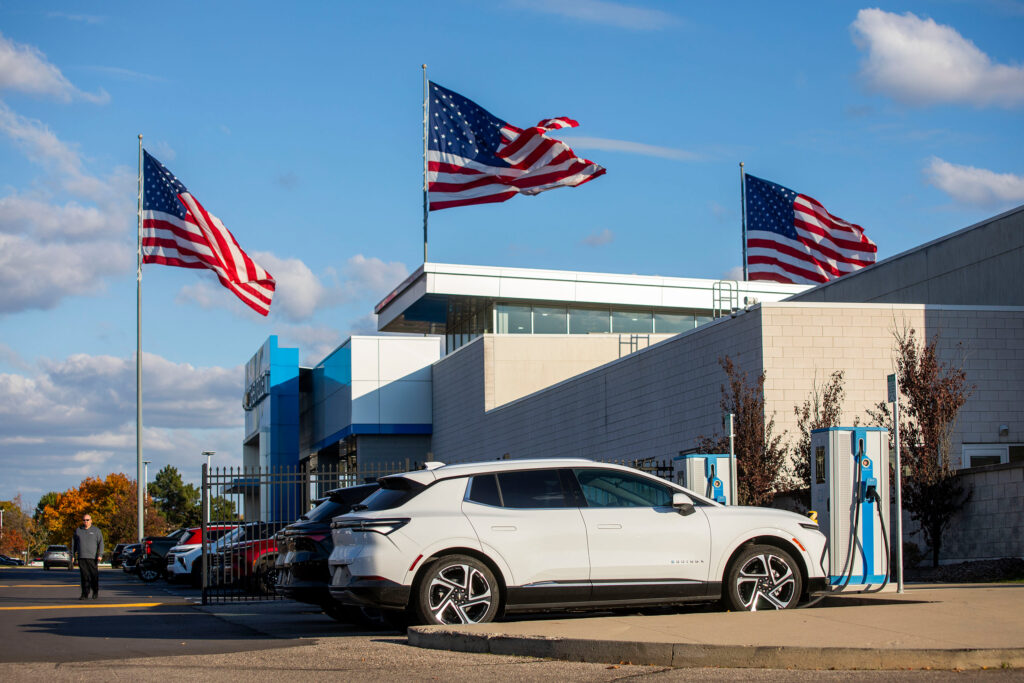
Miller noted that New Jersey has gone from roughly 20,000 plug-in vehicles in 2018 to about 270,000 today, after lawmakers set clear targets and funded incentives and chargers.
The state’s “nation-leading solar program,” he said, is “primarily state-incentivized, primarily state-funded,” and can keep expanding—albeit slower now—even as federal tax credits expire.
“The cheapest energy is the energy you don’t have to make,” Potosnak said, citing efficiency programs, rooftop and warehouse solar and batteries on parking lots that “drive down utility costs for families and businesses” while cutting pollution.
A Guide, Not a Mandate
For all its detail, the Energy Master Plan is not binding.
“The Energy Master Plan does not have the force of law,” Miller said. It has been “very informative,” he added, but “it is not a legal requirement that we follow it exactly.”
Gov.-elect Sherrill will determine how closely New Jersey hews to the map. Neither she nor her opponent had any role in shaping the modeling, Miller said, and the plan was not written with a particular “political future” in mind. Instead, Miller said, the Murphy administration hopes the incoming governor will treat it as “a very useful modeling exercise” or a guide.
Advocates are already trying to lock some of those targets into a statute. Potosnak’s group is backing a lame-duck bill that would incorporate the state’s 2035 goal of 100 percent clean energy—currently in place from a 2023 Murphy executive order—into state law.
If it passes, he said, it would give residents and environmental groups the right to sue if future administrations fall short and send a signal to investors that New Jersey’s direction will not change with every election.
About This Story
Perhaps you noticed: This story, like all the news we publish, is free to read. That’s because Inside Climate News is a 501c3 nonprofit organization. We do not charge a subscription fee, lock our news behind a paywall, or clutter our website with ads. We make our news on climate and the environment freely available to you and anyone who wants it.
That’s not all. We also share our news for free with scores of other media organizations around the country. Many of them can’t afford to do environmental journalism of their own. We’ve built bureaus from coast to coast to report local stories, collaborate with local newsrooms and co-publish articles so that this vital work is shared as widely as possible.
Two of us launched ICN in 2007. Six years later we earned a Pulitzer Prize for National Reporting, and now we run the oldest and largest dedicated climate newsroom in the nation. We tell the story in all its complexity. We hold polluters accountable. We expose environmental injustice. We debunk misinformation. We scrutinize solutions and inspire action.
Donations from readers like you fund every aspect of what we do. If you don’t already, will you support our ongoing work, our reporting on the biggest crisis facing our planet, and help us reach even more readers in more places?
Please take a moment to make a tax-deductible donation. Every one of them makes a difference.
Thank you,

Rambo Talabong
Contributor
Rambo Talabong is a multimedia climate reporter based in New York City. Before moving to the U.S., he led award-winning investigations into the Duterte drug war for Rappler, the Nobel Prize-winning newsroom in Manila. His reporting has been recognized by the Global Investigative Journalism Network, the Society of Publishers in Asia, and the Human Rights Press Awards. He studied data journalism at Columbia University and is currently pursuing a master’s in science journalism at New York University. He has faced—and won—two libel suits in the Philippines over his reporting.