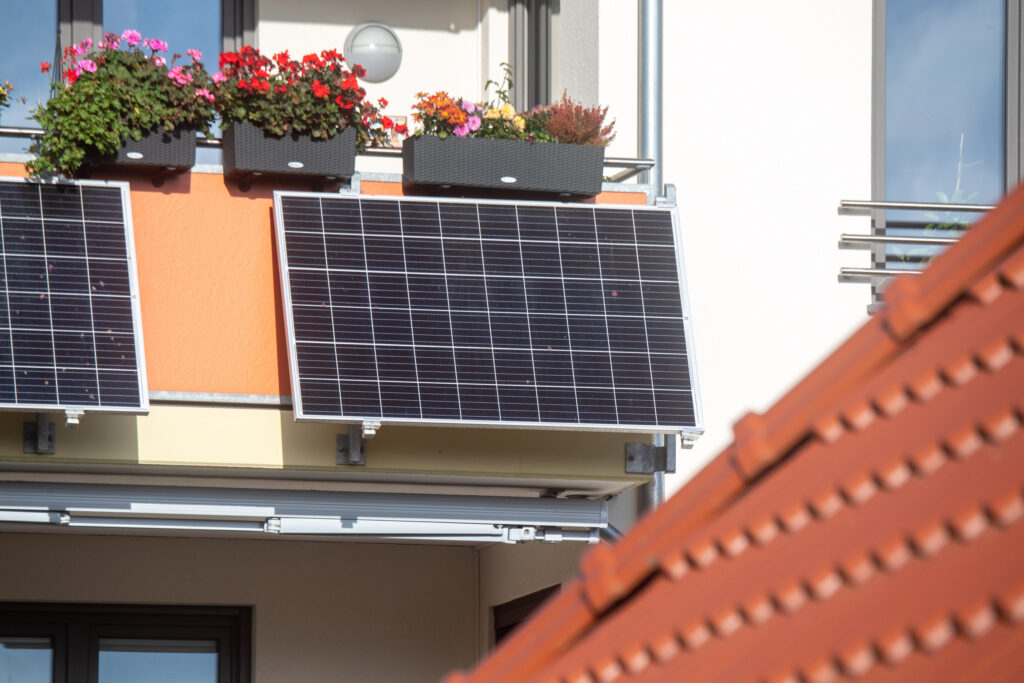


The solar panels that hang from balconies across Europe may soon be coming to New England, helping lower energy costs and ease grid demand.
This could be a breakout year for plug-in solar in the United States, with more than two dozen states considering legislation this session, including Maine, Vermont, New Hampshire, Massachusetts and Rhode Island. The small-scale systems are seen as a way to expand access to renewable energy, particularly for renters and apartment dwellers, but first require legislative approval.
“For many of my neighbors, especially renters, solar panels can feel like they’re meant for someone else,” said state Sen. Nicole Grohoski, a Democrat and sponsor of Maine’s plug-in solar bill, LD 1730. “It’s about giving someone in a third-floor apartment the same chance to lower their electricity bill as a homeowner with a south-facing roof.”
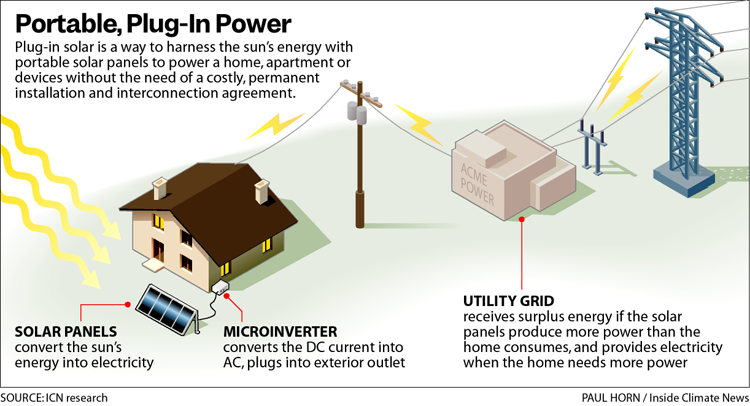
The small units, typically ranging from 200 to 1,200 watts—roughly the power draw of a laptop charger up to a microwave—are prohibited in most of the U.S. because they conflict with electrical codes and utility rules that assume electricity flows in one direction, from the grid through a home’s breaker panel and out to wall outlets.
Plug-in solar reverses that flow, allowing panels equipped with small inverters, devices that convert the electricity produced by the panel into the type typically used in homes, to plug into a standard outlet and feed power back into a household’s electrical system.
Plug-in solar is typically allowed only if customers secure special agreements with their utility, a process that can involve added costs, paperwork and delays. Those restrictions have also kept major retailers like Home Depot and Costco from selling the units. Proposed legislation would remove those contract requirements and update electrical codes, lowering barriers and making plug-in solar easier for households to adopt.
Utah became the first state to formally allow plug-in solar in 2025, offering an early U.S. example of how small-scale systems can work. In Europe, the technology is far more established: plug-in solar is permitted in 25 of the European Union’s 27 countries. In Germany alone, since approval in late 2024, more than 1 million units have been installed.
A study from Germany found that plug-in solar systems can pay for themselves in as little as two and a half years, depending on usage and electricity rates. Units range from a few hundred dollars for a single 400-watt panel—typically about six feet tall—to more than $2,000 for a multi-panel 1,200-watt setup. After the upfront costs are recovered, the systems can save households hundreds of dollars a year on electricity.
Supporters say similar savings are possible in the United States. In testimony backing the bill, the Natural Resources Council of Maine estimated that a 1,200-watt plug-in solar unit could reduce the average Central Maine Power customer’s annual electricity bill by about 21 percent.
For renters and households priced out of rooftop solar, plug-in units could offer a more accessible entry point into clean energy by producing renewable electricity at home and reducing the amount of power drawn from fossil-fuel-dependent utilities. Unlike rooftop systems, they require no permanent changes to a property and are portable, allowing renters to take them along when they move.
This story is funded by readers like you.
Our nonprofit newsroom provides award-winning climate coverage free of charge and advertising. We rely on donations from readers like you to keep going. Please donate now to support our work.
Donate Now
Critics caution that plug-in solar provides only a modest share of a household’s electricity and, at prices that can reach $2,000, may still be out of reach for many residents.
“It is not a solution for low-income Vermonters,” TJ Poor, director of regulated utility planning at the Vermont Public Service Department, said in testimony. ”These products are currently expensive, although it represents an option for renters, it is an expensive one.”
Advocates counter that costs could fall as adoption spreads. BRIGHT Saver, a U.S. plug-in solar advocacy group, estimates that if just five additional states approve the technology, prices could drop by as much as 80 percent as more manufacturers enter the market.
Some also raise safety concerns about sending electricity back into a home’s wiring. A potential safety concern is that if a plug-in unit sends power into a circuit that’s already in use, the circuit breaker might not trip as expected, which could allow the circuit to overload. Supporters say these limitations are exactly why clear rules and standards are needed—and why lawmakers across New England are stepping in.
Plug-in solar is part of a broader wave of small-scale, renter-friendly energy technologies gaining traction across the Northeast. In Boston a pilot program is testing window-mounted heat pumps to see whether the high-efficiency units can cut emissions while keeping residents cool in the summer and warm in the winter.
That shift toward apartment-scale energy is now being tested in state legislatures across New England. Lawmakers in Maine, Rhode Island, New Hampshire, and Vermont are advancing plug-in solar bills, with proposals moving through committees and, in Vermont’s case, already passing the Senate.
In Massachusetts, plug-in solar is included in a broader, and controversial, omnibus climate bill H4744. The legislation, filed in November, is now before the Ways and Means Committee, where it could be revised before advancing.
Even if the bills pass, residents may need to wait for national electrical safety certifications to be finalized before plug-in solar units become widely available in retail stores, a process already underway that supporters are confident will be completed within the next year.
Once legislative and safety hurdles are cleared, plug-in solar could mark a significant shift in how clean energy reaches households, bringing solar power within reach of renters and apartment dwellers long left out of the renewable energy transition.
About This Story
Perhaps you noticed: This story, like all the news we publish, is free to read. That’s because Inside Climate News is a 501c3 nonprofit organization. We do not charge a subscription fee, lock our news behind a paywall, or clutter our website with ads. We make our news on climate and the environment freely available to you and anyone who wants it.
That’s not all. We also share our news for free with scores of other media organizations around the country. Many of them can’t afford to do environmental journalism of their own. We’ve built bureaus from coast to coast to report local stories, collaborate with local newsrooms and co-publish articles so that this vital work is shared as widely as possible.
Two of us launched ICN in 2007. Six years later we earned a Pulitzer Prize for National Reporting, and now we run the oldest and largest dedicated climate newsroom in the nation. We tell the story in all its complexity. We hold polluters accountable. We expose environmental injustice. We debunk misinformation. We scrutinize solutions and inspire action.
Donations from readers like you fund every aspect of what we do. If you don’t already, will you support our ongoing work, our reporting on the biggest crisis facing our planet, and help us reach even more readers in more places?
Please take a moment to make a tax-deductible donation. Every one of them makes a difference.
Thank you,

Ryan Krugman
Fellow
Ryan Krugman is a recent graduate of St. Lawrence University where he majored in Environmental Studies and Sociology. He is currently a masters student at the Columbia Climate School focusing on climate change reporting and communications. Ryan plans to report on climate activism, adaptation and energy policy as an ICN fellow.