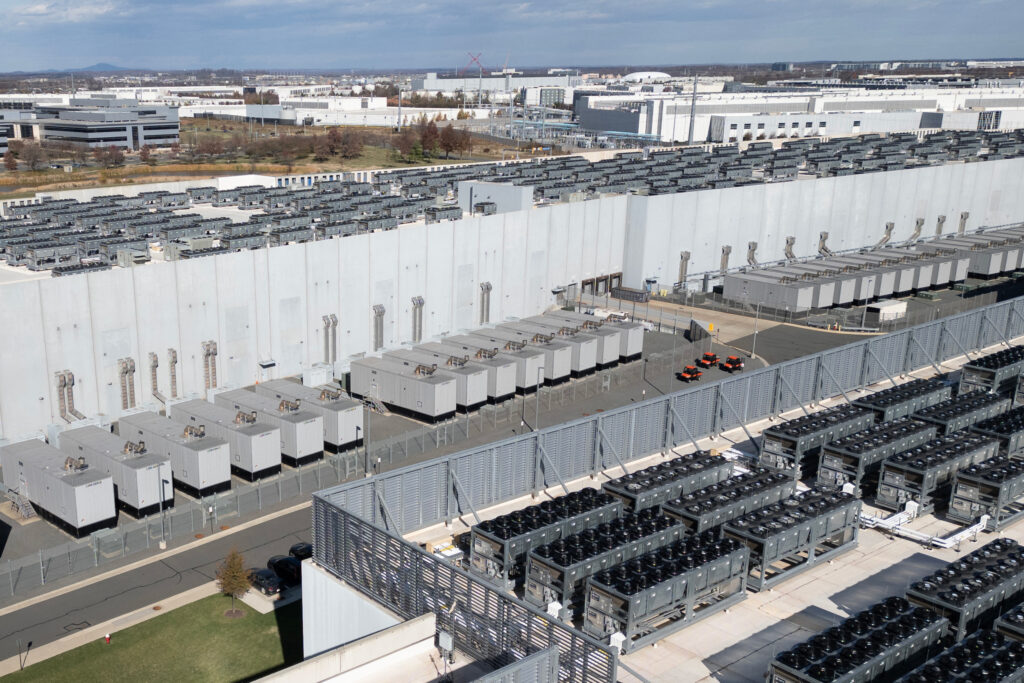


A bipartisan bill introduced Tuesday in the Michigan Legislature would repeal the state’s data center tax incentive laws, which, since their late 2024 approval, have helped attract over a dozen data center proposals.
The proposed repeal comes just as public outrage over, and opposition to, data centers from across the political spectrum is reaching a fever pitch. A “Michiganders Against Data Centers” protest is scheduled at the state capital Tuesday in which activists will call for a moratorium on the projects, after a state hearing last week on one center alone drew over 800 people.
The centers are highly controversial and have pitted local residents against big tech companies developing the centers and the state and federal politicians who back them. Among other issues, residents fear the centers may increase their energy bills, pollute water, drive up water bills and destroy communities’ rural characters.
The repeal legislation also comes as the centers, which require a massive amount of energy, are poised to derail Michigan’s transition to clean energy.
The repeal was introduced by Rep. Dylan Wegela, a Democratic Socialist whose district is in metro Detroit, and Rep. Jim DeSana, a Republican in the state’s Freedom Caucus who represents a largely rural area at the outskirts of metro Detroit.
Wegela said it is “absurd to be subsidizing some of the wealthiest corporations in the country.”
“If they’re going to be coming here—and I don’t think most people want them coming here, especially at this scale—then at the bare minimum we should be taxing them the same as everyone else,” Wegela said.
The existing data center laws provide sales and use tax exemptions for big tech companies like Google, Microsoft, Oracle,
, Related and others that are behind many centers. The tax revenue would otherwise go to the state’s school aid or general fund.
Under an earlier version of the incentive, eligible data centers built between 2020 and 2024 avoided paying about $13 million in taxes, the Detroit News reported. That figure would almost certainly dramatically increase as much larger centers, and more of them, make use of the new laws.
The centers’ supporters say the facilities are needed to house data for the artificial intelligence boom, and they create local jobs. However, most centers would create only dozens of jobs, not hundreds, and many of those positions are often not high paying.
DeSana said the incentives amounted to “corporate welfare.”
“I don’t think we should give businesses tax incentives, period,” DeSana said.
He also questioned why the centers’ owners are targeting rural communities. Michigan, a highly industrialized region, has a significant number of brownfield sites, or former industrial land. Still, the data centers have largely proposed building in rural areas, in part because of proximity to high voltage lines.
“Why are they going into virgin farmland and destroying the rural ecosystem?” DeSana asked.
“This chews up gigantic patches of farmland and these companies are selling rural communities a bill of goods for billionaires.”
Democratic state Sen. Kevin Hertel, who co-authored the original tax incentive bills, did not immediately respond to a request for comment.
It is unclear how much support the repeal has in the legislature. The incentive laws bitterly divided Michigan Democrats in 2024, when they for the first time in around 40 years controlled both legislative houses and the governor’s office. Pro-business Democrats and labor supported the measures, while progressive lawmakers wanted to include ratepayer protections that ensure residential customers did not pay higher bills.
They also proposed requiring renewable generation sources, like wind or solar on-site, to ensure the centers did not derail the climate law. Wegela said the fight over the laws “caused a lot of strain” on the party. The laws were also opposed by some Republicans, who, like DeSana, categorically oppose tax incentives, or objected to it because it was backed by Gov. Gretchen Whitmer, a Democrat.
Among communities that have defeated data center proposals is Kalkaska, a small town in the northwest part of the state’s Lower Peninsula. Mitch Distin, a biologist and ecologist who lives in that region, said that “Republicans, Democrats, every Kalkaskan was against it.” The developer behind the project finally scrapped the plans.
Distin said he supports the tax incentive repeal in part because the incentives “are a main reason why we’re seeing a new one proposed almost every single day.” He said he has reviewed scientific literature on the centers and fears their environmental and public health toll.
Other projects are moving forward over local communities’ objections. In Washtenaw County, just west of metro Detroit, four data centers are in the works. Oracle, OpenAI and Related Digital are behind a center proposed in Saline Township, a rural community just outside Ann Arbor, that is backed by both the Whitmer and Trump administrations.
Saline Township rejected the plans in September, but Related Digital sued and township leaders, fearing they did not have the legal resources to take on the powerful and wealthy companies, agreed to allow the project to move forward.
Jeff Rechten, who lives near the site, said he in part supported the tax incentive repeals because artificial intelligence companies are well capitalized and there is “no real reason for the government to get involved at this level to incentivize these businesses because they have all the money and capital they need.”
The big tech companies, Rechten added, are going to locate in Michigan whether they get the incentives or not because it has in place infrastructure and resources, like access to water, that make the state attractive.
This story is funded by readers like you.
Our nonprofit newsroom provides award-winning climate coverage free of charge and advertising. We rely on donations from readers like you to keep going. Please donate now to support our work.
Donate Now
The data centers are poised to kill the state’s 2023 nation-leading climate laws that require a transition to clean energy by 2040. The laws include an “offramp” provision that allows utilities to keep running or building fossil fuel plants if renewable sources cannot handle the energy grid’s load.
The newly proposed data centers are likely to trigger the offramp because the centers demand so much energy. DTE Energy executives in July reported to investors that they are working on plans to power those centers, which collectively need about 7 gigawatts (GW).
The capacity of the grid that DTE manages is about 11 GW. It already delivers a peak of at least 9.5 GW to its territory, meaning the 7 GW needed to power data centers would cause DTE to exceed capacity. The data center in Saline Township alone would require about 1.4 GW, though it is including some battery storage.
Similarly, Consumers Energy, the state’s second-largest utility, has 7.6 GW of capacity, and 15 GW of data center projects are being discussed.
Executives from both utilities have said they are considering new gas plants long-term to provide additional power.
Still, few politicians have publicly criticized the centers, or big tech.
“It is clear that both parties have been corrupted by big tech, and it is up to working class people on both sides of the aisle to stop big AI from putting centers all over the state,” Wegela said.
About This Story
Perhaps you noticed: This story, like all the news we publish, is free to read. That’s because Inside Climate News is a 501c3 nonprofit organization. We do not charge a subscription fee, lock our news behind a paywall, or clutter our website with ads. We make our news on climate and the environment freely available to you and anyone who wants it.
That’s not all. We also share our news for free with scores of other media organizations around the country. Many of them can’t afford to do environmental journalism of their own. We’ve built bureaus from coast to coast to report local stories, collaborate with local newsrooms and co-publish articles so that this vital work is shared as widely as possible.
Two of us launched ICN in 2007. Six years later we earned a Pulitzer Prize for National Reporting, and now we run the oldest and largest dedicated climate newsroom in the nation. We tell the story in all its complexity. We hold polluters accountable. We expose environmental injustice. We debunk misinformation. We scrutinize solutions and inspire action.
Donations from readers like you fund every aspect of what we do. If you don’t already, will you support our ongoing work, our reporting on the biggest crisis facing our planet, and help us reach even more readers in more places?
Please take a moment to make a tax-deductible donation. Every one of them makes a difference.
Thank you,

Tom Perkins
Contributor
Tom Perkins is a freelancer living in Detroit who focuses on toxic chemicals and corporate wrongdoing.