

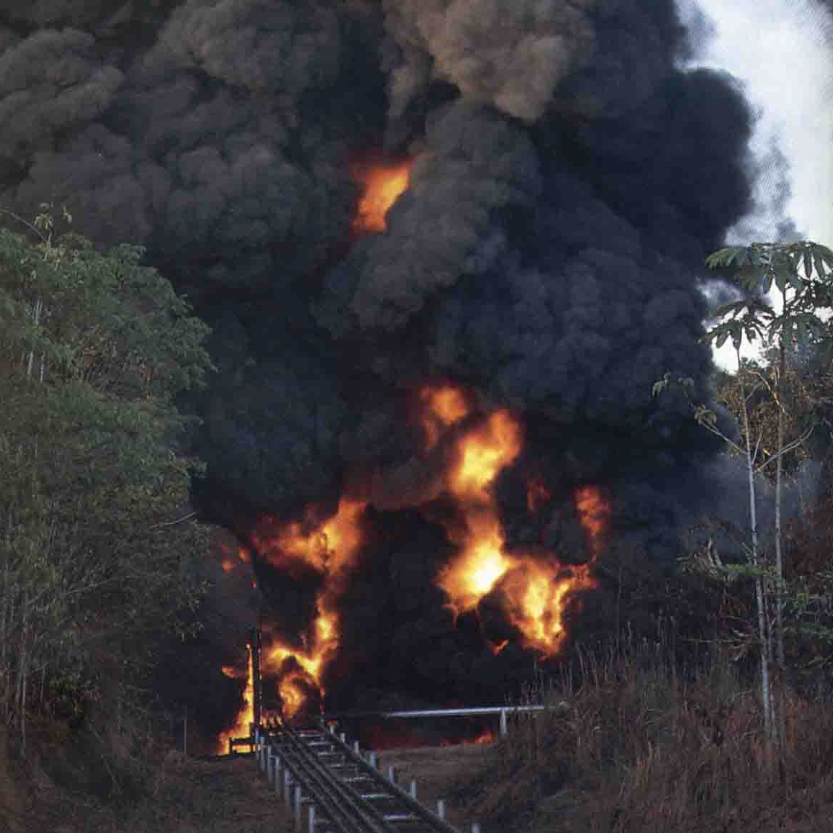
Over a quarter century in the Ecuadorian Amazon, oil giant Texaco (now Chevron) perpetrated an ecological disaster: It dumped 3.2 million gallons of toxic waste, spilled 17 million gallons of crude oil and flared nearly 50 million cubic feet of methane gas. The company also collaborated with U.S. evangelical missionaries to forcibly displace Indigenous peoples from their oil-rich lands. The victims have received no compensation.
Now, three arbitrators have ordered that compensation be paid—by the Ecuadorian government to Chevron. The total: $220 million, according to legal documents made public this week.
The ruling marks the latest twist in a decades-long legal saga that has stretched across continents and consumed millions of dollars in legal fees, all while the local population bears the burden of displacement and high cancer rates from the contamination.
“Our territories, our forests will never be the same,” said Penti Baihua, a traditional leader of the Baihuaeri Waorani of Bameno.
Baihua lived with his community in the forest, uncontacted by outsiders, until the evangelical missionaries Texaco assisted forced contact on him when he was around 6 or 7 in a campaign dubbed “Operation Auca.” Auca is a pejorative term meaning “savage.”
A significant amount of environmental clean up could be done with the $220 million award money, Baihua said, speaking in Spanish. It could also help stop the ever-expanding advance of the region’s oil frontier.
“People who have cancer and other health problems but no money for medicines could get treatment,” he added. “Where will the government get the money to pay? Will it come drill more wells?”

That a major polluter will walk away with hundreds of millions in compensation is possible thanks in part to an international arbitration system known as investor-state dispute settlement. ISDS is embedded into thousands of trade agreements and contracts, endowing foreign investors with expansive rights and allowing them to bypass national courts and sue governments before panels of private arbitrators, many of whom are corporate lawyers.
Companies have used the system to win hundreds of millions and even billions of dollars in awards after governments have raised taxes, strengthened regulations or rejected oil licenses. The vast majority of claims have been brought by companies from wealthy nations against governments in the Global South.
As in the Chevron case, other multinational corporations have won ISDS awards even when leaving the ecosystems where they operated awash in toxic pollution or after being linked to human rights abuses carried out against locals.
“I want this to be understood: Chevron is not the victim, Chevron is the perpetrator,” said Donald Moncayo, president of the Union of Peoples Affected by Chevron-Texaco, an Ecuadorian organization representing individuals affected by the company’s 1964 to 1990 operations. Chevron acquired Texaco, its assets and liabilities alike, in 2001.
“The fundamental issue is how transnational corporations have engineered an international system of impunity that allows them to violate human rights, environmental laws and the rights of nature,” Moncayo said, speaking in Spanish.
Proponents of ISDS say it protects foreign investors from discriminatory national courts. They also say it incentivizes investment in poor countries, though there is no conclusive evidence supporting that assertion.

Fossil fuel companies are among the heaviest users of the system, recently trying to force enormous payouts from governments seeking to phase out fossil fuels.
Chevron’s $220 million award against Ecuador is far below the more than $3 billion the company had sought, and represents legal fees the firm spent related to its Ecuadorian operations, including costs spent defending itself against a class-action-style lawsuit that resulted in a $9.5 billion judgment against the company, issued in 2011.
The validity of that Ecuadorian judgment, a ruling affirmed by the country’s highest court, was at the heart of the ISDS arbitration. In 2018, the arbitrators declared the $9.5 billion judgment fraudulent, finding that Ecuadorian courts had treated Chevron unfairly and that the government was wrong to let the ruling stand.
The 2018 ruling was based on evidence that the lawyers who had won the $9.5 billion judgment did so by forging an expert’s signature, blackmailing a judge, facilitating the ghostwriting of a key piece of evidence and bribing other Ecuadorian judges—acts the lawyers either denied or said weren’t illegal in Ecuador at the time.
The $220 million award made public this week flowed from the arbitrators’ 2018 ruling.
Chevron, which never denied Texaco’s pollution in the Amazon, celebrated the award.
“By condemning judicial fraud, bribery and corruption during a prior Ecuadorian administration, the Tribunal has strengthened the global rule of law,” a company spokesman said.
Earlier, a United Nations special rapporteur told Inside Climate News that deficiencies in a country’s justice system shouldn’t mean foreign corporations are entitled to bypass local courts.
“When people say that investors cannot trust the legal system, I say even communities might not trust the legal system of their own country either,” Surya Deva said last year, adding that ISDS exacerbates what is already an imbalance of power between foreign companies and local communities.
That three private arbitrators can directly challenge a nation’s judicial and legal sovereignty is deeply concerning, said Robert Howse, a professor of international law at New York University School of Law.
Howse, who had not had an opportunity to review the award and was speaking generally about the ISDS system, added: “It shows the kind of intrusiveness that an arbitration panel can engage in, and that raises real, serious issues of a clash with constitutional values and appropriate conceptions of democratic and legal sovereignty.”
Josef Ostřanský, senior policy advisor at the think tank International Institute for Sustainable Development, called ISDS an “outdated system” that allows companies to “avoid accountability for the environmental or social damages caused by their investment projects, while draining already squeezed public finances.”
The Ecuadorian consulate in Washington, D.C., did not respond to a request for comment, but its Attorney General’s Office released a statement in Spanish casting the award as a semi-victory for the country: “Ecuador has avoided paying more than $3.13 billion in the international investment arbitration initiated by Chevron Corp. and Texaco Petroleum Co.”
30 Years of Litigation
Critics of the ISDS system point to the extensive disparities in access to justice between the foreign investors who target developing countries for their natural resources, and the local people who live in those places.
Foreign investors can turn to international arbitration, a highly secretive system that excludes the participation of the locals they impact. Meanwhile, local people living with the environmental consequences are left to fight in national courts that may be under-resourced, politicized or vulnerable to outside influence.
The decades-long dispute over Texaco’s Amazon pollution reflects that divide. The case began in 1993 with a lawsuit in U.S. federal court on behalf of tens of thousands of Ecuadorians living amid widespread contamination.
Shortly after, Texaco held closed-door talks with the Ecuadorian government, its drilling partner, to resolve the company’s liability.
This story is funded by readers like you.
Our nonprofit newsroom provides award-winning climate coverage free of charge and advertising. We rely on donations from readers like you to keep going. Please donate now to support our work.
Donate Now
In 1998, those negotiations produced a final settlement releasing Texaco from liability for environmental claims. (Advocates later questioned the agreement, alleging conflicts of interest involving the Ecuadorian official who approved it.)
Texaco then persuaded the U.S. judge overseeing the pollution suit to dismiss the case in 2002, arguing it belonged in Ecuador. The judge agreed, despite warnings from the plaintiffs that Texaco wielded outsized influence in the country’s courts. Legal scholars have criticized that move, pointing out that decisions about dumping toxic waste had been made at Texaco’s headquarters in the United States.
Forced back to Ecuador, the plaintiffs refiled their case against Chevron in 2003, ultimately winning the $9.5 billion judgment in 2011.
Chevron filed the ISDS complaint in 2009, asking the arbitrators to decide whether Ecuador had violated the U.S.-Ecuador Bilateral Investment Treaty, which went into effect in 1997 and granted foreign investors rights to “fair and equitable treatment” and access to ISDS.
Ecuador challenged the tribunal’s jurisdiction, arguing that Texaco’s 1965 to 1990 operations occurred years before the treaty existed. The arbitrators allowed the case to proceed anyway, reasoning that Ecuador’s 1998 settlement releasing Texaco from liability came after the treaty went into effect.
In the 2018 ruling finding that Ecuador had breached the treaty, the arbitrators rejected the nation’s arguments that Chevron had unclean hands and that Chevron never contested the validity of the $9.5 billion judgment in Ecuadorian courts, but rather went directly to arbitration.
The $220 million award does not include legal fees and costs Chevron incurred in the arbitration, which it could still win—the arbitrators have yet to rule on that portion of the case.
Should Ecuador refuse to pay the award, Chevron could move to seize the country’s overseas assets to extract payment. That’s one reason among many why the ISDS system is so powerful.
American lawyer and professor Judith Kimerling, who extensively documented Texaco’s operations in her 1991 book “Amazon Crude,” called the decision “a perverse outcome and tragic failure of the rule of law.”
“No tribunal can negate the damage caused by Chevron’s operations,” she said. “Affected communities who have clean hands and real injuries still haven’t gotten justice or any meaningful remedies, while Chevron is poised to profit again.”
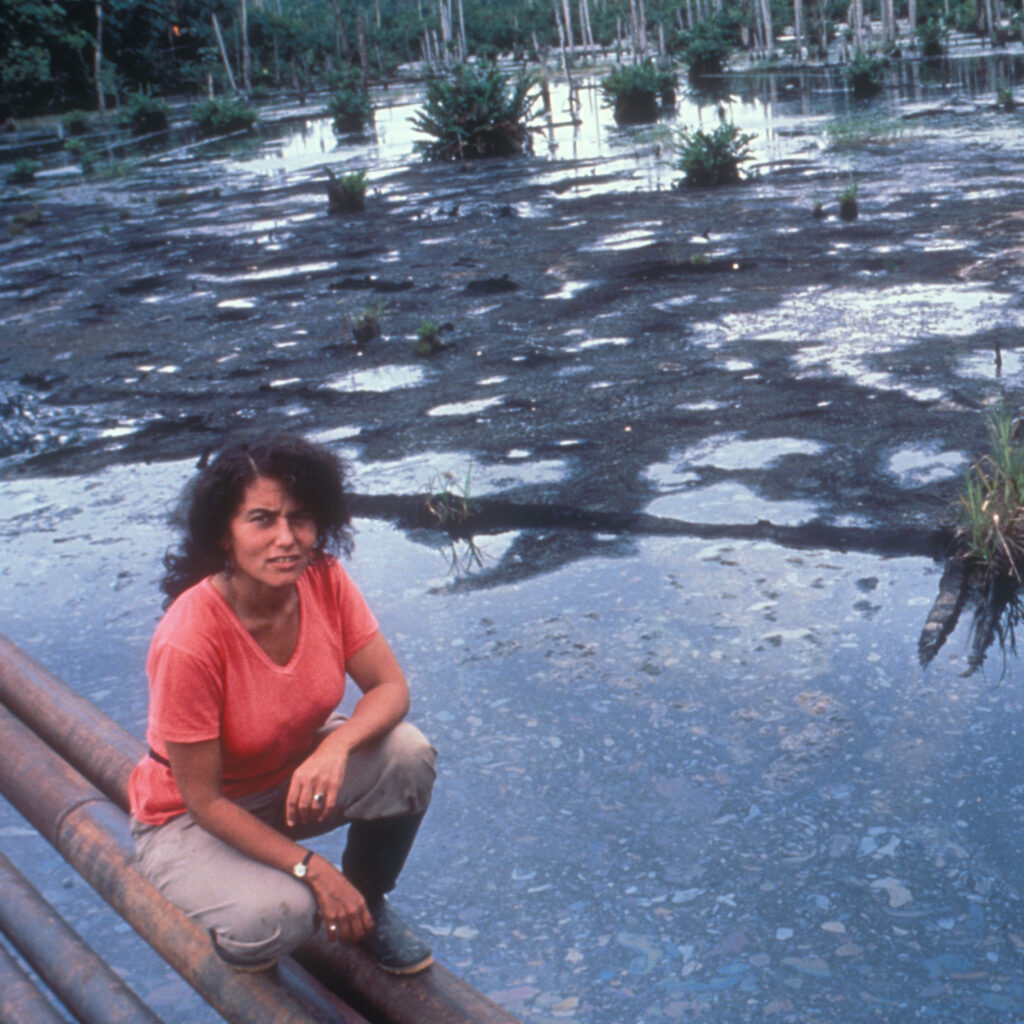
Kimerling was not involved in the Ecuadorian lawsuit that the arbitrators declared fraudulent and has worked with some Ecuadorian Indigenous communities that never consented to be part of that case.
With the $9.5 billion judgment still standing in Ecuador, the plaintiffs’ legal team said they plan to file a legal action to intercept any government attempts to pay Chevron the recent arbitration award.
Meanwhile, on the ground in the Ecuadorian Amazon region, pollution from Texaco’s operations still saturates the rainforest. The oil frontier the company opened continues to expand, penetrating deeper into remote regions of the forest that are home to recently contacted Indigenous communities and the country’s last remaining uncontacted communities. This year, the government announced plans to auction dozens of new rights to oil and gas projects, many of which overlap with Indigenous territories.
While advocates have won a court ruling requiring the Ecuadorian government to scale back harmful gas flaring in the region and voters approved a national referendum forcing the end of oil operations inside a portion of the Amazon, the Ecuadorian government has so far failed to implement those directives.
Unlike Chevron, the impacted communities don’t have access to the ISDS system to force the government’s hand. But their tax dollars will help foot the bill for the $220 million award Chevron won in the system, should the Ecuadorian government pay it.
About This Story
Perhaps you noticed: This story, like all the news we publish, is free to read. That’s because Inside Climate News is a 501c3 nonprofit organization. We do not charge a subscription fee, lock our news behind a paywall, or clutter our website with ads. We make our news on climate and the environment freely available to you and anyone who wants it.
That’s not all. We also share our news for free with scores of other media organizations around the country. Many of them can’t afford to do environmental journalism of their own. We’ve built bureaus from coast to coast to report local stories, collaborate with local newsrooms and co-publish articles so that this vital work is shared as widely as possible.
Two of us launched ICN in 2007. Six years later we earned a Pulitzer Prize for National Reporting, and now we run the oldest and largest dedicated climate newsroom in the nation. We tell the story in all its complexity. We hold polluters accountable. We expose environmental injustice. We debunk misinformation. We scrutinize solutions and inspire action.
Donations from readers like you fund every aspect of what we do. If you don’t already, will you support our ongoing work, our reporting on the biggest crisis facing our planet, and help us reach even more readers in more places?
Please take a moment to make a tax-deductible donation. Every one of them makes a difference.
Thank you,

Katie Surma
Reporter, Pittsburgh