

A polar bear stood outside the Department of the Interior’s headquarters in Washington, D.C., Thursday with a message: “Stop Trump’s Extinction Plan.”
The sign-carrying Arctic creature—actually an environmentalist dressed in a shockingly realistic costume—was joined by around 35 people to protest the Trump administration’s recently proposed changes to the Endangered Species Act. In front of the agency leading this charge, environmentalists and two members of Congress said these proposals could further threaten imperiled species across the United States.
“We must be vocal and push back against this administration’s ignorance and malignant disregard for experts and responsible conservation,” U.S. Rep. Don Beyer (D-Va.) said at the rally, organized by nonprofits including the Sierra Club and the Center for Biological Diversity.
The proposals—four in total, made public four weeks ago—represent the latest in a series of moves to systematically dismantle protections afforded by one of the country’s most central conservation laws. More broadly, they fit into the Trump administration’s widespread attempts to weaken a wide swath of environmental protections that some powerful industries dislike.
Experts say the proposed changes to the ESA would be a boon for logging and oil and gas companies, reducing federal agencies’ ability to restrict the impacts of these activities on endangered plants and animals and their habitats. Some of the new language may also encourage agencies to consider economic impacts when deciding whether to list a species as endangered, environmental groups say, despite the law explicitly prohibiting that.
“These revisions end years of legal confusion and regulatory overreach, delivering certainty to states, tribes, landowners and businesses while ensuring conservation efforts remain grounded in sound science and common sense,” Interior Secretary Doug Burgum said in a statement.
The rule changes, proposed by the U.S. Fish and Wildlife Service and the National Oceanic and Atmospheric Administration (NOAA), are open for public comment until Dec. 22.
Environmental groups are pushing back vehemently against the new proposals.
“The administration has made it very clear that they are in the business of shortcutting and circumventing environmental laws wherever possible to benefit their friends in the fossil fuel industry,” said Jane Davenport, a senior attorney at the nonprofit Defenders of Wildlife.
The battle will almost certainly play out in court. But after widespread cuts to federal staff this year, it’s not clear that the Fish and Wildlife Service and NOAA even have enough people to carry out the new work the proposals would require.
Yanking Off the Protective Blanket
In President Donald Trump’s first term, his administration made a series of sweeping changes to Endangered Species Act regulations. Most were reversed five years later by the Biden administration.
The recent proposals are similar and reflect a continuation of this regulatory “ping-pong match,” said Ramona McGee, a senior attorney and wildlife program leader at the nonprofit Southern Environmental Law Center. This time, the Trump administration “is holding a larger paddle,” taking the changes one step further to undermine conservation safeguards that the Endangered Species Act provides, she said.
“This seems to be very much in line with those efforts to narrow reviews and allow different projects to move forward faster and without due consideration for environmental consequences,” she said.
In the United States, animals and plants facing the highest risk of extinction are marked as “endangered” under the ESA, which means that it is illegal to kill them or destroy their critical habitat. One step below this, species that “are likely to become endangered” are classified as “threatened.”
The “blanket rule” in Section 4(d) of the ESA automatically extends the same level of protection for both classifications. Since that rule was introduced in 1978, it has provided strict protections for hundreds of species of plants and animals on land, which includes animals like grizzly bears, Yosemite toads and white-breasted guineafowls. Ocean species managed by NOAA do not have this blanket stipulation.
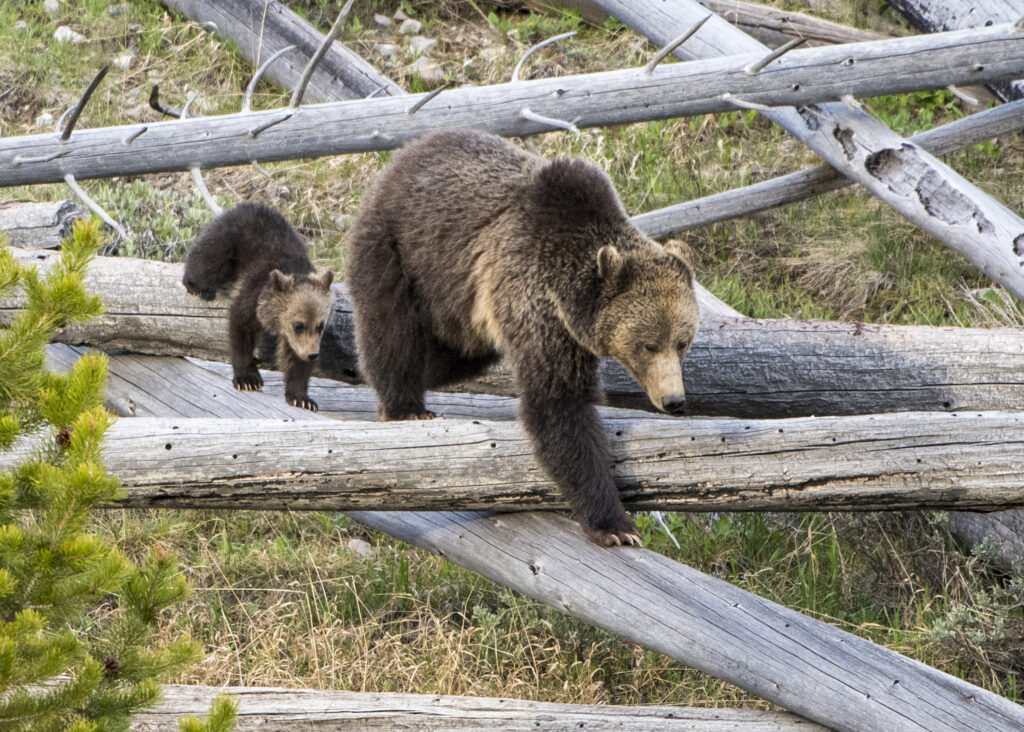
The Trump administration wants to pull that blanket off, instead requiring protections tailored to each newly classified threatened species. This could lead to fewer protections for struggling plants and animals, said Stephanie Kurose, the deputy director of government affairs at the nonprofit Center for Biological Diversity.
“With the blanket 4(d) removal, even if a species should be listed as endangered, we’re going to see a lot more listed as threatened for policy reasons, because industry wants those exemptions … so that they don’t have to do anything related to protecting the species,” Kurose said.
Meanwhile, Scott Lauermann, a spokesperson for the American Petroleum Institute, said in a statement that the fossil fuel trade group continues “to work with the administration on commonsense ESA policies that both protect wildlife and support American energy dominance.”
As part of the proposal, the Fish and Wildlife Service intends to eventually create specific rules for each species already listed as threatened, not only those newly receiving that classification. In the Federal Register, the agency’s statement says this “tailored approach reduces burdens on the Service and regulated entities alike and allows for the Service to better protect threatened species.”
Andrew Mergen, the director of Harvard Law School’s Emmett Environmental Law and Policy Clinic, said it and other recent proposals would largely do the opposite for an already strained staff. For example,creating tailored rules for each threatened species is a time-consuming process. And since January, the Trump administration has fired a vast swath of employees from the agencies responsible for these plans.
“This administration is delivering this double whammy to the environment,” Mergen said. “First, it’s in the form of regulatory rollbacks that might not be so profound in every instance by themselves, but combined with the gutting of the civil service, are a profound threat to the gains that we have made over the many years.”
A recent analysis of federal data, obtained through a Freedom of Information Act request by the Center for Biological Diversity, found that the Fish and Wildlife Service lost 18 percent of staff between 2024 and the end of May. Even prior to these layoffs and recent funding cuts, the Fish and Wildlife Service did not receive enough resources to support the mandate of the Endangered Species Act, according to a 2022 study. As listings have risen over the past three decades, the funding per species has declined, the study found.
“This administration is delivering this double whammy to the environment.”
— Andrew Mergen with Harvard Law School’s Emmett Environmental Law and Policy Clinic
The Fish and Wildlife Service did not respond to requests for comment. Neither did NOAA, which coordinated with the agency on two of the proposals.
Some of the most controversial parts of the Trump proposals center on economics.
Under the ESA, decisions to add a species to the endangered list must be made using “the best scientific and commercial data available” and “without reference to possible economic or other impacts of such determination.”
One of the proposals would remove the latter part of that statement. In doing so, the Trump administration isn’t explicitly directing agencies to consider this financial component. But its proposal would permit them to provide cost-benefit studies for the public and businesses to review before a decision is made.
How to Weigh In
The changes the Trump administration wants to make to Endangered Species Act regulations are spread over four proposals from the U.S. Fish and Wildlife Service, two of those in coordination with NOAA. The deadline for the public to comment is Dec. 22 at 11:59 p.m. EST.
You can submit a comment on each proposal:
Defenders of Wildlife’s Davenport believes having this type of analysis on hand will almost certainly influence listing decisions, likely behind the scenes.
“Why are we wasting staff time and energy putting this information together when you’re legally not allowed to consider it?” Davenport questioned. “Is it because behind closed doors, decisionmakers are going to consider it … outside of public view?”
Habitat Threats
Research shows that habitat loss is a primary driver of extinction in the United States. With this in mind, legislators enacted several amendments to the ESA that direct agencies to not only protect vulnerable animals and plants, but also the ecosystems they depend on—from kelp forests in California to the vast prairies across the Midwest.
One of the main habitat protections afforded by the law is through its regulatory definition of harm, which encompasses “any activity that can modify a species’ habitat.” For example, a timber company may not be allowed to cut down trees in an old-growth forest if the area supports nesting grounds for endangered northern spotted owls.
In April, the Trump administration proposed a rule to rescind the definition of harm, opening the door for more development on endangered species’ territory. Now, some of the November proposals are targeting the other part of the ESA that protects habitats for vulnerable species.
When a species is listed, agencies designate “critical habitat” areas they deem “essential to the conservation,” according to the Fish and Wildlife Service. Sometimes, that includes areas that are not occupied by the species at the time of listing, but could offer important refuge in the future.
The new proposal would restrict the designation of critical habitat and direct the agency to put more weight on whether the economic and national security benefits of excluding a certain area outweigh the benefits of including it. The Trump administration is also trying to make it more difficult to designate unoccupied critical habitat areas.
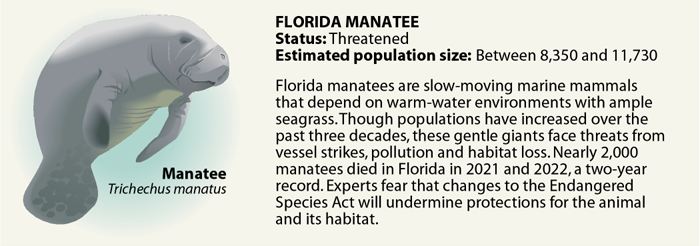
Environmentalists say the changes could impact a wide swath of animals still waiting on critical habitat designations, including the threatened Florida manatee. These iconic aquatic mammals depend on warm-water refuges with plenty of seagrass to survive. In 2024, the Fish and Wildlife Service proposed a revision to expand the Florida manatee’s critical habitat areas, which has yet to be finalized. Now, nonprofits like Save the Manatee Club that have spent more than a decade advocating for such a change are concerned it will be disrupted.
“Manatees and other imperiled species need all of the help they can get with the myriad threats they face from expansion of human habitat, pollution, so many other uncertainties,” said Elizabeth Neville, the director of environmental law and policy at Save the Manatee Club. “This is not the time to be rolling back protections, especially not protections on critical habitat.”
Climate Threats to Endangered Species
Combined, the recently proposed changes could hinder agencies’ ability to protect species against rapid global warming.
The federal government has long grappled with how to address climate change while implementing the ESA. The law does not expressly require officials to consider the effect of global warming in their ESA decisions, but does require they take into account “natural or manmade factors affecting [a species’] continued existence.”
In 2008, during the administration of Republican George W. Bush, the polar bear was the first animal to be listed as threatened at least in part due to climate change. The species was afforded an ample critical habitat designation across the Arctic to help buffer it against melting sea ice, which provides breeding, hunting and feeding grounds and travel corridors for the bears.
It was a landmark decision to afford the species such a large swath of protected habitat through the ESA—one that likely would never have happened if these newly proposed rules were in place then, according to Mergen, who defended legal challenges to the listing when he was working at the Department of Justice around 2012.
“You can imagine that if they were doing that today, [agencies] would say, ‘No, no, no, we have to look at economics,” he said. “We have to pay more attention to the pro-oil and gas people … and this designation is just way too large.”

Mergen added that other animals in the Arctic, such as birds and grizzly bears, could also be vulnerable to fossil fuel development—and may have fewer protections under federal law if these changes go through.
“A lot of the conflicts associated with those animals are around oil and gas development,” he said. “And so the question is, will this result in far less habitat designation?”
Dave Owen, an environmental law professor at the University of California Law San Francisco, thinks some of the biggest threats to imperiled species from these proposals involve how agencies review projects or actions to ensure they do not jeopardize listed species or destroy critical habitat. That includes direct federal government activities as well as the permits agencies issue for state and local governments and to businesses for grazing, oil drilling or other uses.
The new rules could limit the potential impacts on species that officials would review. “The goal is to narrow the scope of activities that can be affected by consultation processes to give a lot more activities a green light, even if they pose risks to species,” Owen said.
A “Multi-Pronged” Attack
Since January, the Endangered Species Act has been a consistent mark for the Trump administration and Republicans in Congress aiming to reduce barriers to development and fossil fuel extraction in the name of “energy domination.”
Several executive orders include language that would allow agencies to streamline or bypass the typical environmental reviews associated with the law, while the Interior secretary has tried to discredit the ESA’s effectiveness. Meanwhile, the House Natural Resources Committee voted on Wednesday to advance the “ESA Amendments Act of 2025,” sponsored by Chairman Bruce Westerman (R-Ark.) and 15 other Republicans. The bill would dramatically weaken the federal government’s ability to restrict activities that could hurt endangered plants and animals, environmental groups say.
Nonprofits including the Center for Biological Diversity have already committed to challenging the federal government if any of the administration’s changes to the ESA go through.
Several legal experts told Inside Climate News that rescinding the harm definition would likely have more profound implications for vulnerable species than the Trump administration’s newest proposed changes to the ESA. But together, the recent actions make up “a multi-pronged effort to take what have been reasonably effective parts of the Endangered Species Act and just whittle away at their effectiveness,” Owen said.
However, he believes the harm definition changes “are quite legally dubious.”
“The Supreme Court may let them get away with it because it’s a very conservative and anti-environmental Supreme Court, but I think that’s a stretch,” Owen said. “I think [the administration is] already, in multiple ways, pushing the envelope pretty aggressively.”
About This Story
Perhaps you noticed: This story, like all the news we publish, is free to read. That’s because Inside Climate News is a 501c3 nonprofit organization. We do not charge a subscription fee, lock our news behind a paywall, or clutter our website with ads. We make our news on climate and the environment freely available to you and anyone who wants it.
That’s not all. We also share our news for free with scores of other media organizations around the country. Many of them can’t afford to do environmental journalism of their own. We’ve built bureaus from coast to coast to report local stories, collaborate with local newsrooms and co-publish articles so that this vital work is shared as widely as possible.
Two of us launched ICN in 2007. Six years later we earned a Pulitzer Prize for National Reporting, and now we run the oldest and largest dedicated climate newsroom in the nation. We tell the story in all its complexity. We hold polluters accountable. We expose environmental injustice. We debunk misinformation. We scrutinize solutions and inspire action.
Donations from readers like you fund every aspect of what we do. If you don’t already, will you support our ongoing work, our reporting on the biggest crisis facing our planet, and help us reach even more readers in more places?
Please take a moment to make a tax-deductible donation. Every one of them makes a difference.
Thank you,

Kiley Price
Reporter
Kiley Price is a reporter at Inside Climate News, with a particular interest in wildlife, ocean health, food systems and climate change. She writes ICN’s “Today’s Climate” newsletter, which covers the most pressing environmental news each week.
She earned her master’s degree in science journalism at New York University, and her bachelor’s degree in biology at Wake Forest University. Her work has appeared in National Geographic, Time, Scientific American and more. She is a former Pulitzer Reporting Fellow, during which she spent a month in Thailand covering the intersection between Buddhism and the country’s environmental movement.