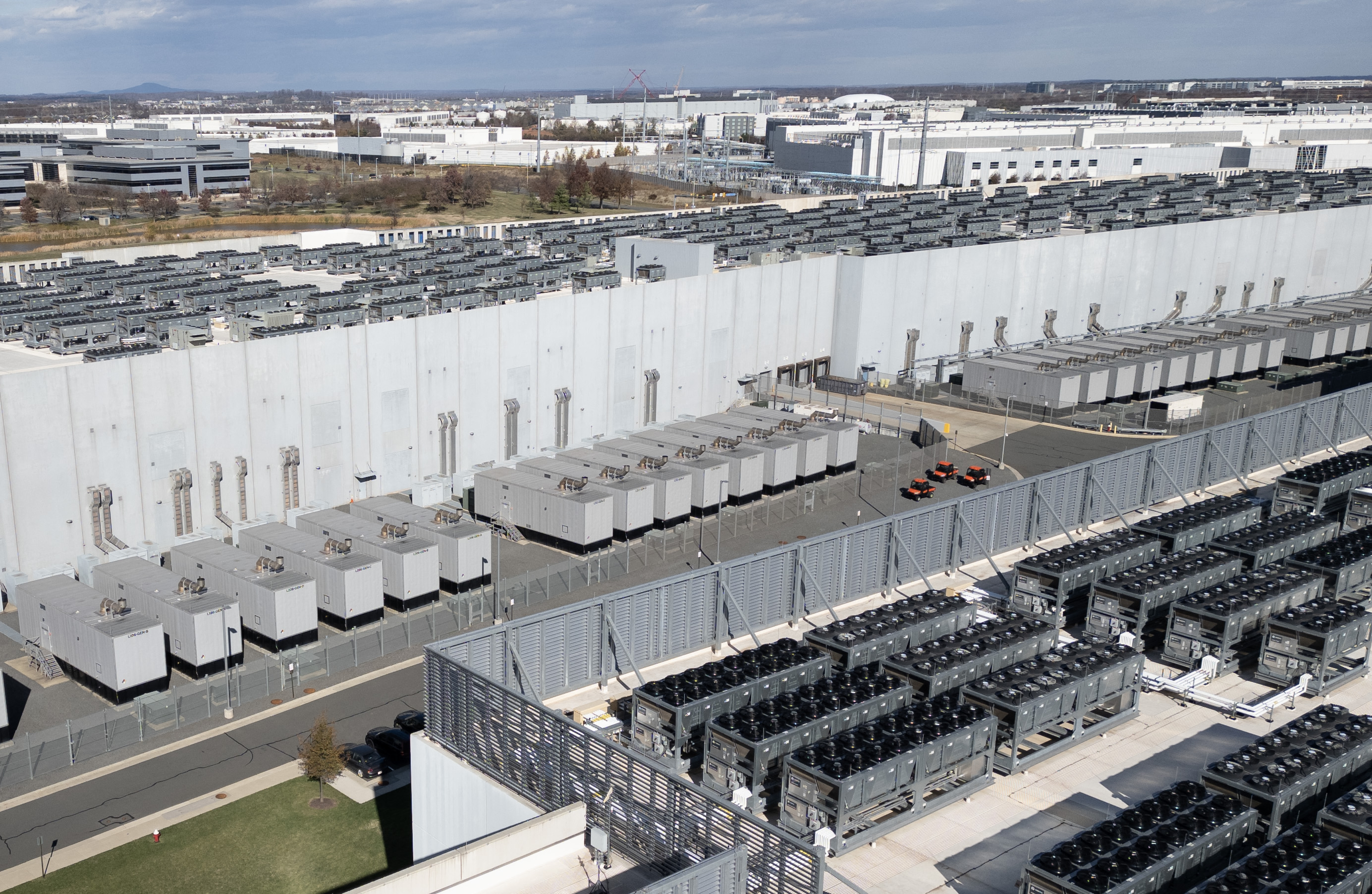


With data center developers in Texas and most other states now commonly deploying fossil fuel generators as backup power sources, a nascent industry from the renewable side of power generation—battery storage—has started elbowing its way into the fast-growing sector.
A new report by Oxford-based Aurora Energy Research detailed how adding battery storage to a site could improve data centers’ power quality, provide flexibility and reduce transmission congestion, while offering an opportunity to reduce emissions.
Battery storage already works as an uninterruptible power supply (UPS), or a bridge from grid power to backup power, as most generators take anywhere from five to 30 minutes to ramp up, said Lizzie Bonahoom, an Aurora Energy Research associate.
There’s a long history of batteries being efficient and cost effective in UPS applications, said Jeff Reeves, a vice president of Battery Council International, a leading industry trade group in North America.
But there’s been a seismic shift in how data centers and digital infrastructure operate, Reeves said. It’s made battery companies reexamine how they do things to ensure they’re brought into the future, Reeves said.
“Everybody’s really racing to figure it out,” Reeves said. “AI is having a moment and everyone wants to make sure that they’re there for it.”
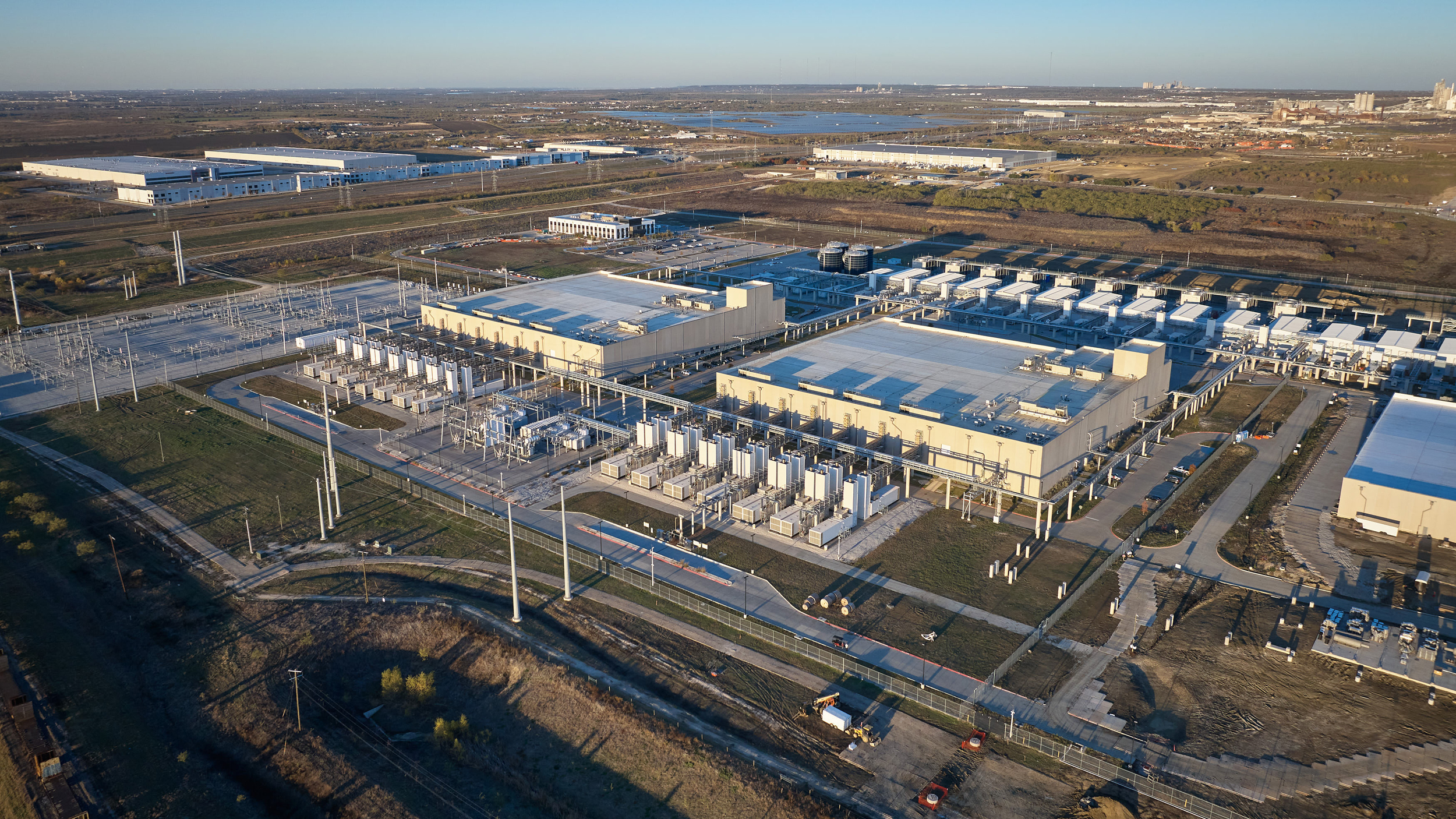
Some data center facilities being built in Texas have planned to co-locate their sites with battery storage. Of Google’s three new data centers across the state, totaling a $40 billion investment, one in Haskell County will be paired with a new solar and battery storage plant.
Elon Musk’s company Tesla rolled out its own battery marketed for industrial facilities like data centers called the Megapack. It’s currently being used at Musk’s xAI’s Colossus data center in Memphis, Tennessee.
The Megapack is said to be used to help smooth workloads to meet utility and generator requirements, improve the data center’s ability to stay online during voltage disturbances, offer flexible interconnection and emissions-free back up power.
Making the work more steady helps stop the quick spikes in electricity use that happen when training artificial intelligence. These spikes look like large swings on a power chart and present challenges for both the data center and the grid to handle. The oscillations often go beyond what’s recommended for the backup generators and can damage the equipment while also causing problems with the power grid’s stability.
Whether data centers can “ride through” voltage or frequency disturbances on Texas’ electric grid is already a concern for Electric Reliability Council of Texas (ERCOT) officials. Most data centers are designed to disconnect from the grid during a disturbance to avoid data corruption or loss and switch to backup power.
Batteries can react right away when power use suddenly changes, the Aurora report said, functioning as a fast-acting ancillary service that keeps electricity steady and prevents big swings in demand.
Reeves said pairing batteries with data centers is an area that’s still under development but growing in popularity.
“They’re kind of like shock absorbers and load stabilization,” Reeves said about batteries in power-smoothing uses.
Prasad Enjeti, a professor of electrical and computer engineering at Texas A&M University, said there are other technological options for load smoothing that are available now at scale. One being supercapacitors—a relative of batteries in their ability for a super-quick surge of power but with worse energy storage. Enjeti said there’s already some commercial supercapacitors available to smooth the load data centers are consuming to train language-learning models. It also could be solved on the software side, Enjeti said.
“There are many solutions,” Enjeti said. “I think they have to get their act together to come up with the right approach to minimize the cost.”
Tesla reports that its Megapack can make power use much more steady, cutting big ups and downs by more than 70 percent, so new data centers can use power systems already in place and get connected faster.
The battery can act in lieu of a transmission upgrade, Bonahoom said, preventing congestion— power lines being overloaded from demand. Doing so could likely get the data center faster interconnection, Bonahoom said.
“Time is of the essence,” Bonahoom said. “The value of getting a quicker interconnection is so high” because of the race to develop the most capable AI system.
Dallas-based Aligned Data Centers announced in October that a data center it is developing in Oregon will come online years earlier than would have been possible with traditional utility updates by securing a 31-megawatt battery from Calibrant, a company that provides on-site energy systems.
The on-site battery addresses siting and capacity bottlenecks and can give power back when the grid needs help, according to Aligned. It’s also designed to discharge during peak grid demand and ensure the “five-nines” of reliability—reliable power 99.999 percent of the time—data centers are seeking, the company stated.
Battery storage has quickly altered the Texas grid in recent years. Texas added nearly 1,500 megawatts of battery storage to the grid’s summer rated, peak demand capacities in 2023. That figure almost tripled to 4,374 megawatts added in 2024.
But given the scale of data center projects, the cost of batteries for how few hours they can run when compared to diesel generators, could make them prohibitively expensive, Bonahoom said.
Diesel generators for 2028 deployment cost companies on average about $1,159 per kilowatt and can run one or two weeks. By contrast, lithium-iron phosphate batteries cost nearly double, at $2,371 per kilowatt, and max out around 20 hours of run time, according to Aurora.
While there are investments in new technologies and battery chemistries to improve long duration storage, such as flow batteries—rechargeable batteries where energy is stored in liquid in external tanks, instead of inside solid battery cells—it’s still early, Reeves said. Some prospective clients are considering the batteries as a way to move away from relying solely on fossil fuels, or search for bridge solutions that can run for a few hours.
“Unless there are stringent congestion or flexibility requirements from the grid system operators and a clear outlook of what compensation would look like for batteries, the adoption of storage at data centers will depend on how well they can pitch themselves,” Bonahoom said. “That’s TBD.”
About This Story
Perhaps you noticed: This story, like all the news we publish, is free to read. That’s because Inside Climate News is a 501c3 nonprofit organization. We do not charge a subscription fee, lock our news behind a paywall, or clutter our website with ads. We make our news on climate and the environment freely available to you and anyone who wants it.
That’s not all. We also share our news for free with scores of other media organizations around the country. Many of them can’t afford to do environmental journalism of their own. We’ve built bureaus from coast to coast to report local stories, collaborate with local newsrooms and co-publish articles so that this vital work is shared as widely as possible.
Two of us launched ICN in 2007. Six years later we earned a Pulitzer Prize for National Reporting, and now we run the oldest and largest dedicated climate newsroom in the nation. We tell the story in all its complexity. We hold polluters accountable. We expose environmental injustice. We debunk misinformation. We scrutinize solutions and inspire action.
Donations from readers like you fund every aspect of what we do. If you don’t already, will you support our ongoing work, our reporting on the biggest crisis facing our planet, and help us reach even more readers in more places?
Please take a moment to make a tax-deductible donation. Every one of them makes a difference.
Thank you,

Arcelia Martin
Reporter, Texas Renewables
Arcelia Martin is an award-winning journalist at Inside Climate News. She covers renewable energy in Texas from her base in Dallas. Before joining ICN in 2025, Arcelia was a staff writer at The Dallas Morning News and at The Tennessean. Originally from San Diego, California, she’s a graduate of Gonzaga University and Columbia University Graduate School of Journalism.