

Air quality can be brought within legal limits without the need for – and faster than – a charging Clean Air Zone, says Greater Manchester Combined Authority (GMCA), which cites new modelling in support of proposals that favour this “investment-led approach”.
Greater Manchester’s 10 local authorities are legally directed by government to bring nitrogen dioxide within legal limits as soon as possible and by 2026 at the latest, and are preparing to submit evidence to government in December in support of their preferred investment-led, non-charging plan, which has been benchmarked against a charging Clean Air Zone in the centre of Manchester and Salford.
The GMCA instead proposes to build on its subsidised bus network – recently brought back under local government control – and clean air funding already awarded by government. Its proposal includes a £51.2m investment in zero-emission electric buses for its new bus service (“the Bee Network”), £30.5m to fund grants for cleaner taxis, and £5m for measures to manage traffic flow on some roads in the centre of Manchester and Salford.
The GMCA’s preferred plan would mean that no vehicle would be charged to drive in a Clean Air Zone in Greater Manchester. Modelling shows this would bring air quality within legal limits for nitrogen dioxide on local roads in 2025.
Modelling of a charging Clean Air Zone in the centre of Manchester and Salford shows it would not achieve compliance by 2026, failing to meet the government’s own compliance date, said a press release from the GMCA.
“It is for government to decide the measures that get the green light – Greater Manchester’s preferred investment-led, non-charging plan, or a charging Clean Air Zone.”
Mayor of Greater Manchester, Andy Burnham, said: “By accelerating investment in the Bee Network to create a London-style integrated public transport network, and upgrading GM-licensed taxis, we can improve air quality faster than if we introduced a Clean Air Zone, and without causing hardship to our residents or businesses.
“Since the first bus services came under local control, we have listened to feedback to make improvements and deliver change and are already seeing the benefits the Bee Network brings, with more people getting on board with lower fares under a locally controlled service, with new, state-of-the-art electric buses.
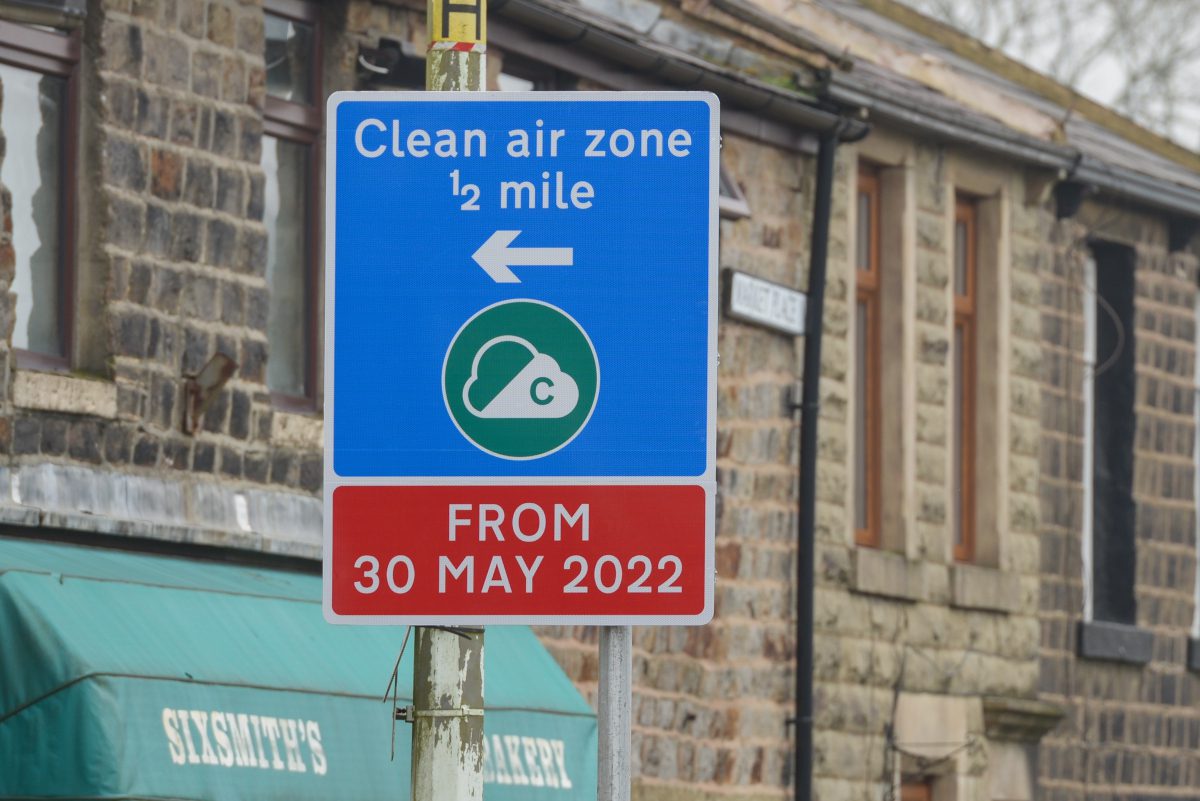
“I’d also ask government to urgently consider allowing Greater Manchester local authorities to remove charging Clean Air Zone signs, as modelling shows that only Greater Manchester’s investment-led plan can meet the legal test placed on the 10 councils to deliver compliance in the shortest possible time and by 2026 at the latest.”
GM’s non-charging plan
Details of the plans will be published in December in a report to the Greater Manchester Air Quality Administration Committee. The committee will be asked to approve the submission of Greater Manchester’s evidence to government when it meets on 20 December.
The investment-led plan includes a £51.2m investment in 64 zero-emission electric (ZEB) buses and upgrades to electric vehicle charging infrastructure at bus depots in Manchester, Bolton and Middleton. “Bringing buses back under local control through the Bee Network allows Greater Manchester to run ZEBs on routes where they can have the biggest impact on improving air quality,” said the statement.
A £22.5m Clean Taxi Fund providing grants of between £3,770 and £12,560 will aim to help all taxis (Hackney Carriages and Private Hire Vehicles) licensed by the authority to meet a new minimum emission standard by 31 December 2025.
Other funds will support vehicle upgrades and measures to manage traffic flow on roads in Manchester and Salford.
Modelled charging zone
Modelling for the regional centre Clean Air Zone ‘benchmarked’ at the request of government was based on the introduction of charges for non-compliant buses, coaches, taxis, private hire vehicles, HGVs, vans and minibuses.
It suggests that the benchmarked approach would not address all the locations above the legal limits for nitrogen dioxide until after 2026, with eight locations exceeding legal nitrogen dioxide limits in 2025.
“Once we have had full, formal government feedback on our Clean Air Plan following the submission of this additional evidence, we will consider timescales for a public consultation on the plan,” said the GMCA’s press release.
Leader of Bury Council and Clean Air lead for Greater Manchester, Cllr Eamonn O’Brien, said:
“We know that there are very serious consequences of dirty air in Greater Manchester and that the health impacts are not always felt equally.
“We want to do the right thing in the right way, using an investment-led, non-charging plan to clean the air in a supportive and transitional way, that does not create the risk of financial hardship. While we can now prove our case for an investment-led plan, modelling shows that we can’t achieve compliance through a charging Clean Air Zone by 2026. There is now a compelling case for what Greater Manchester has set out – a plan that is fairer, cheaper, more affordable and more democratic.
“Subject to the approval of the Greater Manchester Air Quality Administration Committee at its meeting on 20 December, this evidence will be submitted to government. It is then for government to determine which scenario Greater Manchester is to implement – an investment-led, non-charging plan, or a charging regional centre Clean Air Zone.”
In September, Greater Manchester became the first place in England to re-establish local authority control of its buses after decades of deregulation.
“Despite higher volumes of road traffic year-on-year, the performance of franchised bus services is as good as, if not better, than before. Weekend traffic is up 12 per cent in parts of Manchester and Salford in 2023 versus 2022, the equivalent of an additional 80,000 vehicle movements.”