

Every day when Rajaa Musleh wakes up and checks her phone, she fears she will see news that another member of her family has been killed in Gaza.
Musleh, a nurse and humanitarian worker who evacuated from Gaza to Cairo last year, works at the charity organization Human Concern International delivering food, medicine and other essential aid. Her 75-year-old mother and other family members are still in Gaza, where they face constant dangers: bombing, disease, starvation, medication shortages and environmental devastation.
“I feel that I am divided into two parts,” Musleh said. “My body is here in Cairo and my soul inside Gaza.”
Israeli forces have killed more than 70,000 Palestinians over the past two years and two months, according to official estimates. The United Nations estimates that 90 percent of Gaza’s population is displaced and that 1.5 million people are in urgent need of shelter.
Over the past two years, the U.N. and global medical and human rights authorities have continuously sounded the alarm on famine and forced starvation in Gaza, widespread environmental destruction, near-constant bombardment and violations of international law, deeming Israel’s assault a genocide. Israel has destroyed Gaza’s water, sewage and hospital infrastructure and, the U.N. said, continues to restrict the entrance of food, tents, warm clothes and life-saving medical supplies, leaving millions without basic necessities.
Now, as multiple reports show Israel violating the latest ceasefire, winter rains are flooding thousands of tents in Gaza amid plummeting temperatures. Escalating environmental destruction, from the impact of chemical weapons to heavily polluted water, make the scale of humanitarian devastation even more apocalyptic.
“This war, I call it a climate war,” Musleh said. “It has created catastrophe, an environmental health crisis … and I think this will affect Gaza for generations.”
The unusually heavy rains, strong winds and floods Storm Byron brought to Israel and Gaza this week are making conditions for displaced families even more dire. One baby in Gaza died overnight this week in a cold and flooded tent.
“The storm is exacerbating the humanitarian crisis amid the destruction of infrastructure and a lack of resources,” Gaza City Mayor Yahya Al-Sarraj told Al Jazeera.
According to the U.N. Office for the Coordination of Humanitarian Affairs, nearly 850,000 people in Gaza are sheltering in 761 displacement sites particularly vulnerable to flooding expected from the storm.
Israeli officials have said they expect to see unprecedented rainfall and warned residents to stay inside and watch for signs of hypothermia.
Thousands of children in Gaza are experiencing acute malnutrition, while lacking shelter, sanitation and warm clothing. Flooding rains and lack of access to safe water for drinking and even basic hygiene interventions like handwashing accelerate the rapid spread of disease. Cold weather also increases the body’s energy needs, putting malnourished children with insufficient reserves of fat and muscle at severe risk of hypothermia, according to the United Nations Children’s Fund.
Doctors Without Borders found that diseases linked to poor living conditions, including skin, eye, respiratory and gastrointestinal diseases, make up 70 percent of outpatient consultations in the organization’s health care clinics in southern Gaza. As winter rains mix with sewage, winter exacerbates the spread of disease.
“Without immediate improvements to water, sanitation, shelter and nutrition, more people will die from entirely preventable causes,” the organization wrote in a statement denouncing bloodshed after Israeli strikes on Nov. 19.
In an emailed statement, the Israel Defense Forces said allegations of genocide are “not only unfounded but also ignore Hamas’ violations of international law.” The IDF denied claims it is limiting the number of humanitarian aid trucks entering Gaza.
“The IDF remains committed to conducting its operations in accordance with international law,” the statement read, contending that Hamas is not fulfilling its part of the ceasefire agreement, including by killing three Israeli soldiers and not returning all hostages by the deadline. “The IDF is acting in response to threats, violations, and terror infrastructure.”
The BBC reported on Nov. 11 that Israel has destroyed more than 1,500 buildings in Gaza since the ceasefire went into effect on Oct. 10, and Al Jazeera reported that Israeli forces have killed at least 360 Palestinians and injured more than 900 over the same period. The United Nations Children’s Fund said on Nov. 21 that at least 67 children had been killed in Gaza since Oct. 10, an average of almost two children slain per day.
Hamas has reportedly returned all but one deceased hostage, whose body has not yet been found. Hamas officials have said they have had difficulty locating the bodies of hostages under rubble following Israeli strikes. The U.N. adopted a resolution this month calling on Israel to comply with international law by ending its “unlawful” occupation in Palestine.
The U.S. government continues to funnel billions of dollars to Israel. U.S. and Israeli officials reportedly expect the second phase of the U.S.-brokered Gaza peace plan to begin as soon as this month, while Hamas officials are calling for international pressure on Israel to first fully implement the terms of the plan’s initial phase, including ceasing attacks and ending the aid blockade.
Hala Sabbah, co-founder of The Sameer Project—a mutual-aid organization supplying emergency shelter, food and medical aid in Gaza—is based in London and coordinates donations to colleagues on the ground bringing tents and warm clothes to displaced Gazans. The Sameer Project’s doctors are treating displaced patients with severe injuries and chronic diseases, doing so without basic medical supplies and while also living in hazardous conditions themselves.
“Unless borders open really, really, really soon, we’re just basically seeing a slow genocide where people are dying because of the lack of infrastructure and the lack of aid coming in,” Sabbah said. “If this lasts even longer, that means more and more and more deaths.”
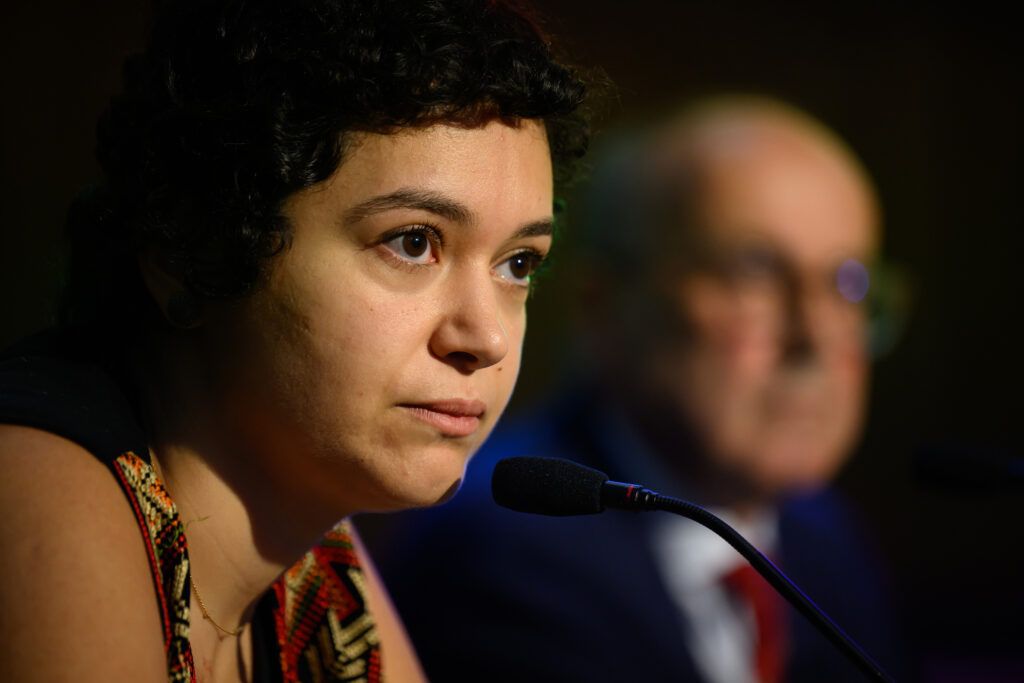
The Sameer Project is named after Sabbah’s uncle, who she said was killed in an Israeli bombing in 2024. The group is led by Gazans and members of the Palestinian diaspora, like Sabbah. The organization has about 100 team members on the ground, she said, but the scale of need far exceeds their capacity.
“What we’re doing, really, is a drop in the ocean,” Sabbah said. “It’s really, really frustrating.”
Lena Dajani, who coordinates The Sameer Project’s medical aid work while based in California, described the impact of the rain on displaced families living in makeshift shelters.
“They’re drowning in their tents,” Dajani said. “There’s no drainage. … There are just rivers of dirty water now, raw sewage, chemicals flooding into tents and destroying the very little that anyone owns.”
The flooding with contaminated water is exacerbating gastrointestinal diseases, infections and chronic coughs, and elevating hypothermia risks, which were already deadly last year.
“This winter is going to be catastrophic,” Dajani said.
After the latest ceasefire went into effect on Oct. 10, The Sameer Project saw a drop in donations, Sabbah said, but the dire circumstances on the ground have remained largely unchanged.
In late October, a Sameer Project staffer was killed along with 17 relatives in an Israeli airstrike on a residential building they were staying in, Dajani said.
Musleh, with Human Concern International, evacuated Gaza last year after spending 50 days trapped in Al-Shifa Hospital, where she worked as a nurse. Musleh is traumatized by the scenes of carnage she saw at Al-Shifa. When she evacuated in March 2024 she only planned to stay in Cairo for a month before returning to continue her work in Gaza, but she has not been able to get back in. She now coordinates aid to Gaza, including food, warm clothes and hygiene and medical supplies.
But aid is severely restricted. International human rights organizations and aid workers have criticized Israel for keeping healthy food, medical supplies and other essentials out of Gaza. This fall, Musleh said that Israeli authorities removed dates—high in nutrition desperately needed by malnourished children and adults—from Human Concern International’s food aid packages before letting them through.
Musleh’s mother, who is still in Gaza, suffers from kidney disease, but Musleh’s attempts to send her basic medication have been blocked, she said. She pays $2,000 each month to secure her mother a place in a two-bedroom apartment where 20 people are currently living, just to keep her out of the rain and floods. But there’s nowhere safe from violence, she said.
“When they announced the ceasefire, it’s just [a] lie,” Musleh said. “They attack every day, bombing the people in their tents.”
Even before October 2023, 97 percent of Gaza’s groundwater was already considered unfit for human consumption, due to a depleted coastal aquifer, over-extraction, nitrate pollution from sewage disposal, saltwater intrusion and the flushing of agricultural fertilizer, according to the U.N. Environment Programme. Palestinians have long lacked sufficient water access, and in 2012, the U.N. warned that the Gaza Strip could be unlivable by 2020 if no action was taken to secure clean drinking water as well as energy and sanitation access.
Gaza has been under Israeli blockade for nearly two decades, with Israeli authorities significantly restricting residents’ freedom of movement, employment, and ability to access imported goods including food, medical supplies and fuel. Israel has also restricted and undermined water access in Gaza for decades, including by restricting fuel used to operate desalination plants, overexploiting the coastal aquifer and deliberately targeting and destroying water and sewage infrastructure, according to water and human rights organizations.
Today, none of Gaza’s wastewater treatment plants are operational, according to the U.N., and just a fraction of the aid needed to sustain its population is allowed through the blockade.
Climate change is making the crisis even more acute, aid workers said. The rain came late and heavy this year, Musleh said, following scorching summer heat. Palestine is in a region particularly vulnerable to climate change, and climate models predict increased temperature highs and lows, as well as exacerbated droughts and floods. Palestine is already seeing significant sea-level rise, which scientists have projected will cause coastal flooding and erosion and continued saltwater intrusion in groundwater aquifers.
In August, Gazan journalist Bisan Owda described the impact of brutal heat over 104 degrees.
“There is no electricity, no fans, no ACs, no cold water, no safe places … because of climate issues and because of the intense bombings,” Owda said.
Groups like The Sameer Project are delivering truckloads of water, but once again, the need is far greater than their capacity.
“Families have gotten used to drinking brackish water,” Dajani said. “We’re seeing a lot of problems with kidneys because they can’t identify the taste anymore of the salt water.”
This story is funded by readers like you.
Our nonprofit newsroom provides award-winning climate coverage free of charge and advertising. We rely on donations from readers like you to keep going. Please donate now to support our work.
Donate Now
Dajani added that her colleagues are seeing kidney inflammation, hepatitis, jaundice, and Guillain-Barré syndrome, a rare and potentially life-threatening condition that can result in paralysis and breathing problems and most commonly follows a viral infection.
In a briefing published on Nov. 27, Amnesty International detailed the extent of the ongoing human rights crisis.
“The ceasefire risks creating a dangerous illusion that life in Gaza is returning to normal,” said Agnès Callamard, secretary general of Amnesty International, in a statement. “The world must not be fooled. Israel’s genocide is not over.”
Amidst staggering immediate needs, aid workers are seeing widespread trauma and medical complications that will impact Gaza’s population for generations to come.
Dajani described a child named Ahmed Al Homs, who was hit with tear gas last year, and suffered asphyxiation and brain damage. Now, he is paralyzed, Dajani said. The Sameer Project has been providing care and medications for Al Homs, who lives in the Refaat Alareer Camp, an emergency medical aid site the organization operates in central Gaza.
Doctors are also seeing severe birth complications likely tied to continuous exposure to highly toxic air and water, Dajani and Musleh both said. In a report from September, the U.N. Environment Programme found that 78 percent of Gaza’s buildings have been destroyed, generating 61 million tonnes of debris, including rubble that could contain high-risk contaminants like asbestos, industrial waste and heavy metals that Gazans living among the rubble are exposed to.
“That’s going to be a whole generation … that are not the proper size for their age, they’re not meeting cognitive milestones,” Dajani said. “An entire generation is going to be affected by this.”
In September, the Israel-based Arava Institute for Environmental Studies released a report on the scope of environmental damage in Gaza, detailing the destruction of croplands, desalination plants and wastewater treatment infrastructure, increased air pollution from the burning of solid waste and building materials—including through bombing—and a buildup of hazardous medical waste.
More than 80 percent of croplands have been damaged or destroyed, leaving more than 90 percent of Gaza’s population suffering crisis-level food insecurity, the report found.
Fuel shortages and a collapsed power grid further exacerbate water insecurity—experienced by at least 93 percent of households—and prohibit basic activities such as cooking and communication.
“What we are witnessing is not just a humanitarian catastrophe but an ecological collapse that threatens the very possibility of recovery,” said David Lehrer, director of the institute’s Center for Applied Environmental Diplomacy, in a statement at the report’s release. “Gaza’s aquifer is contaminated, farmland has been decimated, and sewage seeps into the soil, polluting shared groundwater and setting the stage for outbreaks of waterborne disease that could spread beyond Gaza’s borders.”
Masum Mahbub, CEO of Human Concern USA—the U.S. affiliate of Human Concern International—emphasized that the depth of environmental devastation in Gaza will impact the humanitarian crisis for years to come. Mahbub described a cycle of harm: emissions from the war exacerbate the climate crisis, which impacts Gaza’s future livability, while the bombardment itself destroys its capacity for resilience. Any effort to rebuild Gaza’s infrastructure will have to prioritize the environment, he said.
“The world cannot rebuild Gaza without restoring its land, which takes a long time,” Mahbub said. “The recovery must prioritize environmental remediations, renewable energy and sustainable agriculture. … It’s about restoring the ecological foundation of life and dignity.”
About This Story
Perhaps you noticed: This story, like all the news we publish, is free to read. That’s because Inside Climate News is a 501c3 nonprofit organization. We do not charge a subscription fee, lock our news behind a paywall, or clutter our website with ads. We make our news on climate and the environment freely available to you and anyone who wants it.
That’s not all. We also share our news for free with scores of other media organizations around the country. Many of them can’t afford to do environmental journalism of their own. We’ve built bureaus from coast to coast to report local stories, collaborate with local newsrooms and co-publish articles so that this vital work is shared as widely as possible.
Two of us launched ICN in 2007. Six years later we earned a Pulitzer Prize for National Reporting, and now we run the oldest and largest dedicated climate newsroom in the nation. We tell the story in all its complexity. We hold polluters accountable. We expose environmental injustice. We debunk misinformation. We scrutinize solutions and inspire action.
Donations from readers like you fund every aspect of what we do. If you don’t already, will you support our ongoing work, our reporting on the biggest crisis facing our planet, and help us reach even more readers in more places?
Please take a moment to make a tax-deductible donation. Every one of them makes a difference.
Thank you,

Keerti Gopal
Reporter, Health and Justice
Keerti Gopal covers intersections between climate change, public health and environmental justice at Inside Climate News. Previously, she covered climate activism and movement repression. She is a National Geographic Explorer and has received fellowships from Fulbright, the Solutions Journalism Network, The Lever, and the National Press Foundation.