

Rising electricity costs and the rapid build-out of energy-hungry data centers across the mid-Atlantic region brought a bipartisan group of governors to the White House Friday for an agreement on a joint action plan meant to “ensure data centers pay their fair share.” The proposal also would extend a wholesale price cap that is now in place, possibly shielding consumers from further increases.
The Trump administration laced the announcement with jabs at the Biden administration, and the plan amounted to a nonbinding deal the parties are urging the region’s grid operator, PJM Interconnection, to adopt. Environmental advocates worry that the proposal will prioritize natural gas plants over renewable energy resources that have been stuck in a bottleneck waiting for PJM’s approval to be connected to the regional grid.
Thirteen governors, Energy Secretary Chris Wright and Interior Secretary Doug Burgum signed a “statement of principles” saying that PJM must extend for two years a price cap that the grid operator last year agreed to place on costs related to making sure the region has enough power plant capacity to meet demand. (Mayor Muriel Bowser of the District of Columbia, also part of PJM’s region, did not participate.) It was not clear how many of the governors came to the White House meeting, and President Donald Trump himself was not scheduled to participate.
The governors’ and Trump administration’s statement said PJM should accelerate the build-out of new power plants by holding an “emergency” special auction for new capacity by September. The costs of any new capacity to serve data centers in those auctions should be allocated to the data centers, the joint statement said. “Their size and the risks they pose to resource adequacy make today’s data centers unique,” it said.
As an incentive, the governors and Trump administration officials said the builders of new plants should be provided “revenue certainty” for 15 years. Such a revenue guarantee has the potential to upend the basics of PJM’s market, which has long relied on market forces and competition to set prices.
It will be up to PJM, the nation’s largest grid operator, to decide whether to implement the plan. The governing board of PJM discussed the issue at a previously scheduled meeting in the afternoon. Late in the day, the board announced some steps that were in line with the proposal from the governors and Trump administration, including that it would initiate a “backstop generation procurement” process to address its short-term needs for more power.
PJM also said it would begin a “holistic review” of incentives throughout its market, acknowledging that it was not seeing adequate resource investment under the current framework of short-term contracts. But the grid operator said it would be seeking more feedback from stakeholders before deciding whether to extend the wholesale price cap.
“PJM is reviewing the principles set forth by the White House and governors,” the grid operator said in a prepared statement, adding the board had been deliberating on the issue for months with input from market participants. “We will work with our stakeholders to assess how the White House directive aligns with the Board’s decision.”
PJM spokesperson Jeff Shields said in an email that the grid operator was not invited to the White House meeting.
PJM manages the flow of electricity on a grid serving 67 million customers in 13 states and the District of Columbia. Electricity rates have been soaring nationwide as demand has been rising. The mid-Atlantic states have been among the hardest hit, with residential prices up 22 percent in Maryland, 16.5 percent in Pennsylvania and Virginia and 14.6 percent in New Jersey in the period from January to October 2025, the most recent data available from the Energy Information Administration.

Electricity prices were a top issue in the November election, with both New Jersey and Virginia choosing Democratic governors who pledged to get a hold on prices.
In announcing the agreement with the governors, however, the Trump administration sought to shift the blame for the prices to its predecessors and states that have voted for Democrats.
“High electricity prices are a choice,” said a fact sheet the Department of Energy issued. “Regions that aligned themselves with the Biden administration’s energy subtraction agenda and shut down reliable baseload power are paying the price.”
“For too long, the Green New Scam has left Mid-Atlantic families in the dark with skyrocketing bills,” Burgum said in a prepared statement.
But the three states that saw the highest electricity price increases—of more than 30 percent—from January to October were Oklahoma, Wyoming and North Dakota, all of which voted for Trump and all of which are fossil fuel-reliant states. “Reliable baseload power” is a code phrase for fossil fuel and nuclear plants for Trump administration officials, who dismiss solar and wind power as inherently unreliable.
The administration’s anti-renewable energy policies are adding to PJM’s woes, the grid operator indicated in a legal brief filed earlier this month. PJM said the Trump administration’s move to block offshore wind projects off the Atlantic coast was harming its ability to provide sufficient reliable power in its region.
On Friday, the federal judge in that case ruled that the project in question—Dominion Energy’s $11 billion Coastal Virginia Offshore Wind project—could resume construction while the legal battle on offshore wind continues. It was the third federal court ruling against the Trump administration’s offshore wind policy in a week.
Environmental and climate action advocates said that by side-stepping any discussion of renewable energy in their statement of principles, the governors and the Trump administration were missing a major solution to the region’s electricity problems.
“The omission of clean energy from this announcement is glaring,” Julia Kortrey, director of strategic initiatives for the advocacy group Evergreen Action, said in a statement. “Clean energy sources are the fastest and cheapest way to get power online to meet skyrocketing data center demand. Without fixing PJM’s broken interconnection process and allowing ready-to-build clean energy resources onto the grid, this deal could amount to little more than a band aid over a mortal wound.”
David Masur, executive director at PennEnvironment, an environmental organization in Pennsylvania, said the agreement was not likely to “move the needle” in terms of helping Americans pay their energy bills.
“If that was the goal, I don’t think people should expect that,” he said. Even if data centers are required to build their own power plants, they will still cause major strain on grid infrastructure that was already struggling to meet rising demand and dealing with costs related to climate change and severe weather before the advent of AI.
“Holding data centers accountable and making them responsible for their own costs is a big step in the right direction,” said Elowyn Corby, the mid-Atlantic regional director at Vote Solar, an affordable-solar advocacy group.
But she cautioned that “details matter.” PJM’s absence and the non-binding aspect of the deal raise questions about how it would actually be implemented.
Corby and other clean energy advocates are concerned that by establishing a special emergency process tailored to the data center problem, the agreement could incentivize the construction of more natural gas power plants at the expense of renewable energy projects that have languished in PJM’s queue for years. Increasing the region’s reliance on natural gas would likely add to electricity costs, particularly as gas prices are set to soar in the near future because of several factors, including an increase in exports of U.S. liquified natural gas.
Claire Lang-Ree, a climate and energy advocate for the Natural Resources Defense Council, said it was important that the fast-track process that the agreement outlined for powering data centers did not displace resources already in PJM’s interconnection queue, especially those designed to help meet state clean energy standards.
With thousands of clean energy resources waiting to join PJM, she said, “it would be really unfair to let an onslaught of things like gas plants cut in front of those resources just to privilege data centers.”
This story is funded by readers like you.
Our nonprofit newsroom provides award-winning climate coverage free of charge and advertising. We rely on donations from readers like you to keep going. Please donate now to support our work.
Donate Now
In addition to its attacks on renewable energy projects and advocacy for coal, oil and gas, the Trump administration has championed the rapid build-out of data centers. In July, Trump hailed $90 billion in private investments for artificial intelligence in Pennsylvania, calling it “a really triumphant day for the people of the Commonwealth and for the United States of America.”
Pennsylvania Gov. Josh Shapiro, a Democrat who spearheaded the litigation against PJM that led to the temporary price ceiling the grid operator put in place last year, agreed to participate in Friday’s event at the White House only if extension of that cap would be part of the principles articulated by the group, said a source familiar with the governor’s plan.
In September, Shapiro convened a conference in Philadelphia about PJM, where representatives from 11 of the 13 states that make up the membership in the grid agreed to work together to find solutions. At the time, Shapiro threatened to leave PJM if the operator did not “get serious about making significant reform.” Because Pennsylvania is the largest energy producer in the grid, leaving PJM would have serious repercussions for the states left behind.
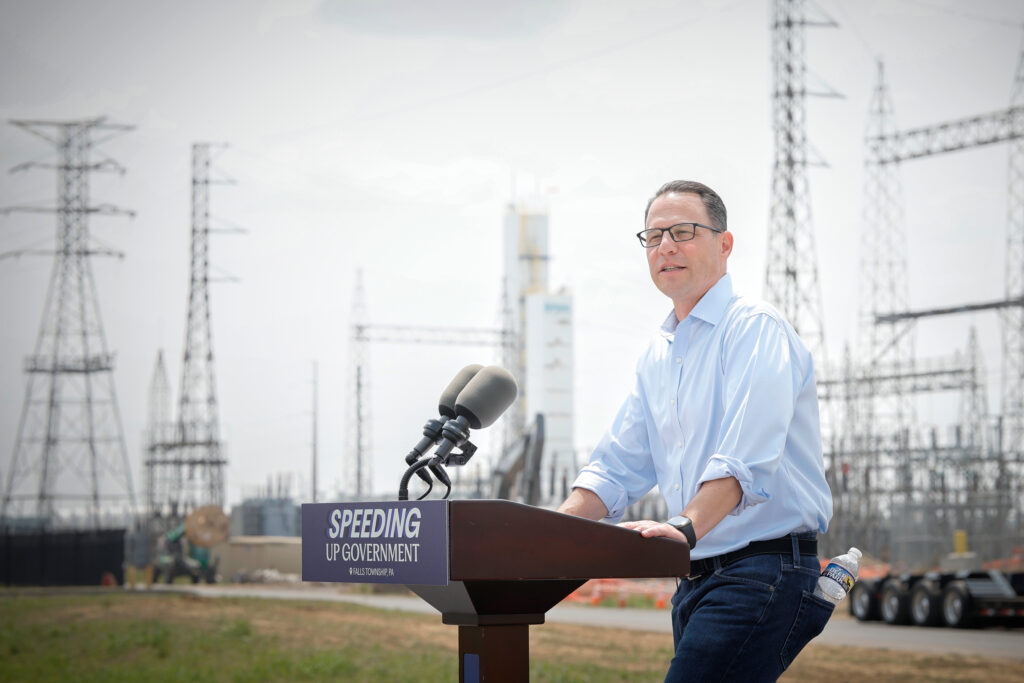
Among the reforms Shapiro has pushed for are state influence over who serves on PJM’s board, a faster and more streamlined process for approving new power projects in PJM’s queue and changes to its capacity market.
“If PJM refuses to change, we will be forced to go in a different direction,” Shapiro said in September.
Shapiro filed his complaint against PJM in 2024 over its price hikes. The settlement reached in January 2025 lowered the capacity auction price cap by 35 percent. Shapiro said that the deal would save electricity consumers more than $21 billion over the next two years.
“The Shapiro administration can and should point to the extension of the price cap that is part of this plan as a big win that honestly wouldn’t have happened without them,” Corby said.
Affordability issues are likely to play a key role in the elections this fall, and Shapiro recently announced his campaign for reelection. In his first campaign speech in Philadelphia, Shapiro said “we’ve got to hold those companies that are trying to raise our electric bills accountable.”
Some residents have criticized the governor for his support for building more data centers in the state, arguing it’s at odds with his focus on affordable energy bills. Artificial intelligence is fueling the enormous spike in electricity demand that has sent prices skyrocketing.
Politicians like Shapiro, facing pressure from energy companies, tech corporations, labor unions and members of the public who are angry about their bills, may find it increasingly difficult to manage these competing demands. “I’m not sure that at the end of the day, they can have their cake and eat it too,” Masur said.
Yesterday, elected officials held a rally in Pittsburgh denouncing the Trump administration for its failure to lower energy costs for consumers.
“Donald Trump promised working people he would cut energy bills in half, yet what families got instead was a coordinated assault by him and congressional Republicans on the clean energy investments that lower costs, create good union jobs and protect our future,” said U.S. Rep. Summer Lee (D-Pa.), in a press release about the event.
Masur said the governors’ proposal was taking one step forward and one step back. Progress on the fundamental problem of PJM’s unapproved backlog of electricity projects would be key.
“Advocates have been flagging it for years that there’s a train coming down the track, and we can all see it coming,” and PJM hasn’t done anything about it, he said. “If we could put a man on the moon 60 years ago, PJM should be able to figure out how to get these projects moving rapidly out of their queue.”
Corby agreed with Masur’s assessment.
“This alone is not going to be enough,”Corby said. “We need structural reforms at PJM.”
Inside Climate News’ Dan Gearino contributed to this report.
About This Story
Perhaps you noticed: This story, like all the news we publish, is free to read. That’s because Inside Climate News is a 501c3 nonprofit organization. We do not charge a subscription fee, lock our news behind a paywall, or clutter our website with ads. We make our news on climate and the environment freely available to you and anyone who wants it.
That’s not all. We also share our news for free with scores of other media organizations around the country. Many of them can’t afford to do environmental journalism of their own. We’ve built bureaus from coast to coast to report local stories, collaborate with local newsrooms and co-publish articles so that this vital work is shared as widely as possible.
Two of us launched ICN in 2007. Six years later we earned a Pulitzer Prize for National Reporting, and now we run the oldest and largest dedicated climate newsroom in the nation. We tell the story in all its complexity. We hold polluters accountable. We expose environmental injustice. We debunk misinformation. We scrutinize solutions and inspire action.
Donations from readers like you fund every aspect of what we do. If you don’t already, will you support our ongoing work, our reporting on the biggest crisis facing our planet, and help us reach even more readers in more places?
Please take a moment to make a tax-deductible donation. Every one of them makes a difference.
Thank you,

Marianne Lavelle
Bureau Chief, Washington, D.C.
Marianne Lavelle is the Washington, D.C. bureau chief for Inside Climate News. She has covered environment, science, law, and business in Washington, D.C. for more than two decades. She has won the Polk Award, the Investigative Editors and Reporters Award, and numerous other honors. Lavelle spent four years as online energy news editor and writer at National Geographic. She spearheaded a project on climate lobbying for the nonprofit journalism organization, the Center for Public Integrity. She also has worked at U.S. News and World Report magazine and The National Law Journal. While there, she led the award-winning 1992 investigation, “Unequal Protection,” on the disparity in environmental law enforcement against polluters in minority and white communities. Lavelle received her master’s degree from Columbia University Graduate School of Journalism, and is a graduate of Villanova University.

Kiley Bense
Reporter, Pennsylvania
Kiley Bense covers climate change and the environment with a focus on Pennsylvania, politics, energy, and public health. She has reported on the effects of the fracking boom in Pennsylvania, the expansion of the American plastics industry, and the intersection of climate change and culture. Her previous work has appeared in the New York Times, the Atlantic, Smithsonian Magazine, the Believer, and Sierra Magazine, and she holds master’s degrees in journalism and creative writing from Columbia University. She is based in Pennsylvania.