

In the midday hours, prices plummet. An excess of energy produced across Texas, largely due to the state’s solar and wind fleet, signals it’s a good time to buy. It’s then that 500 batteries, which once fueled General Motors’ electric vehicles, charge up.
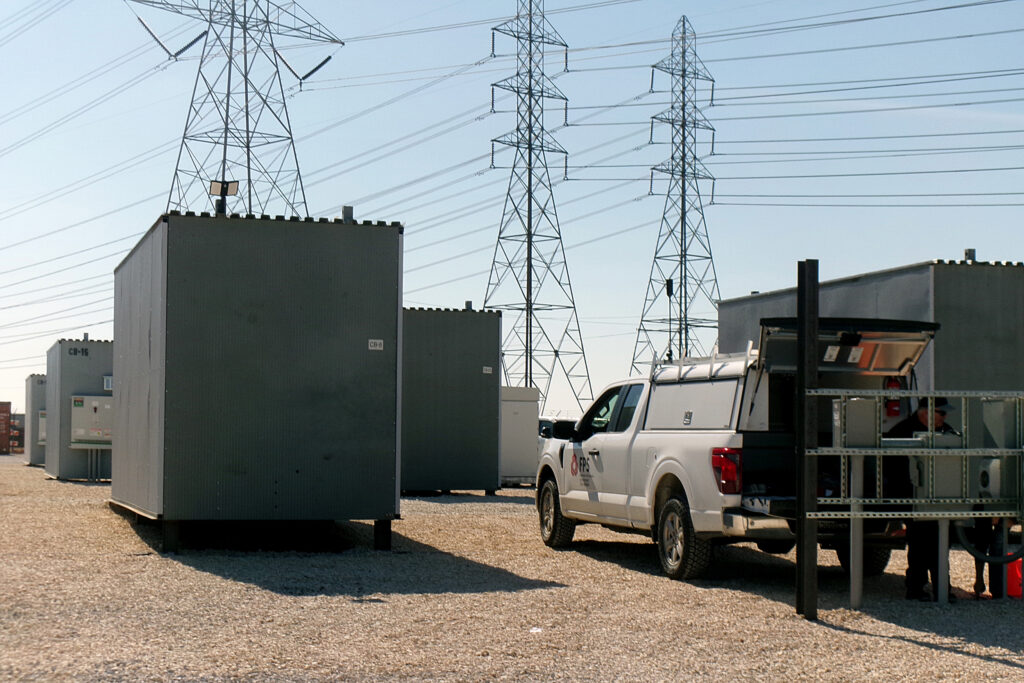
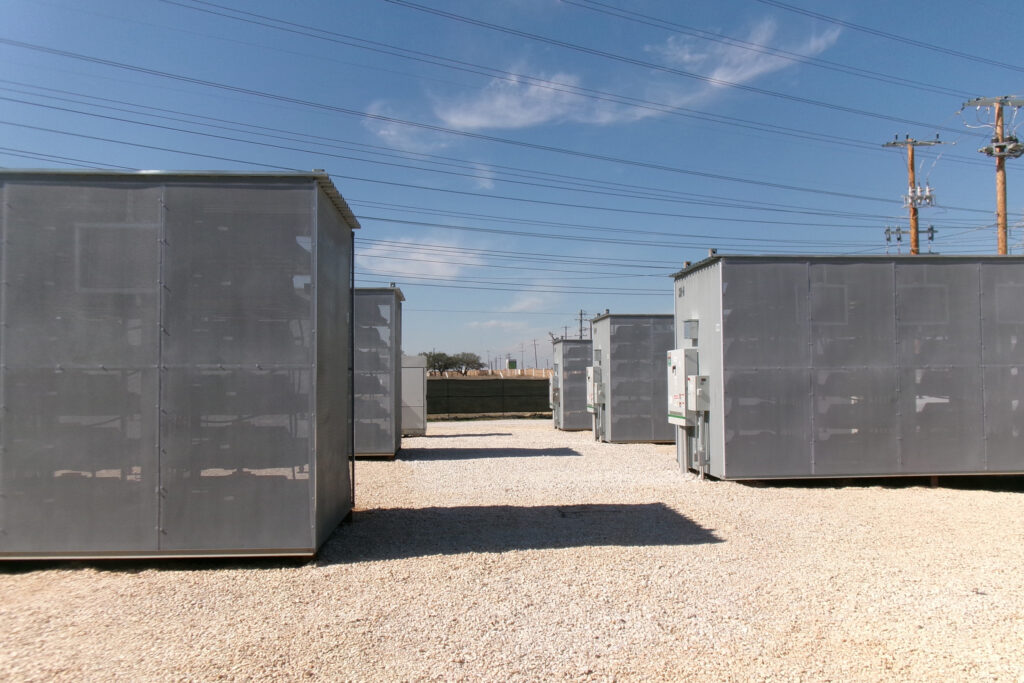
The batteries, now in their second careers, are kept in staggered steel mesh containers, powered by electricity sent across miles and miles of transmission lines until it reaches a site just east of San Antonio.
Then, as renewable energy production across the state dips as night rolls into morning and Texas begins to draw more energy from dispatchable fossil fuels, these retired EV batteries can sell power back to the state’s electric grid when the price fits.
The 24 megawatt-hour battery project is the first site online in Texas for B2U Storage Solutions, a California-based company. The firm plans to get three more battery sites connected to the Texas grid, bringing the total capacity to 100 megawatt hours of storage across Texas. The company estimates it’s enough energy to power some 3,300 homes for a day.
The site near San Antonio will interconnect to the CPS Energy distribution system, one of the nation’s largest city-owned utility companies.
The way B2U engineered its cabinets allows the batteries to be deployed in a storage system as they came from the carmaker, in a “plug-and-play” fashion. The company’s battery systems are brand agnostic, able to incorporate Nissan, Honda, Tesla or Ford electric vehicle batteries. B2U is able to do so for well under $200 per kilowatt hour, said Freeman Hall, co-founder and CEO. The global average price for a turnkey battery energy storage site is around $117 per kwh, and in the U.S., it’s closer to $219 per kwh, according to a December 2025 BloombergNEF report.
“This is super scalable,” Hall said. “We designed them to be very safe, very effective, but cost effective, too.”
Some analysts aren’t so starry-eyed about the economic viability of an industry centered around second-life grid applications for EV batteries.
George Hilton, a senior renewables analyst at S&P Global Energy, said for the reuse market to take off, it has to compete with easier and cheaper options, such as recycling the batteries or exporting the used cars to emerging EV markets.
Hilton said reusing batteries is more complicated than recycling or exporting them, which makes it harder for companies to grow and expand their operations quickly.
“This has been a very strong barrier to growth for second life battery companies and is much of the reason why we have not seen much growth in this area to date,” Hilton said.
Also, given the plunge in battery cell prices due to a maturing manufacturing sector, there’s little economic incentive to try to repurpose end-of-life EV cells for storage, said Henrique Ribeiro, a clean technologies and supply chains analyst at S&P Global Energy. Newer batteries designed for grid storage have longer life cycles than those developed years ago for EVs and make them much less competitive, Ribeiro said, even if their cost is lower.
All that said, there’s no critical challenge to repurpose EV cells for storage, Ribeiro said. It’s just that the market has been mostly limited to pilot projects.
That is except for a few notable players. There’s B2U, and another California-based company, Element Energy, which began storing electricity using 900 second-life EV batteries within ERCOT last year.
Another large market member is Redwood Materials, which was first founded by a former Tesla technology executive to recycle EV battery materials into the domestic supply chain. In 2025, the company entered the nascent second-life grid storage space under Redwood Energy. Since then, Redwood has built a 12 MW and 63 MWh capacity microgrid powering a data center near Reno, Nev., for artificial intelligence company Crusoe.
The battery storage site using retired EV batteries affords the AI infrastructure developer cheaper power than if it were to buy it from the grid, according to Redwood.
The B2U project comes as Hall and other storage and energy providers look to earn money by addressing the demand for additional capacity on Texas’ electric grid, operated by the Electric Reliability Council of Texas (ERCOT). Most battery storage sites mostly participate in ERCOT’s day-ahead market, offering to sell energy the next day, and to provide ancillary services to the grid, helping grid operators curb frequency deviations and imbalances.
Batteries have made significant capacity contributions within ERCOT in recent years and have been credited with helping prevent summer and winter blackouts by bolstering grid reliability. The storage systems also bolstered the state’s energy supply which exceeded power demand during the recent Winter Storm Fern.
Many saw the days of freezing weather as a test: Whether grid operators and energy leaders had learned how to keep the grid going in tight winter conditions after the catastrophe of Winter Storm Uri, when battery storage barely existed within ERCOT.
There’s more than 16,000 MW of storage capacity within ERCOT, and another 600 MW planned to come online soon, according to the most recent resource adequacy report.
Equipment installed at B2U’s site allows the batteries to operate at a standard voltage and stay aligned, despite the different capacities of the repurposed electric vehicle batteries. That solved the issue of how to integrate batteries that vary in how quickly they’ll run out of juice, Hall said, while letting the company get the maximum effectiveness out of all of the batteries.
While most monitoring work at B2U is automated, an around-the-clock system operator can see an array of batteries represented by small tiles on the company’s internal dashboard. Green means good, red signifies something’s wrong. A popped fuse was responsible for one of the red blocks in January.
“You don’t have to touch the batteries very often,” Hall said. The company has operated battery systems for some five years and have only replaced a few batteries.
B2U manages more than 3,000 batteries across its California and Texas sites. The plan is to grow toward 30,000, then 300,000, then 3 million, Hall said. “Keep on adding zeroes.”
While some analysts are skeptical that the second-life industry can grow due to lack of economic incentive, others are bullish about old EV batteries being used on the grid. The technology is already engineered by a few market participants and is able to reduce mining of additional resources, they said.
Allison Feeney, a utility-scale energy storage research analyst at Wood Mackenzie, said the challenges facing this grid use concept seem to have been solved by some of the leading companies in the space. Namely, coordinating batteries from various manufacturers and getting the most of the batteries’ lifetimes to shorten the period before companies see a return on investment. “That opens up a lot of opportunities,” Feeney said.
But it’s still early days for these companies, Feeney said. “You can make all of these assumptions and run tests on how many cycles you can get, but I think it’s still to be proven.”
Regardless, these second-use grid storage applications allow for the mined materials in batteries to be used to the end of their useful life before they’re sent to be recycled, said BloombergNEF Senior Associate Andy Leach, who focuses on energy storage.
“From a climate perspective, you should always use something fully, in my opinion, before you recycle it,” Leach said. “Both reuse and recycling is going to reduce the impact of mining primary material … because every type of mining and extraction of natural resources has its downsides.”
While Leach projects that the U.S. energy storage market, growing with the rise of data centers, will be magnitudes larger than the battery reuse market, these small impacts can still prepare options for the future, he said.
“It may not be a really big industry in 2030 or 2035, but if companies and processes develop and improve, maybe in the 2040s—it might seem crazy to think about it, but it’s less than 15 years from now—these companies will grow and they’ll be well established and everything they’re doing now will help that learning,” Leach said.
One of the main concerns around the physical elements of storage projects is preventing thermal runaway, or when a battery overheats and triggers a feedback loop, which releases more energy and spikes temperatures. It can end in fires or explosions that can be difficult to extinguish.
This story is funded by readers like you.
Our nonprofit newsroom provides award-winning climate coverage free of charge and advertising. We rely on donations from readers like you to keep going. Please donate now to support our work.
Donate Now
Thermal runaway became more of a public concern following the Moss Landing fire last year, when an energy storage facility, some 20 miles south of Monterey, California, burned for several days and distributed a layer of heavy metals across the landscape. The cleanup is ongoing.
The steel mesh containers enclosing the retired electric vehicle batteries were designed to ensure that hydrogen gas can’t build up and explode, Hall said.
B2U’s first generation of storage systems were enclosed and used heating and air conditioning to control the temperature inside the cabinets, as extreme heat and cold can degrade batteries’ efficacy. But with the new mesh enclosure, B2U utilizes a liquid cooling solution throughout the storage systems that mirror those used in electric vehicles, to keep the battery packs cool.
Under safety standards for these storage facilities, companies like B2U have to fire test their sites. Essentially, the company works to set a cabinet of the repurposed EV batteries on fire and measures how far the heat spreads to see what would propagate around it.
At their Bexar County site, the heat radius is around 13-14 feet, Hall said, so they spread the cabinets 20 feet apart. They’ve also installed insulation stone for fire trucks to be able to easily access the site and to prevent weeds from growing near the cabinets, and installed infrared sensors to detect any thermal issues.
Another issue they’ve had to solve is security. As the value of copper has risen more than 30 percent throughout the past year, stealing has become a problem at power plants and at data center facilities. The metal is used largely for the wiring needs of the equipment and for transmission lines.
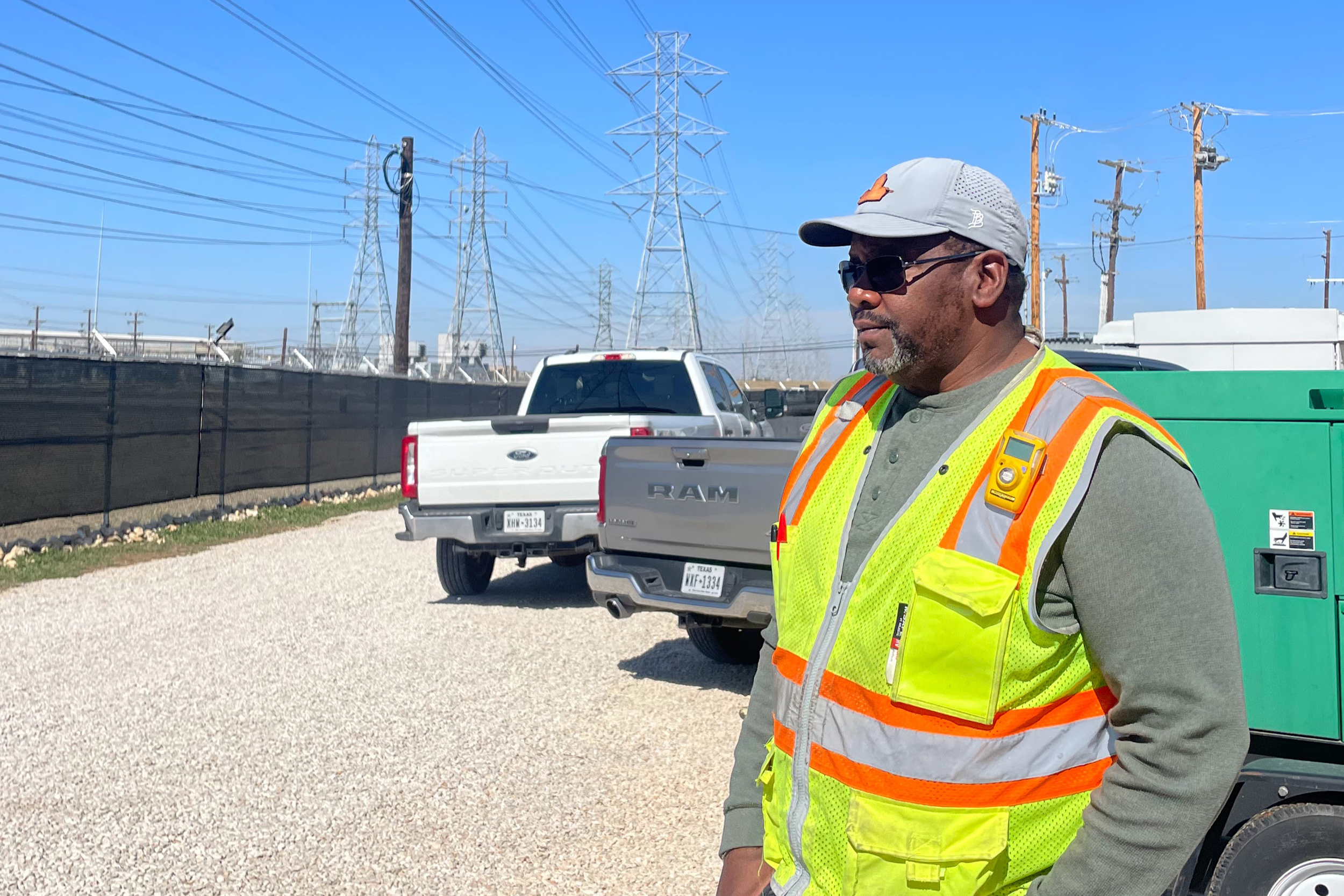
Joao Domingos, the site’s project manager, had motion cameras installed at each corner of the lot and gets called if it’s triggered after hours—which has happened a handful of times, he said, especially while the project was under construction. Once the site is built and the copper is buried beneath the ground or strung high above, Domingos said, it’s a much riskier theft.
Originally, Hall believed they could get another seven or eight years out of these used batteries, offering another application before the batteries are stripped for parts and begin the recycling process. He now thinks the original number is conservative. Some estimates suggest EV batteries could see up to 15 years in repurposed applications, he said.
The firm owns the land along U.S. Route 87, a highway full of industrial truckers heading south toward Port Lavaca. When one battery, or a cabinet storing a handful of batteries, needs exchanging, they’ll be able to swap it in with little trouble, Hall said.
“Our whole view is that once you plug into the grid system, this site will operate for a long time,” Hall said.
About This Story
Perhaps you noticed: This story, like all the news we publish, is free to read. That’s because Inside Climate News is a 501c3 nonprofit organization. We do not charge a subscription fee, lock our news behind a paywall, or clutter our website with ads. We make our news on climate and the environment freely available to you and anyone who wants it.
That’s not all. We also share our news for free with scores of other media organizations around the country. Many of them can’t afford to do environmental journalism of their own. We’ve built bureaus from coast to coast to report local stories, collaborate with local newsrooms and co-publish articles so that this vital work is shared as widely as possible.
Two of us launched ICN in 2007. Six years later we earned a Pulitzer Prize for National Reporting, and now we run the oldest and largest dedicated climate newsroom in the nation. We tell the story in all its complexity. We hold polluters accountable. We expose environmental injustice. We debunk misinformation. We scrutinize solutions and inspire action.
Donations from readers like you fund every aspect of what we do. If you don’t already, will you support our ongoing work, our reporting on the biggest crisis facing our planet, and help us reach even more readers in more places?
Please take a moment to make a tax-deductible donation. Every one of them makes a difference.
Thank you,

Arcelia Martin
Reporter, Texas Renewables
Arcelia Martin is an award-winning journalist at Inside Climate News. She covers renewable energy in Texas from her base in Dallas. Before joining ICN in 2025, Arcelia was a staff writer at The Dallas Morning News and at The Tennessean. Originally from San Diego, California, she’s a graduate of Gonzaga University and Columbia University Graduate School of Journalism.