

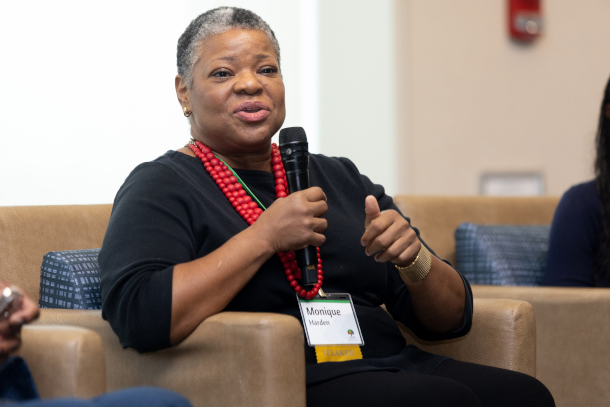
From our collaborating partner Living on Earth, public radio’s environmental news magazine, an interview by Paloma Beltran with Monique Harden, an environmental justice lawyer and advocate in New Orleans.
For generations, African American and other communities of color have been exposed to higher levels of pollution from landfills, chemical plants and highways.
While the majority of the 300,000 or more Americans who die every year from burning gas, oil and coal are white, the National Academy of Sciences has found that Black people are exposed to 66 percent more pollution than they produce, while white people are exposed to 17 percent less pollution than they create.
As sociologist Dr. Robert Bullard, one of the architects of the environmental justice movement, has said, “America is segregated and so is pollution.”
In 1979, Bullard started to document this history of contamination and the placement of especially dirty dumps and industry closer to brown people and farther from white people as facts for lawsuits. And in 1982, Civil Rights activist the Rev. Dr. Ben Chavis—credited with coining the term “environmental racism”—led the fight against the dumping of PCBs near Black neighborhoods in Warren County, North Carolina.
For years, research has documented the disproportionate impact on people of color of environmental risks such as toxic exposure, the urban heat island effect and other dangers from the climate emergency. In 2021, protests and social concerns finally spurred the Biden Administration and Congress to allocate billions of dollars to remediate the short-changing of environmental protections in underserved communities.
But that ended under the Trump administration. Likening the Biden-era environmental justice policies to reverse discrimination, the Environmental Protection Agency has now cut grants and rolled back regulations designed to improve environmental quality in both white and Black communities. Among the hardest hit are African American enclaves, like those along the highly industrialized Cancer Alley in Louisiana.
Monique Harden is an environmental justice lawyer and advocate in New Orleans. This interview has been edited for length and clarity.
PALOMA BELTRAN: Environmental justice is facing a tough time right now across the United States. How can people in the U.S hold polluters accountable at a time when the federal government is dismantling environmental enforcement and regulations?
HARDEN: People should first take a breath: You can have some really positive outcomes in terms of community health, in terms of environmental justice, with this current administration, which is really ripping some of the guardrails that were expected for environmental consideration.
One area to bring focus to is what can be done at local, county and, perhaps, state levels of government. You can have a state issue a pollution standard that’s more stringent, more protective than a federal standard. You can have a land use decision from a parish government to deny turning a residential or an agricultural zone into one for heavy industrial development—polluting facilities.
Bringing the fight to areas of government where there might be opportunities to achieve environmentally just results is an important thing to do, because each victory that can be achieved can be looked at when the opportunity comes again for new federal standard setting.
BELTRAN: President [Donald] Trump has called environmental justice reverse discrimination. What’s your take on that issue?
HARDEN: This is an administration that wants to promote racism. People around the country have and are rejecting that, whether it’s environmental justice or other issues; people are organizing and making a difference with their local leaders.
BELTRAN: You’re an attorney, and a lot of your career has focused on environmental justice. How did you get involved in this work?
HARDEN: I always saw communities as a place for enjoyment: people coming together, sharing experiences, stories, looking out for each other. As I grew into adulthood, I knew that I wanted to be a lawyer. I wanted to work for justice, having an opportunity as a law student to work on environmental issues and seeing the racial disparities that were just blatant. It was just jarring to see folks suffering every day from pollution and having no voice in the decision that placed that toxic smokestack, toxic industrial facility in their midst.
It was a very easy connection, seeing the thing that I love about communities really being attacked by decisions that allowed this kind of heavy, toxic industrial growth and pollution to be present in a way that is life-destroying.
One of my first cases, in 1996, was a proposal by a Japanese-owned petrochemical company called Shin-Etsu to build what they were touting to be the world’s largest polyvinyl chloride complex; the name that they gave it was Shintech. It was planned for the town of Convent, Louisiana, in St. James Parish.
I learned the importance of community organizing, the way in which my skill as a lawyer could be applied in a way that strengthened the voice of people to have a decision-making role in what would affect their lives and their futures and generations to come, and being able to use the law in a way that it may not have been designed, which is recognizing the right of Black people to live in a healthy environment.
This story is funded by readers like you.
Our nonprofit newsroom provides award-winning climate coverage free of charge and advertising. We rely on donations from readers like you to keep going. Please donate now to support our work.
Donate Now
BELTRAN: You live in Louisiana, not far from what is known as Cancer Alley. What is Cancer Alley, and why is it considered ground zero in the fight for environmental justice in the United States?
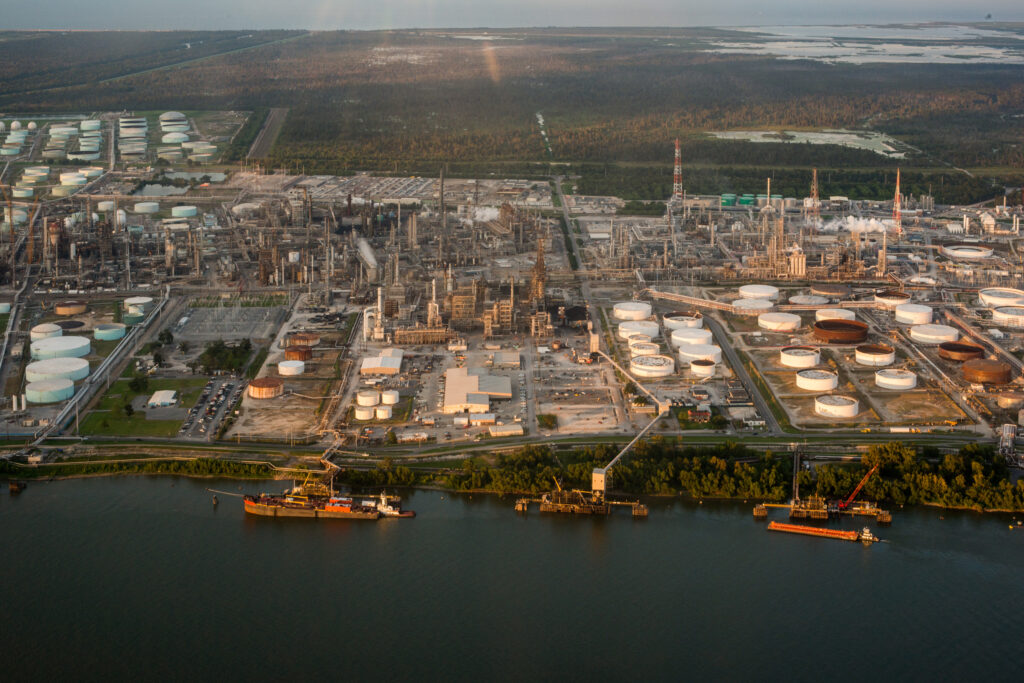
HARDEN: I live in the city of New Orleans, which is in Cancer Alley. It’s a section of the Mississippi River chemical corridor that begins just north of Baton Rouge and tracks the Mississippi River down to where it flows out into the Gulf of Mexico. Along this stretch of the river, on the land that abuts it, you’ll find over 200 petrochemical industrial facilities.
In the midst of those towering smoke stacks are historic African American communities that were founded—some before the Civil War, many soon after the war—as safe havens for Black families to live and have a place that they could call home. With federal, state and local government decisions, our communities have become the targets of industrial development, beginning in the late 1930s and continuing to this day. Cancer Alley is the name that communities that organize themselves around environmental justice have put to it because of the health-damaging effects of huge amounts of toxic pollution spewed from these industries.
BELTRAN: There is a case involving St. James Parish, which is being sued because an overwhelming number of the petrochemical facilities there are located in majority-Black districts. How can land-use decisions be a friend or foe of environmental justice communities?
HARDEN: The case is an extremely important one that brings attention to environmental justice.
Before there’s a permit issued, there has to be land use approved for that industrial facility. If you don’t have a sense of local governance that regards all communities fairly and with dignity, you can best believe that communities of color will be on the menu for toxic industrial development.
The Center for Constitutional Rights and Tulane Environmental Law Clinic (representing the community groups of Rise St. James and Inclusive Louisiana) have looked at decades of decisions by the St. James Parish government approving land use that may have been residential at one point, but now they’ve been designated as heavy industrial, where the neighbors are residents living in homes.
Time and time again, those neighbors are Black residents, Black families. Holding the St. James Parish government to account on using Constitutional protections is where that lawsuit is. It’s really looking at whether or not Black communities have the right to not be discriminated against in land-use decisions.
BELTRAN: There are, of course, a number of other lawsuits filed across Cancer Alley. What are some of those lawsuits? What are they fighting against?
HARDEN: They’re fighting for a healthy future, health and safety. Human dignity is central to that, and freedom from racial discrimination, because there’s such a disparity in terms of who bears the severest burden of pollution in Louisiana’s Cancer Alley. Like much of the United States and other parts of the world, it’s people of color. It’s African American, African descendants, other people of color and Indigenous people who are bearing these serious environmental burdens and climate impacts.
BELTRAN: They’ve taken this all the way to federal court, so that’s a huge struggle.
HARDEN: It’s a huge struggle, but it’s an important one to have. Victory in that lawsuit would mean victory for a lot of communities where land-use decisions are made without regard to their health and safety and their wellness. The precedent-setting effect of that can have national importance for everyone.
BELTRAN: Why is it important for Black Americans to understand and protect their history here in the United States, and how can that be a tool for healing?
HARDEN: It’s important to understand history because it means that you have a sense of what your future could be. Knowing the history around environmental justice is moving us toward, I think, with some urgency, climate solutions.
If environmental justice was taken seriously 50 years ago, would we have this climate crisis today? The decisions that got us into this were decisions that did not value people, did not respect human dignity or human rights. That means our solutions have to be really wrapped around human rights and dignity and a sense of how special future generations are and that there’s something we do today that affects them forever.
Black history is extremely important, because it gives you a guidebook around how to do things better today. Maybe it was childhood asthma, or maybe it could have been a climate disaster and a slow recovery that forced, or was a factor in, moving away from a neighborhood or a place where that disaster happened. These are all signs of environmental injustice and so it’s about our survival to be able to, number one, be aware of this, and number two, organize to change it.
About This Story
Perhaps you noticed: This story, like all the news we publish, is free to read. That’s because Inside Climate News is a 501c3 nonprofit organization. We do not charge a subscription fee, lock our news behind a paywall, or clutter our website with ads. We make our news on climate and the environment freely available to you and anyone who wants it.
That’s not all. We also share our news for free with scores of other media organizations around the country. Many of them can’t afford to do environmental journalism of their own. We’ve built bureaus from coast to coast to report local stories, collaborate with local newsrooms and co-publish articles so that this vital work is shared as widely as possible.
Two of us launched ICN in 2007. Six years later we earned a Pulitzer Prize for National Reporting, and now we run the oldest and largest dedicated climate newsroom in the nation. We tell the story in all its complexity. We hold polluters accountable. We expose environmental injustice. We debunk misinformation. We scrutinize solutions and inspire action.
Donations from readers like you fund every aspect of what we do. If you don’t already, will you support our ongoing work, our reporting on the biggest crisis facing our planet, and help us reach even more readers in more places?
Please take a moment to make a tax-deductible donation. Every one of them makes a difference.
Thank you,