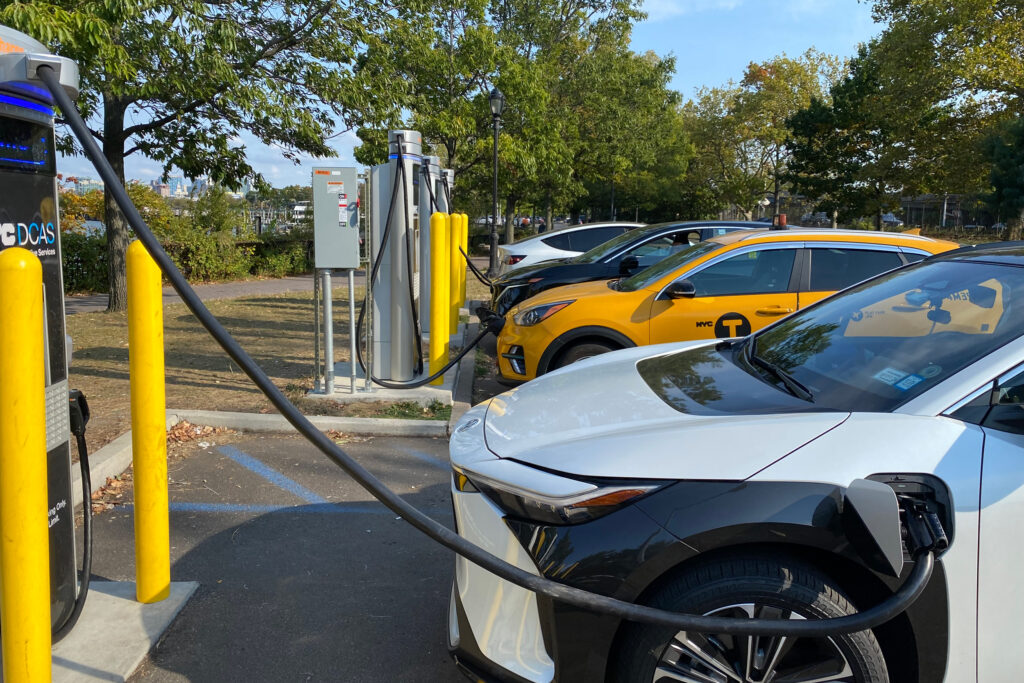


A budget bill moving through Congress this week would defund a 5-year-old program designed to expand electric-vehicle charging stations.
The National Electric Vehicle Infrastructure, or NEVI, program got off to a slow start and had spent only a small share of its budget when the Trump administration took office a year ago and sought to claw back funding.
Now, NEVI is facing a $500 million reduction, part of a larger package totaling about $900 million in proposed cuts related to electric transportation. This would be a major step back for EV charging, but it’s an afterthought in a budget debate that has been more about immigration enforcement rules and avoiding a government shutdown.
At the same time, state governments and environmental groups have succeeded so far in their push to use the courts to unfreeze funding the government has already committed to states, including a Jan. 23 ruling in U.S. District Court in Washington State. But the bill would negate some of the effects of the ruling.
The gutting of NEVI would not be surprising given the Trump administration’s other actions to cut EV consumer subsidies, but it would be short-sighted in a world moving toward electrified transportation, according to states and organizations that want to preserve funding.
It’s also a blow to states’ confidence in the federal government to live up to basic commitments, said Corrigan Salerno, policy manager for Transportation for America, an advocacy group that works for sustainable transportation investments.
“This is the kind of cut that really undermines the trust that should be there,” he said.
Last week, the U.S. House passed an appropriations bill that cuts funding for NEVI and reallocates the money for other transportation uses. This was part of a measure that covers funding for transportation, housing and urban development for the fiscal year that began last October. The government was running on a stopgap measure agreed to in November, after a 43-day government shutdown.
The Senate on Friday passed a version of the bill as part of a larger agreement to prevent another government shutdown.
Now, the bill is back in the House to consider the Senate’s changes, but the language defunding NEVI remains unchanged. House Speaker Mike Johnson (R-La.) said on Sunday that he expects to hold votes as soon as Tuesday.
Rep. Steve Womack (R-Ark.), the chairman of the subcommittee that drafted the transportation budget, said in a statement that the bill “reflects a deliberate shift away from bloated bureaucracy and refocuses taxpayer dollars on priorities that matter to the American people—safety, mobility, economic growth, and housing affordability.”
In the same news release, Womack’s office said the bill redirects $2.3 billion in “wasteful Democratic priorities” to instead “invest in safety and improve the movement of freight and the traveling public.”
The NEVI program was designed to provide about $5 billion, spread over five years, to expand EV charging accessibility, as part of a significant increase in federal support to ease the transition to EVs. It was part of the bipartisan Infrastructure Investment and Jobs Act signed by President Joe Biden in 2021.
But various delays meant it took more than two years for the first federally funded charging station to open, which happened in December 2023 in Ohio. As of a year ago, there were only 57 NEVI-funded stations in operation, according to a report issued by Congress last summer. Estimates vary about the current number.
The Trump administration said in a letter in February 2025 that it was rescinding all prior and future funding for NEVI programs. This sent shockwaves through state governments that had established processes for using the money and had already spent some of it.
Environmental groups and 17 state governments sued the Trump administration to unfreeze the funds that the government had already promised. Last week, a U.S. District Court judge in Washington State ruled in favor of the states, allowing the NEVI spending to continue.
Judge Tana Lin, appointed by Biden, said the Trump administration’s conduct was capricious and “simply not how things are lawfully done.”
But the ruling’s effect will likely be undercut by the budget bill in Congress, according to Salerno of Transportation for America.
“The administration played a dirty game with Congress here, making sure that states couldn’t spend down their money, and held that money hostage for long enough such that Congress could eventually take it and re-appropriate those funds for new priorities,” Salerno said. “It’s really unfortunate to see the confidence undermined in what’s supposed to be a bipartisan negotiated infrastructure law.”
About This Story
Perhaps you noticed: This story, like all the news we publish, is free to read. That’s because Inside Climate News is a 501c3 nonprofit organization. We do not charge a subscription fee, lock our news behind a paywall, or clutter our website with ads. We make our news on climate and the environment freely available to you and anyone who wants it.
That’s not all. We also share our news for free with scores of other media organizations around the country. Many of them can’t afford to do environmental journalism of their own. We’ve built bureaus from coast to coast to report local stories, collaborate with local newsrooms and co-publish articles so that this vital work is shared as widely as possible.
Two of us launched ICN in 2007. Six years later we earned a Pulitzer Prize for National Reporting, and now we run the oldest and largest dedicated climate newsroom in the nation. We tell the story in all its complexity. We hold polluters accountable. We expose environmental injustice. We debunk misinformation. We scrutinize solutions and inspire action.
Donations from readers like you fund every aspect of what we do. If you don’t already, will you support our ongoing work, our reporting on the biggest crisis facing our planet, and help us reach even more readers in more places?
Please take a moment to make a tax-deductible donation. Every one of them makes a difference.
Thank you,

Dan Gearino
Reporter, Clean Energy
Dan Gearino covers the business and policy of renewable energy and utilities, often with an emphasis on the midwestern United States. He is the main author of ICN’s Inside Clean Energy newsletter. He came to ICN in 2018 after a nine-year tenure at The Columbus Dispatch, where he covered the business of energy. Before that, he covered politics and business in Iowa and in New Hampshire. He grew up in Warren County, Iowa, just south of Des Moines, and lives in Columbus, Ohio.