

New wind projects could be coming to Northern Maine–just not new power.
The Maine Public Utilities Commission (PUC) has released a final Request for Proposals (RFP) for up to 1,200 MW of new onshore wind or other renewable generation—enough to power nearly 450,000 homes—plus a new transmission line to carry that power to southern Maine and New England.
Maine has been trying for years to build new renewable generation in its most remote northern counties, Aroostook and Washington, an area with enormous potential wind and biomass resources but one that, due to a historic quirk of grid architecture, is electrically disconnected from the rest of New England.
With the effort facing headwinds ranging from a hostile presidential administration to local opposition to transmission, the destination for the power could become the thorniest issue of all.
The current RFP is the second time the PUC has put this proposal out to bid since Maine passed a law directing it to do so in 2021. Although the PUC selected winning bidders in early 2023, that effort fell apart amid disagreements with the transmission developer over the cost and route of the proposed transmission line.
Former Maine Senate President Troy Jackson, who represented the northern half of Aroostook County until 2024 and is now running in the Democratic primary to be Maine’s next governor, was a key sponsor of the 2021 legislation. Jackson told Inside Climate News that he chose not to require that his district share in the power, because he didn’t want to include “anything that becomes a poison pill” in an effort that was already likely to be controversial.
Aroostook County and much of Washington County—for simplicity, “Northern Maine”—are unique among New England regions in not being part of the New England transmission grid. They have no current direct physical connection to it and are not within the jurisdiction of the regional transmission operator, ISO-New England.
Instead, the Northern Maine Independent System Administrator (NMISA) oversees local transmission and coordinates with the New Brunswick Power grid operator to balance load in the region. Generators in Northern Maine can send power to New England through New Brunswick and vice versa—a practice known as wheeling—but the additional transmission costs tend to be prohibitive.
The proposed transmission line would bring the region one step closer to joining New England electrically. But because that line will only carry power in one direction, it will not on its own lead to full integration or provide new power to Northern Maine
Jackson and other backers have focused on the economic benefits the project would bring to an area with unemployment rates among the highest in Maine and average household income among the lowest. Those benefits, they say, include jobs, funding for government services and perhaps even property tax relief. Yet electricity prices are for many an even hotter topic than jobs or taxes.
Average household electricity bills in much of the region have increased by at least 67 percent in the last 5 years and, after coming down some the last couple years, spiked again this month. Rates paid by manufacturing plants and other larger power consumers have also soared. A proposed data center in the region could further exacerbate these issues.
In recent years, Northern Maine has obtained most of its electricity from New Brunswick Energy Marketing, a private energy broker arm of the New Brunswick Power Corporation (NBP)—a utility owned by the Canadian province of New Brunswick.
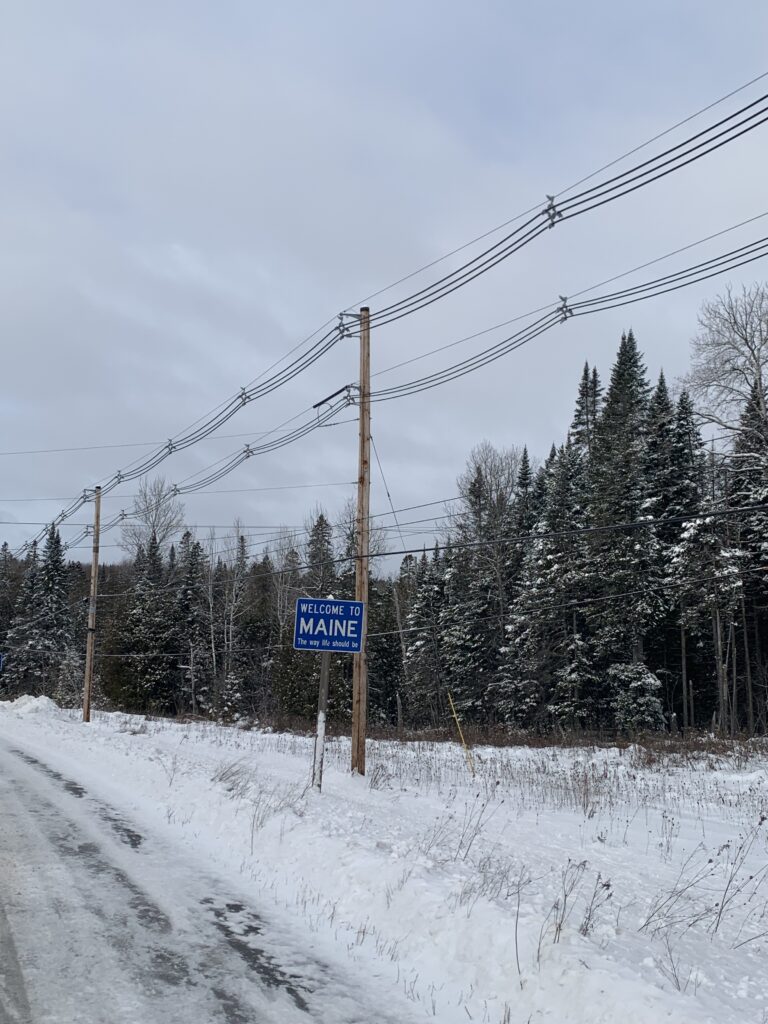
A recent surge in distributed solar generation means Northern Maine can now produce enough power to exceed demand on the sunniest of days—leading the country in the ability to supply peak demand with distributed solar power, according to Versant, the local utility. But at other times, the region gets most of its power from New Brunswick.
That fact ruffles some local feathers. “I don’t particularly like getting our power from Canada,” Aroostook County Administrator Ryan Pelletier told ICN. “Because you’re beholden to another entity that you have absolutely no political influence or negotiation power with.”
As tensions between the U.S. and Canada have grown over the past year due to President Donald Trump’s tariffs and talk of making the entirety of Canada a 51st state, public speculation about New Brunswick cutting off that power as a bargaining chip in a potential trade war has only heightened those concerns.
A Potential Wind Powerhouse
Northern Maine has the consistent winds, wood waste from timber and paper operations and open space to sustainably meet more of its power needs. But with low levels of local demand and without additional transmission capacity to export power to New England, further development of those abundant resources has been stymied.
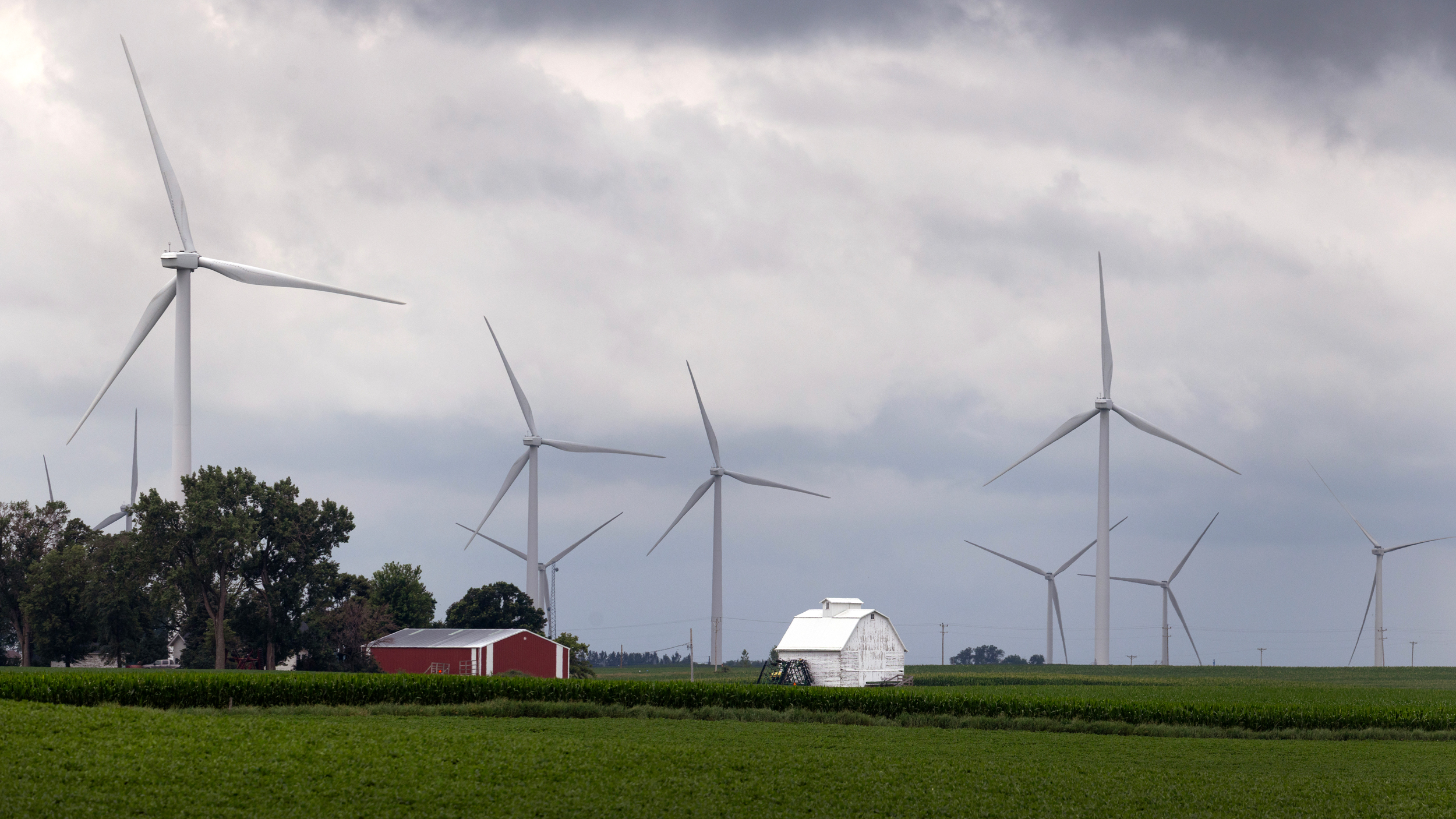
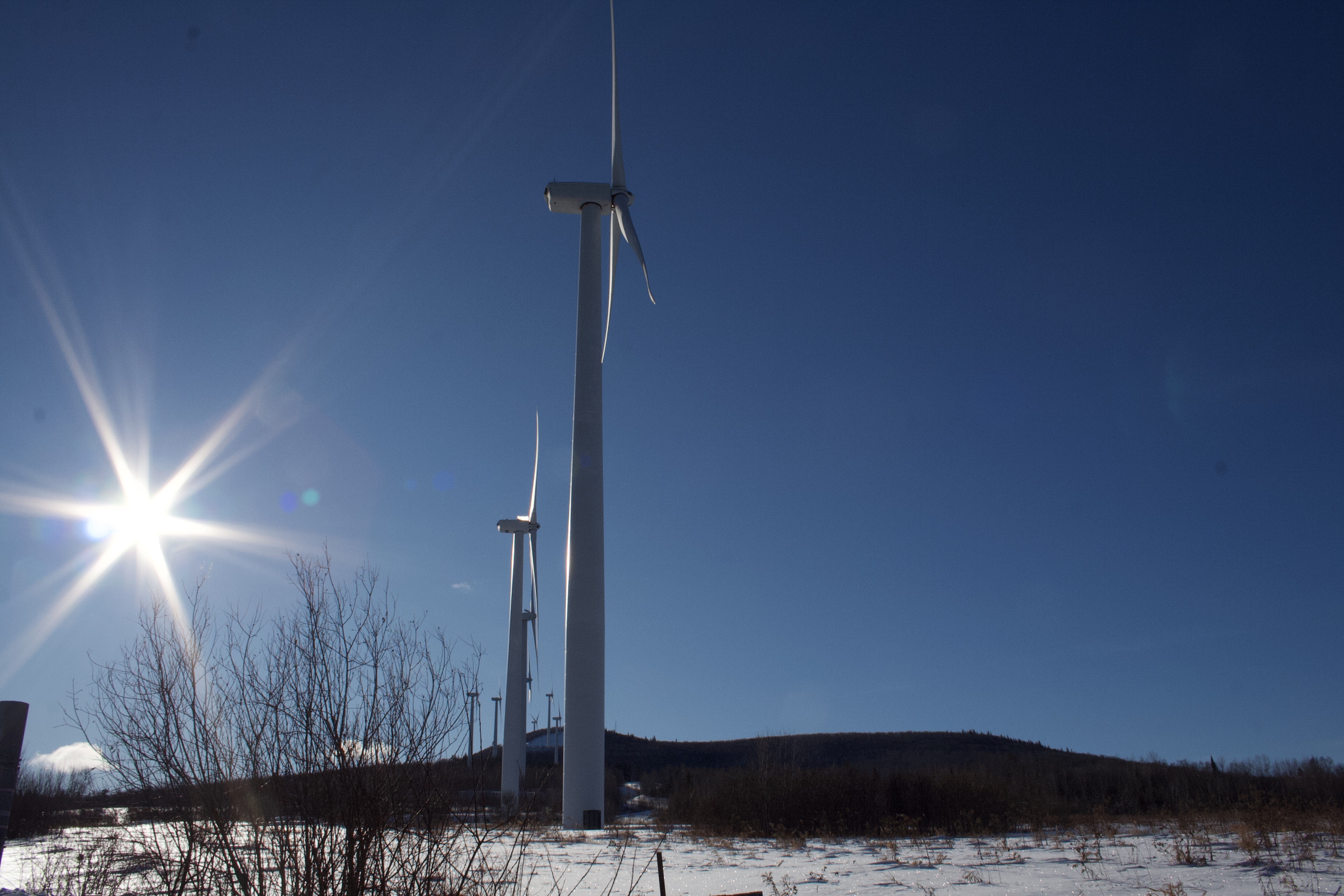
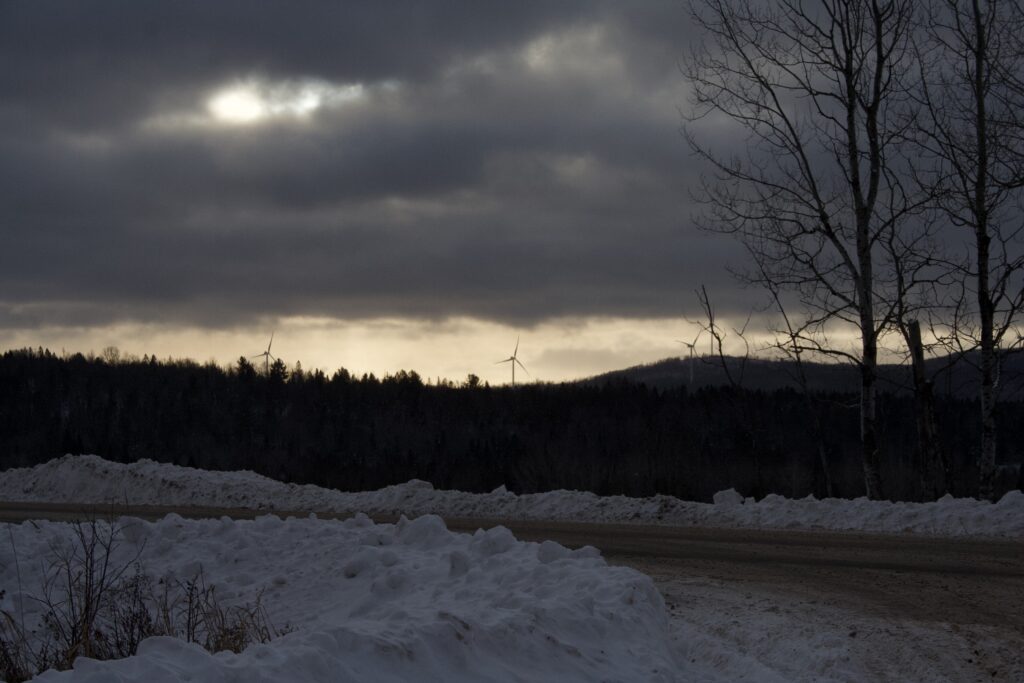
In 2023, the PUC selected a single massive wind farm on about 175,000 acres of timber land west of Houlton as the winning generation bid, though that selection was canceled along with the transmission line. Representatives for Longroad Energy, the developer of that “King Pine” project, told ICN they were reviewing the latest RFP and expect to prepare a new bid. Wind turbines are a familiar sight to locals; there are already several large installations in the southern part of the region, with a collective nameplate capacity of roughly 500 MW. All but the Mars Hill project, which sells its power to NBP, provide energy to the New England grid, feeding power into a transmission line running south from Canada.
However, generation is often “curtailed” at these plants—meaning they produce less power than they otherwise would—due to bottlenecks in the transmission system, said Francis Pullaro, president of RENEW Northeast, a nonprofit alliance of renewable energy companies and environmental nonprofits.
Over the years, developers have signed preliminary land leases, mostly with timber companies, to build several other large wind farms, including the aforementioned King Pine. But none of those projects got off the ground, hampered by the same transmission constraints as existing projects. That led to the current combined generation and transmission procurement.
Who Benefits?
Although environmental advocates tout the climate benefits of wind power, they have largely focused their arguments in support of this effort on energy affordability. “We’ve always seen Maine wind as being the least cost source of new generation of any type in New England,” Pullaro told ICN.
Heather Sanborn, in her role as Maine’s public advocate, is charged with representing the interests of ratepayers in PUC proceedings and told ICN that energy affordability is “a more salient concern these days than ever before.”
Although the transmission and generation developers selected through this process will rely on private financing for construction, ratepayers will eventually repay those costs via their utility bills. The question that Sanborn, and ultimately the PUC, will consider is whether the projects will unlock enough savings—for example, by generating cheaper power than existing sources and eliminating transmission bottlenecks—to outweigh those costs, as well as who bears the risk or potential rewards.
Sanborn said she is encouraged by the fact that, compared to the prior bidding round, “much more of what needs to be built in Maine will be regionalized in terms of the cost and shared amongst more of the New England states.”
That’s due to two factors: First, those states have pooled their resources to build transmission upgrades from Pittsfield, Maine, to southern New England in a parallel procurement led by ISO-NE, cutting off a chunk of the transmission line from what will be built via the PUC’s procurement. Second, Vermont, Rhode Island and Connecticut have joined Massachusetts and Maine in expressing interest in buying a portion of the new power generated via this project. If they do, they will share in the transmission costs north of Pittsfield as well.
That greater regional interest does mean that less power could ultimately be available for Maine utilities to purchase via long-term contracts, also known as power purchase agreements (PPAs). While no distribution of power purchase rights has been agreed to yet, PUC chair Phil Bartlett told ICN that there is no minimum amount of power Maine would need to reserve in order for the PUC to approve a project. “The directive is clear to get this line built. That is what the legislature wants to see. And we feel like we have flexibility in how to do that to maximize the benefit for Maine consumers,” Bartlett said.
That’s a problem for Jackson, the former Maine Senate president, who told ICN that in light of Trump’s multiple attempts to stymy offshore wind, he thinks Maine should try to hold onto all of the power from the project: “If our goal is to get to 100 percent renewable [energy], then I think we need to take all of this power, because it is going to be the cheapest power.”
Yet renewable energy and affordability experts alike told ICN that who “takes” the power via long term contracts matters less than the overall downward pressure large wind projects generate on wholesale electricity prices. “It’s not really true that there would be less benefit for Mainers if Massachusetts is on the hook for some of the PPAs. The price suppressive effects are operating separate from that at the wholesale level,” Sanborn said.
Jack Shapiro of the Natural Resources Council of Maine explained those effects: To balance supply and demand in real time, ISO-NE brings plants online in order from least to most expensive. With next to no marginal costs, renewables like solar and wind are typically the first to be brought online when the sun is shining and wind is blowing, so a large amount of new wind power can bump a costlier coal or gas plant out of this “stack” at many times throughout the year. This is especially valuable in winter when natural gas prices and wind speeds both tend to be higher than normal. Crucially, the price paid to the last plant brought online is the price to paid to all, and so these cost savings to all utilities in the region can be significant.
Long-term contracts do matter to a degree because, as Jackson pointed out, they can lock utilities who sign them into a price below or above this wholesale market price, with ratepayers realizing the savings or additional costs.
Grid Ties Will Have to Wait
Whatever this project’s impact on electricity prices in southern Maine and the rest of New England, it will likely not be felt by those living next to the new generation in Northern Maine.
Barry Hobbins, Maine’s public advocate at the time the 2021 law was proposed, urged the legislature to keep some of the power local: “There must be interconnection ‘off ramps’ to allow for the use of power generated in Aroostook County be accessible and utilized by the people of Aroostook County,” Hobbins testified.
And Jackson’s senate colleague Trey Stewart, who represents the Southern half of Aroostook County and is the current Senate minority leader, told ICN, “I was really hoping, when we do a big infrastructure build like this, that there would be an interconnection for [the Northern Maine Independent System Administrator] …and yet, that’s not what we have in front of us.”
Bartlett and Jackson both told ICN that whether fully integrating NMISA into ISO-NE would ultimately benefit local ratepayers was an open question in their minds, and in any case, not what the legislature directed via this procurement. It may be possible to build the sort of “off ramps” suggested by Hobbins or otherwise isolate a portion of a local generator’s power to supply Northern Maine without fully integrating into the New England grid; NMISA CEO Dwayne Conley told ICN he thought it was “theoretically” possible but would need to be studied by engineers. But the RFP makes it extremely unlikely that anything of the sort happens with this project: A footnote clarifies that no interconnection to Northern Maine is expected.
The Power Squeeze
Stewart, minority leader of the Maine Senate, is among those who sees an urgency in greater integration, or at least competition. “The Canadians have been absolutely screwing us on power,” he told ICN. “They generate hydro and coal across the border for the absolute lion’s share of what they have. And yet, when the natural gas market in New England started to spike, they stuck it to my constituents.”
“Our costs are tied to electricity supply costs in the Northeast,” New Brunswick Energy Marketing (NBEM) Executive Director Rob Gillies told ICN, adding “we always try to find the cheapest cost for our customers.”
Gillies said the electricity NBEM supplies to Northern Maine is a mix of surplus energy from New Brunswick Power and power purchased on the wholesale markets in the Eastern United States and Canada.
A stakeholder group of Northern Maine utility, businesses and government leaders convened by the Governor’s Energy Office in 2022 overwhelmingly identified “too much market power given to New Brunswick and Quebec which causes economic and technical risks to the NMISA territory” as a top concern and additional in-region generation as one potential solution.
Available data partially support these assertions. While overall household electric bills in much of Northern Maine increased by at least 67 percent from 2020 to 2025, the bulk of that increase was due to increased distribution and transmission charges. The price for electricity supply alone (known as the standard offer rate) increased by about 35 percent in this time, which is roughly equivalent to the overall increases in power prices in New Brunswick over the same period, according to an ICN analysis.
Yet it is true that precisely in the years that gas and oil prices spiked, from 2022-23, a much larger share of the power NBP supplied to Northern Maine came from gas and oil plants, according to public disclosures by the Maine PUC. Northern Maine standard offer ratepayers saw larger electricity supply cost increases in these years than New Brunswick ratepayers.
“We would never serve an export customer if it would negatively impact reliability or rates for New Brunswick customers,” Gillies said, but said he could not comment on the specific generation mix reported by the PUC.
Local Perceptions
Prices and turbines going up at the same time hasn’t sat well with residents of Aroostook County. “People are seeing their electricity bills go up and up and up, and meanwhile there are all these projects getting built and they’re not seeing any benefit from it,” Josh Davis, a resident of Monticello and substitute teacher, told ICN. Davis added that he supports wind power but felt that the state was “going about it the wrong way.”
Similarly, LaNiece Sirois, executive director of the Central Aroostook Chamber of Commerce, which convened a series of local discussions on energy in 2023, said she hears the question “‘why is it built here if [the power] is going to be shipped somewhere else?’” all the time from community members.
That skepticism is not universal. Pelletier told ICN he hopes Northern Maine one day gets a share of any new power but acknowledged that was not guaranteed or even likely with this project. Yet he said he supports the project anyway, based on the jobs, local tax revenues and community benefits package (mandated at $4,000 per wind turbine per year under state law) it would bring.
This story is funded by readers like you.
Our nonprofit newsroom provides award-winning climate coverage free of charge and advertising. We rely on donations from readers like you to keep going. Please donate now to support our work.
Donate Now
Locals who receive those community benefits often show support for wind power. Luke Nadeau is from the Town of Oakfield (home to the Oakfield wind farm) and still lives in Northern Maine; he told ICN that the $2,300 annual deduction in property taxes year-round Oakfield residents receive under an economic benefits agreement with the project’s developer was of huge help to his extended family, and that he supports further wind development.
The Election Ahead
The conversation about energy is about to get louder: 2026 is a significant election year in Maine, with races for governor, the U.S. Senate and U.S. House all predicted to be hotly contested. The PUC’s bidding process for this project will unfold right in the middle of those campaigns. Bids are due in late February and the PUC aims to select projects by the end of May.
Northern Maine makes up a small share of the electorate, but it is disproportionately represented in these elections. U.S. Senator Susan Collins is from Aroostook County and has supported local wind power in the past, though she has not weighed in on this current effort and her office did not respond to a request for comment. Her potential opponents vying for the Democratic nomination include current governor Janet Mills, who has supported the Northern Maine energy effort. And longtime project champion Troy Jackson is running in a crowded Democratic primary to replace Mills.
Recent state elections have proven the political salience of high energy costs, with Democrats able to successfully capitalize on the issue in 2025 after Republicans did so in 2024. In Maine, where the two parties have different prescriptions for getting power prices under control, “who gets the power?” could be a question that helps swing an election.
About This Story
Perhaps you noticed: This story, like all the news we publish, is free to read. That’s because Inside Climate News is a 501c3 nonprofit organization. We do not charge a subscription fee, lock our news behind a paywall, or clutter our website with ads. We make our news on climate and the environment freely available to you and anyone who wants it.
That’s not all. We also share our news for free with scores of other media organizations around the country. Many of them can’t afford to do environmental journalism of their own. We’ve built bureaus from coast to coast to report local stories, collaborate with local newsrooms and co-publish articles so that this vital work is shared as widely as possible.
Two of us launched ICN in 2007. Six years later we earned a Pulitzer Prize for National Reporting, and now we run the oldest and largest dedicated climate newsroom in the nation. We tell the story in all its complexity. We hold polluters accountable. We expose environmental injustice. We debunk misinformation. We scrutinize solutions and inspire action.
Donations from readers like you fund every aspect of what we do. If you don’t already, will you support our ongoing work, our reporting on the biggest crisis facing our planet, and help us reach even more readers in more places?
Please take a moment to make a tax-deductible donation. Every one of them makes a difference.
Thank you,