

PHOENIX—Standing before a podium at an Arizona Corporation Commission public hearing—with none of the ACC’s elected officials there to listen—Doris Freeman explained how she, like nearly everyone else in the room, was there to speak out against a proposed rate hike from the state’s largest utility.
The company, APS, was asking the commission, widely regarded as Arizona’s fourth branch of government and tasked with regulating the state’s water and energy utilities, to approve a 14 percent increase in customers’ rates. In 2023, APS reported over $600 million in profit; if the rate increase is passed, it would be its third in four years.
But Freeman, a retiree living on social security, earning $23,000 a year, can’t afford it. Many of the other speakers could face the same predicament. People “are unable to make ends meet,” Freeman said. “They’re doing everything possible, and they can’t make ends meet. I am in that situation as well.”
She’s cut back on her use, turning off her air conditioning during peak hours in the summer. Previous rate hikes and changes to APS’s low-income plan have led to her bill doubling in cost to $130 a month over the last year. Four months ago, her air conditioner broke, and she’s unable to pay for repairs. Even if she does, she fears she won’t be able to afford a higher monthly bill.
If things don’t change by the summer, she said, her only option will be to pack up and head to the free public land campsites in the mountains north of Phoenix. “It is not Arizona Public Service,” Freeman said. “It is Arizona Greedy Electric.”
Freeman’s story was not unique. Others said that if the rates went up, they would have to choose which bills to pay. Some said they could end up homeless. None spoke in favor of the rate increase.
“What the ACC misses is that their decisions impact real people,” said Sandy Bahr, president of the Sierra Club’s Grand Canyon chapter. “In some cases, it really is a matter of life and death.”
The newest rate hike comes as energy demand soars in Arizona, not due to residential growth, but the state’s growing number of data centers and the utility’s commitment to power them with more expensive natural gas. It comes as the Trump administration cuts back funding for clean energy and for programs designed to help low-income families pay their energy bills and make their homes more energy efficient.
This week, the Department of Energy clawed back its commitment of a $1.8 billion loan to APS to fund renewable energy, transmission, and energy storage projects. The loan, which was not finalized, was issued in the final days of the Biden administration.
“Arizona needs more low-cost power to keep up with its growing economy and rein in rising bills,” said Ted Kelly, director and lead counsel of U.S. Clean Energy at Environmental Defense Fund. “Instead, the Department of Energy is killing much-needed clean power projects and pouring money into aging coal plants that are expensive, unreliable and dirty.”
Across the country, electricity rates are rising as utilities look to meet the energy demands brought on by AI and data centers. That’s especially true in Arizona, with Phoenix being the country’s third-largest data center market. Along with slashed investments from the federal government, experts and environmentalists say the ACC has been captured by APS—with the utility and its parent company, Pinnacle West, spending tens of millions to influence who is elected to the commission—and that it fails to reckon with the real people impacted by its decisions. The state’s attorney general, Kris Mayes, has called the rate case a “blatant corporate greed,” and has filed to intervene.
APS’ proposal would also establish formula-based rates, allowing the utility to charge more annually without a formal hearing and rate process.
“We have a captive commission that is not protecting customers in the way that it should, through evaluation and maintaining rules and requirements,” said Amanda Ormond, former director of the Arizona Energy Office and clean energy consultant. “They like to get rid of regulations. Well, regulation is there not to punish the utility. Regulation exists to protect customers because [the utilities] are monopolies.”
Ann Porter, a spokesperson for APS, said the utility understands that rising costs are impacting many of its customers, and those same rising costs are, in turn, affecting APS.
“Our current rates are based on costs from three to four years ago and no longer reflect today’s economic realities,” Porter said. “For example, wood power poles, just one piece of equipment essential to maintaining the grid and keeping the lights on, are priced 71 percent higher now than in 2021.”
Porter added that APS appreciates the public weighing in on the rate case and that the utility has assistance programs to help customers struggling with their bills. The utility did not comment on the Department of Energy’s loan cancellation.
“Our mission is to serve customers with safe, reliable and affordable energy—customers are the focus of everything we do at APS,” Porter said. “We deliver top-tier reliability and customer service, with rates just below the national average, and we are here to help customers with assistance programs, resources, tools and options to save money and manage electric bills.”
Unaffordable Energy Affecting Arizona Communities
Electricity is quickly becoming unaffordable, Ormond said.
That will have real consequences. Hundreds of people die each summer in Phoenix due to the extreme heat. “When you can’t pay your bill, you turn off your air conditioning, and more people die,” Ormond said.
There is a confluence of factors, she said, creating a challenging and dangerous energy situation in Arizona: the Trump administration has cut almost $8 billion in federal clean-energy funding just in the state and cutting programs like the Low Income Home Energy Assistance Program, which helps families pay their bills; the ACC is looking to dismantle Arizona’s renewable energy and energy efficiency standards; and utilities like APS have walked back their climate commitments.
Isolating the clean energy issues alone, Ormond said, isa recipe for higher rates since clean energy is the lowest-cost form of energy. Arizona’s utilities like APS, she said, are on a “natural gas kick,” with plans for a 400-mile gas pipeline delivering fuel from Texas and a major new natural gas plant in Gila Bend.
Her big issue with the natural gas expansion is that the price to build those plants and pipelines has not been compared to the cost of other forms of energy, like solar.
On top of it all, the need for growth is predicated on industrial and data center development.
“Data center load growth is highly speculative, more speculative than I’ve seen in my 30-plus-year career,” Ormond said. “So we are building, or proposing to build, at breakneck pace, infrastructure that residential and commercial customers will have to pay for.”
Currently, the APS system has a capacity to generate over 9,000 megawatts, with a peak energy demand record of 8,631 MW last summer. Requests for new connections, however, have exceeded 19,000 MW. APS has proposed a “growth pays for growth” plan—echoing a phrase long celebrated by the state’s leaders as the answer to just about anything—that would have large users pay for the second phase of its proposed Gila Bend natural gas plant.
But having large users pay for that needs approval first.
“Can we build this much energy? Having worked in this forever, my thought is, no,” Ormond said. “Where is the land coming from? How much transmission does it take? How much water consumption? What is the cost to customers? Can it physically be built?”
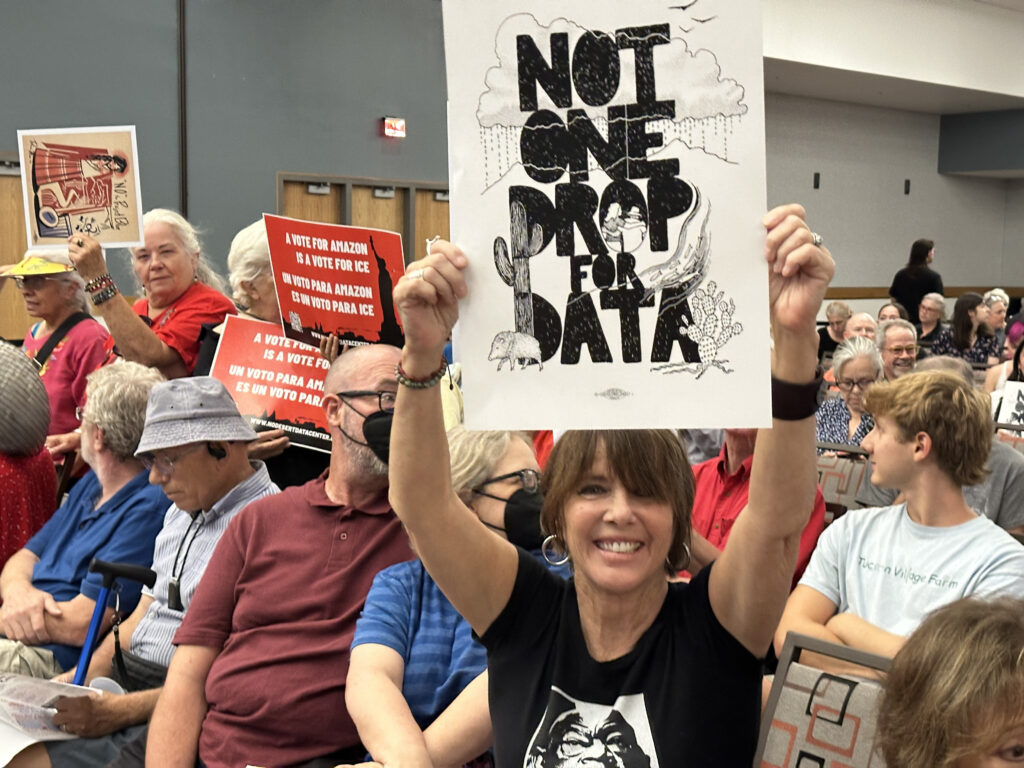
Those issues have risen to the forefront of Arizona politics. Local communities across the state have begun to oppose data centers, most notably Project Blue near Tucson.
At the ACC rate case hearing, that community opposition was present.
This story is funded by readers like you.
Our nonprofit newsroom provides award-winning climate coverage free of charge and advertising. We rely on donations from readers like you to keep going. Please donate now to support our work.
Donate Now
Winslow Mayor Roberta Cato made the three-hour trek from her town to Phoenix to speak at the hearing (and for other business). She explained that her city is in Navajo County, the second-poorest in the state. For years, she and her council have tried to revitalize the community’s economy, bringing jobs for Winslow and their neighbors on the Hopi and Navajo Nations.
They have come close to striking major deals that would help do just that, she said, but there’s been one issue: APS won’t invest new infrastructure to service Winslow, and the businesses then look elsewhere. She said they’ve talked to the utility about bringing in more energy, but they won’t do so unless the businesses come. But the businesses won’t come.
“How is it that we as a city have to pay these rate increases when we’re not even being supplied with the proper energy to grow and prosper?” she asked.
Her constituents cannot afford another rate increase. Not while the city struggles to bring in new, higher-paying jobs. “This is going to devastate our community,” she said.
About This Story
Perhaps you noticed: This story, like all the news we publish, is free to read. That’s because Inside Climate News is a 501c3 nonprofit organization. We do not charge a subscription fee, lock our news behind a paywall, or clutter our website with ads. We make our news on climate and the environment freely available to you and anyone who wants it.
That’s not all. We also share our news for free with scores of other media organizations around the country. Many of them can’t afford to do environmental journalism of their own. We’ve built bureaus from coast to coast to report local stories, collaborate with local newsrooms and co-publish articles so that this vital work is shared as widely as possible.
Two of us launched ICN in 2007. Six years later we earned a Pulitzer Prize for National Reporting, and now we run the oldest and largest dedicated climate newsroom in the nation. We tell the story in all its complexity. We hold polluters accountable. We expose environmental injustice. We debunk misinformation. We scrutinize solutions and inspire action.
Donations from readers like you fund every aspect of what we do. If you don’t already, will you support our ongoing work, our reporting on the biggest crisis facing our planet, and help us reach even more readers in more places?
Please take a moment to make a tax-deductible donation. Every one of them makes a difference.
Thank you,

Wyatt Myskow
Reporter, Phoenix
Wyatt Myskow covers drought, biodiversity and the renewable energy transition throughout the Western U.S. Based in Phoenix, he previously reported for The Arizona Republic and The Chronicle of Higher Education. Wyatt has lived in the Southwest since birth and graduated from Arizona State University with his bachelor’s degree in journalism.