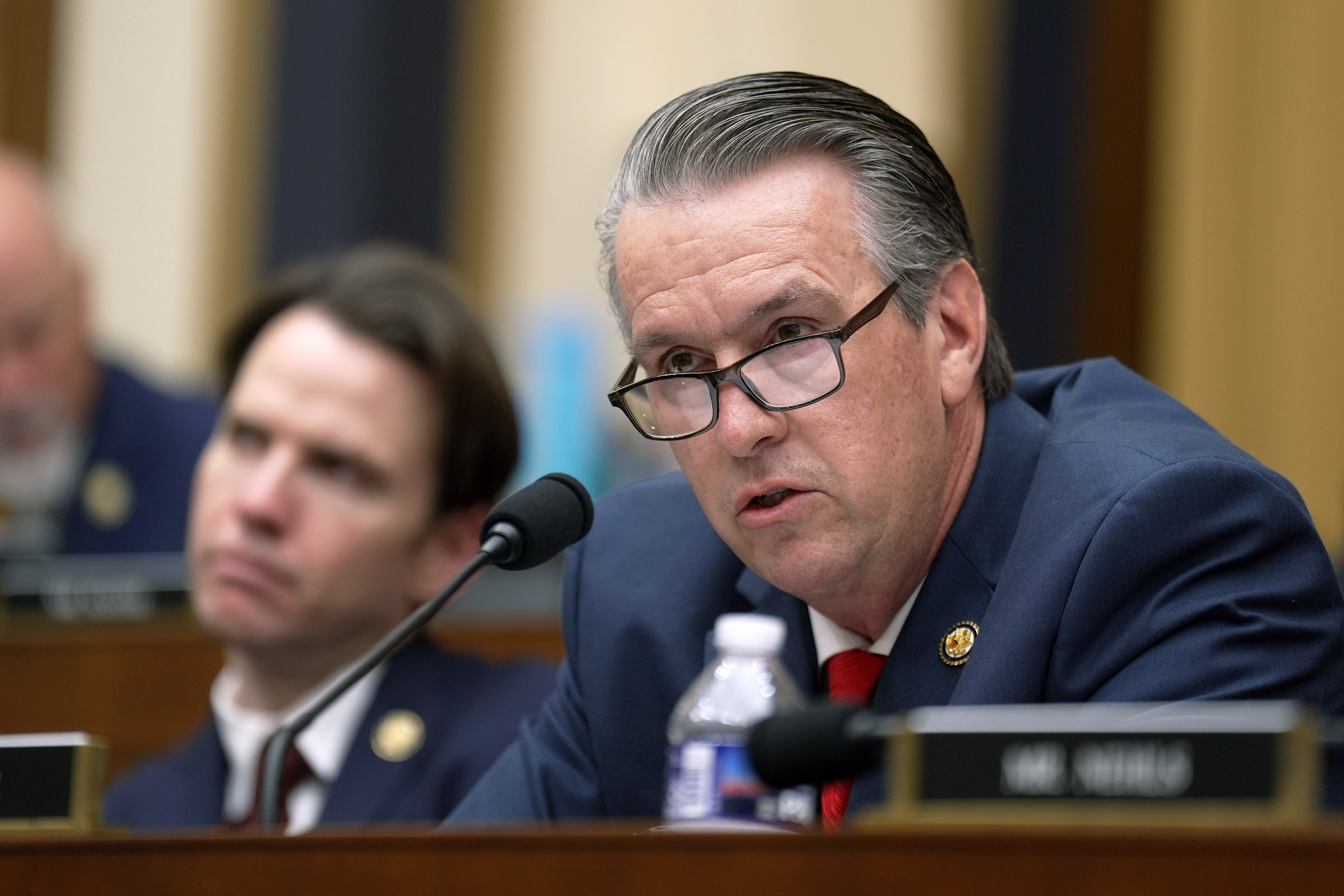


ENTERPRISE, Ala.—U.S. Rep. Barry Moore, a longtime political figure in this rural Alabama community, has his priorities. Among them? A reform effort aimed at the modern gas can.
A congressman since 2021, the Republican may be headed toward one of the most powerful positions in Yellowhammer State politics, a seat in the U.S. Senate, given President Donald Trump’s recent endorsement.
“Congressman Barry Moore, an America First Patriot who has been with me from the very beginning (he was the first Elected Official in the Country to Endorse me!), is running for the United States Senate in Alabama, a place I love and WON BIG in 2016, 2020, and 2024, getting the highest vote in that great State’s history,” Trump posted on Truth Social on Jan. 17. “Barry Moore is a good friend, fighter, and WINNER, and has my Complete and Total Endorsement to be the next United States Senator from Alabama — BARRY WILL NEVER LET YOU DOWN!”
Shortly before that, Moore issued a press release championing newly filed legislation outlining one of the issues he plans to fight for: fast-pour gas cans.
Moore’s proposed legislation, called the “Freedom to Fuel Act,” would exempt gas cans from federal regulations limiting emissions caused by “portable fuel containers.” Some commentators on the right have decried newly manufactured gas cans, which often have no-drip mechanisms that experts have said help avoid environmentally harmful spills, reduce public exposure to dangerous chemicals and prevent fires.
Trump’s endorsement was a significant boost to Moore’s campaign to secure the Republican party’s primary, a race that also features Alabama Attorney General Steve Marshall, a powerful figure in the state. The winner of the March GOP primary may go on to face former Sen. Doug Jones, the last Democrat to represent the state in the upper chamber, in an election that analysts say is a safe bet for Republicans in deep red Alabama, even in a midterm year.
But Trump’s endorsement in an Alabama race doesn’t guarantee a candidate electoral success. In 2017, Trump issued a half-hearted endorsement of Luther Strange, who later lost the GOP primary to disgraced former
. Moore would go on to lose the general election to Jones, a rare win for a Democrat in the Deep South.
In a 2022 Senate race, Trump endorsed Republican Mo Brooks but later turned on the former congressman after Brooks said the right should “move on” from claims about fraud in the 2020 election. Sen. Katie Britt would fill the seat. Now, Alabama’s second spot in the U.S. Senate is up for grabs, with incumbent Tommy Tuberville an early favorite to replace term-limited Gov. Kay Ivey.
Gas-can regulation has become a frequent target of the right, with Trump Environmental Protection Agency officials declaring in July 2025 that the agency would “make gas cans great again” by sending a letter to manufacturers emphasizing that a nearly two-decade-old emissions reduction rule does not ban vents in gas-can designs.
Barry Moore’s legislation would go further, completely exempting gas cans from Clean Air Act evaporative emissions limits that were aimed at improving public safety and saving consumers in lost fuel costs.
Toxic emissions from gasoline spilling from cans in the U.S. is substantial, researchers have concluded.
In its decision finalizing new gas-can rules in 2007, EPA officials emphasized that the scientific evidence is clear: reducing spillage and other emissions from portable fuel containers would improve public health.
“People experience elevated risk of cancer and other noncancer health effects from exposure to air toxics,” the EPA said at the time. “Mobile sources are responsible for a significant portion of this risk. For example, benzene is the most significant contributor to cancer risk from all outdoor air toxics.”
Benzene, a chemical present in gasoline products, is known to increase cancer risks for anyone exposed to it, including motorists, according to the Centers for Disease Control and Prevention.
The 2007 EPA rule, the implementation of which was delayed for years, did not require a specific gas-can design. Instead, it put in place a standard for the amount of gasoline hydrocarbons allowed to come from newly manufactured cans in a given amount of time—0.3 grams per gallon per day.
Moore’s office did not respond to a request for comment.
If passed, it’s unclear whether Moore’s legislation would improve the modern design of gas cans to his liking. In the last two decades, the designs have changed significantly because of other, bipartisan legislation, including the Children’s Gasoline Burn Prevention Act.
That bill, passed in 2008 and signed into law by then-President George W. Bush, required gas-can manufacturers to include child-resistant mechanisms on their products similar to those on medicine bottles. The law was sponsored by then-Rep. Dennis Moore, a Kansas Democrat, and Rep. Spencer Bachus, an Alabama Republican.
Dennis Moore said he filed the legislation after hearing from numerous parents about young children who suffered from severe burns due to quick, easy access to canned gasoline.
“In 2003, the Consumer Product Safety Commission released a report estimating that, in a single year, about 1,270 children under the age of 5 were treated in emergency rooms for injuries resulting from unsecured gas cans either through fires or from the inhalation of fumes,” Moore told fellow members of Congress in hearings on the law. “Mr. Chairman, I have seven grandchildren right now, and I expect my eighth grandchild by noon today, and I am doing this for my grandchildren and for every child in this country to protect those children.”
Eighteen years later, Rep. Barry Moore—no relation—and others on the right have repeatedly attacked gas-container regulations and what they view as a resulting decline in gas-can quality. In addition to Moore’s proposed legislation, Republicans have introduced a bill to repeal the Children’s Gasoline Burns Prevention Act in its entirety.
That legislation, filed last year, is titled the Gas Can Freedom Act of 2025. The bill’s House and Senate versions have 12 Republican cosponsors.
“For years, farmers, construction crews, small businesses, and homeowners have been forced to use government-mandated, slow-pour, spill-prone gas cans that break easily and make simple tasks harder,” Moore said in the press release about his legislation, the Freedom to Fuel Act. “From day one, President Trump and Republicans have been committed to cutting red tape, empowering American workers, and restoring common sense.”
Moore’s cosponsor, Rep. Julie Fedorchak of North Dakota, said emissions from gas cans are negligible.
“Who hasn’t had the maddening experience of filling up a lawnmower or snowmobile with gas only to spill it everywhere because of the terrible nozzles? Gas cans contribute only a tiny share of emissions,” Fedorchak said in a statement, adding: “Glad to work with Rep. Moore on the Freedom to Fuel Act to roll back this nonsense.”
A 2007 EPA report disputes claims that controlling emissions from gas cans amounted to “nonsense.”
“Although an individual gas can is a relatively modest emission source, the cumulative emissions from an estimated population of 80 million gas cans are quite significant,” the report concluded.
This story is funded by readers like you.
Our nonprofit newsroom provides award-winning climate coverage free of charge and advertising. We rely on donations from readers like you to keep going. Please donate now to support our work.
Donate Now
The report used modelling to estimate that around 327,000 tons of emissions were the result of portable fuel container use as of 2005.
If exempted from EPA emissions requirements by legislation or executive action, gas-can manufacturers would still be required to use child-resistant caps under the Children’s Gasoline Burns Prevention Act unless efforts to repeal it, too, are successful.
In a June 2007 hearing on the passage of that law, then-Rep.Cliff Stearns, R-Fla., pushed a witness, Consumers Union’s Sally Greenberg, on why products like gas cans should be regulated when accidents are relatively rare.
Stearns suggested that Greenberg and other consumer advocates are too focused on bad outcomes in a small number of cases and that decisions about public policy should be based on the outcome of the many, not the outcome of the few.
“Do you take into account the overall percentages when you look at this, or do you just look at the deaths and the incidents?” Stearns asked, saying that the number of burned children was low and that parents may simply be “delinquent too” in accidental burn cases.
He pressed: 1,200 children a year—out of millions, he emphasized.
“You don’t take that much into account?” Stearns asked.
Greenberg replied without pause.
“If we did, there would be a lot more injured or dead children today.”
About This Story
Perhaps you noticed: This story, like all the news we publish, is free to read. That’s because Inside Climate News is a 501c3 nonprofit organization. We do not charge a subscription fee, lock our news behind a paywall, or clutter our website with ads. We make our news on climate and the environment freely available to you and anyone who wants it.
That’s not all. We also share our news for free with scores of other media organizations around the country. Many of them can’t afford to do environmental journalism of their own. We’ve built bureaus from coast to coast to report local stories, collaborate with local newsrooms and co-publish articles so that this vital work is shared as widely as possible.
Two of us launched ICN in 2007. Six years later we earned a Pulitzer Prize for National Reporting, and now we run the oldest and largest dedicated climate newsroom in the nation. We tell the story in all its complexity. We hold polluters accountable. We expose environmental injustice. We debunk misinformation. We scrutinize solutions and inspire action.
Donations from readers like you fund every aspect of what we do. If you don’t already, will you support our ongoing work, our reporting on the biggest crisis facing our planet, and help us reach even more readers in more places?
Please take a moment to make a tax-deductible donation. Every one of them makes a difference.
Thank you,

Lee Hedgepeth
Reporter, Alabama
Lee Hedgepeth is Inside Climate News’ Alabama reporter. Raised in Grand Bay, Alabama, a small town on the Gulf Coast, Lee holds master’s degrees in community journalism and political development from the University of Alabama and Tulane University. Lee is the founder of Tread, a newsletter of Southern journalism, and has also worked for news outlets across Alabama, including CBS 42, Alabama Political Reporter and the Anniston Star. His reporting has focused on issues impacting members of marginalized groups, including homelessness, poverty, and the death penalty. His award-winning journalism has appeared in publications across the country and has been cited by the New York Times, the Wall Street Journal and the Washington Post, among others.