

From our collaborating partner Living on Earth, public radio’s environmental news magazine, an interview by Steve Curwood with Dr. Vanessa Kerry at the Harvard T. H. Chan School of Public Health.
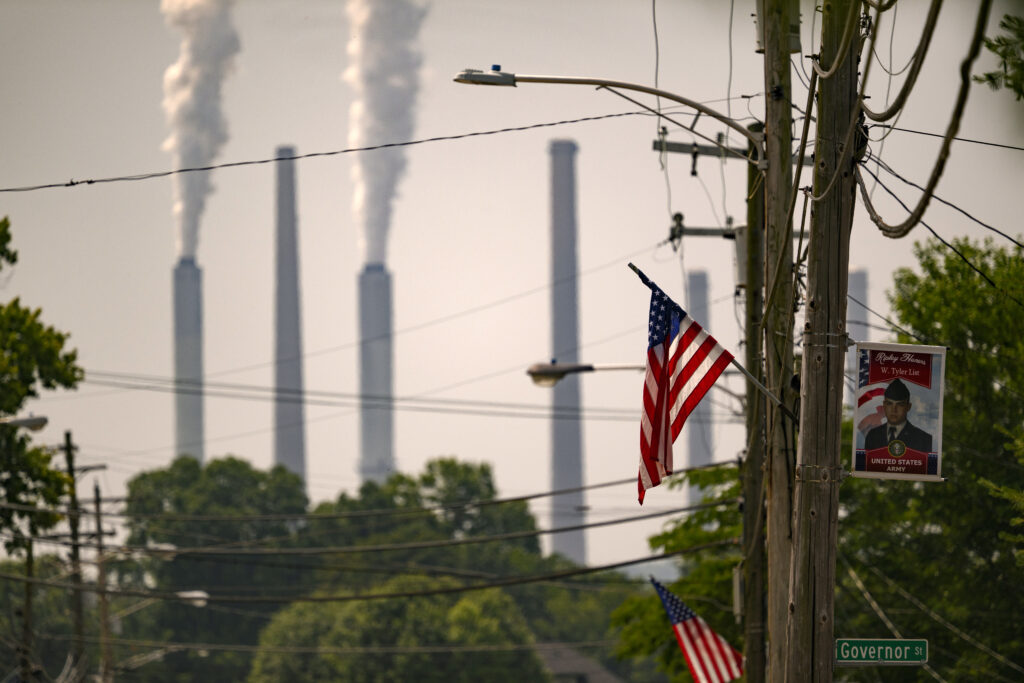
Ever since the Six Cities study, led by Harvard University’s public health experts, first found in the 1990s that coal power plant smokestacks were sources of deadly and serious health effects for people living downwind, there have been debates about what to do about it.
This first research and its iterations supported by federal funds suggested as many as 70,000 Americans were dying prematurely from the tiny particles the plants emitted. Today, the most recent work led by Harvard links as many as 300,000 deaths in America every year to the burning of fossil fuels, not to mention the related carbon emissions that promote global warming.
Dr. Vanessa Kerry, a critical care physician who directs Harvard’s Global Health and Climate Policy program and teaches at its T. H. Chan School of Public Health, speaks out about the major health costs and lost opportunities linked to pollution. She is also the World Health Organization special envoy for climate change and health.
This interview has been edited for length and clarity.
STEVE CURWOOD: There’s been a shift in messaging from environmental groups regarding the impact of air pollution on environmental health. Discuss what that means in terms of the effectiveness of helping people understand the impact of the environment on their daily lives.
VANESSA KERRY: The shift in messaging that we’re experiencing around the environment and climate change, the dreaded two words, I think it’s twofold.
“When you have these massive events like the wildfires in Canada that turn the air orange in New York, it’s very hard to deny that we are facing new and different challenges.”
It’s getting very, very divided now in terms of how we think about it. There’s a group that calls it the greatest hoax of our time, and there are others that are really trying to think strategically about how we understand what is happening on this Earth and in our changing climate in ways that we can really relate to, that aren’t just numbers or degrees Celsius, but are in the numbers of lives lost or saved.
And health has been a really important piece to being able to make that transition, I think, and having people understand that you walking down the street are very well going to be impacted by what is happening, be it a moment of extreme heat, or how that affects you and puts you at risk of flaring your diabetes or your lung disease or your heart disease, or in terms of understanding how extreme weather impacts us.
When you have these massive events like the wildfires in Canada that turn the air orange in New York, it’s very hard to deny that we are facing new and different challenges. And health is a very important tool to be able to do that.
But I think there’s another step that we can also take to help people really understand what we’re up against in climate change, which is that these health impacts that we’re seeing cost us money. Because if you are too sick to go to work, or you can’t breathe, or your child has an asthma attack, and you can’t go to work because you’re taking them to hospital, that’s lost income.
We know, for example, that the United States is losing $100 billion in productivity from extreme heat already now, and that’s supposed to go to $500 billion in the next 20 years. So it’s very real. For those that can’t even think about health, understanding the economic bottom line and how it affects your pocket is something that I think is universally related and understood.
CURWOOD: Let’s talk about some of the research that we were told from folks at Harvard. Studies show that there are some 300,000 excess deaths in the United States each year, and maybe 7 to 8 million globally because of the fine particulate matter that’s in the air due to the air pollution from the fossil fuel industry. Burning fossil fuels makes people sick. To me, it seems, if it’s that much of a health danger, climate change is almost an aside. You know, you could argue about climate change, and some people want to, but that kind of health impact seems to me that people should really be acting on not burning fossil fuels just because of that. What do you think?
Read More
NIH Scientists Link Air Pollution and Lung Cancer Mutations in Non-Smokers
By Keerti Gopal
KERRY: The data on fossil fuels and what it does to our health are profound. Without question, the burning of fossil fuels is driving our risk through multiple pathways.
But in terms of the air pollution in the particulate matter: Particulate matter is co-emitted with the greenhouse gases, and particulate matter that is being spewed out by fossil fuels have very direct impacts on your health. Not only do you breathe it in, and can it cause issues in your lungs, but actually particulate matter 2.5 and lower, which is what is very frequently seen, is something that actually can cross into your bloodstream, lead to increased risk of heart attacks, worsen your blood pressure, increased risk of strokes, cause all sorts of other problems in the body, and it is dangerous to our health. And it is dangerous to keep having that continue.
CURWOOD: Recently, the U.S. Environmental Protection Agency said it’s going to stop calculating the health care savings from key air pollution rules, things that do focus on things like particulates. What signal does that send? What’s the harm from that?
KERRY: It’s undermining, without question, the general public and scientists and everyone’s understanding of really how impactful the regulations and these protections are. What is happening ultimately, you’re not measuring the cost, you’re not taking in the full stock of how humans are affected, because economic savings are a major incentive for corporations and for individuals to understand why we can have climate action be a win-win.
So they’re just removing information to be able to tell a narrative that benefits a few.
But at the end of the day, we know that when you breathe air pollution and you are unable to go to work, you lose your income. Or when you have a workforce that is not able to perform because of the reduced productivity of air pollution, a company suffers. And when you’re spending a huge amount of money out of pocket, or when a government is spending money or an insurance company is spending money to provide health care to somebody who’s suffering from that, we’re not giving a full picture of what the harm is here.
The social determinants of health are also incredibly important. So beyond the direct impacts of fossil fuels, people who are paying out of pocket for catastrophic health costs related to this are therefore losing access to nutrition, ability to send their children to school, access to other resources that are critically important. There are deep links between poverty and poor health.
Forty-four million people are going to fall into poverty from the health impacts of climate change alone, according to the World Bank, in the next 20 years. These are real impacts. And history is getting rewritten, and a narrative is getting rewritten, when we don’t provide the full picture.
CURWOOD: So if the air pollution has such a tremendous impact on us, health-wise and economically as well, why aren’t we talking about this more in America?
KERRY: It doesn’t make sense to me. One of the things that I’m really eager to pursue in some of the work that I’m hoping to do at [the] Harvard School of Public Health and Department of Environmental Health is actually to look at that exact question—to help consolidate the narrative and the deep understanding of this economic bottom line of poor health and what it actually means, so that health foundationally becomes part of our conversations about economic security, human security, understood as a powerful investment for economic growth, right?
And there’s lots of data out there that tells us that investments in health actually have higher returns. So the Biden administration’s EPA, the very EPA that is no longer calculating the costs of climate change, has calculated that for every dollar spent in reducing PM2.5 overall, there could be as much as $77 in health benefits. So the cost of mitigating the problem can cause profound savings in terms of people’s health and well-being.
CURWOOD: To what extent are the massive impacts of air pollution on public health part of the reason that we have such a huge economic divide in this country?
KERRY: That’s an interesting question. There’s a vicious cycle that we see. There’s a term for it, the deprivation gradient, which is this fact that climate change is actually having impacts on those that are already most vulnerable in a way that it makes them even more vulnerable, because all of their social determinants are actually getting more difficult for them to achieve health, to achieve opportunity, to see economic gain or to have the ability to move upward socially.
“There’s a massive divide that is happening where we are exacerbating inequity.”
So when you look at who lives in urban cities, in heat deserts, where it can be absolutely crippling to live in high heat, it’s often people of color or people in poverty. And so there’s a massive divide that is happening where we are exacerbating inequity without question, not just in the United States, but globally.
For me, that raises the question of, are we going to accept that? Beyond just the moral sort of unacceptableness of that to me, the question also is: Is that a sustainable pathway for humanity?
CURWOOD: We don’t have much more time now, but I have to ask you about [a] conversation that’s come out of the Heritage Foundation in Washington that claims that climate change alarmism, quote-unquote, is discouraging families from having children. Now you’re not only a physician, you’re a mom. For a moment, speak to that issue about how concern for climate change can have the opposite effect. I mean, how dangerous is it to have that level of environmental skepticism? How cynical is it to have that level of environmental skepticism?
KERRY: It’s a fascinating point, but I think the real danger here isn’t necessarily concern about climate change. It’s really actually the perpetuation of misinformation, and the inability to communicate truth, and the mixed messaging that we’re seeing, and we’re seeing this with vaccines. We are seeing this with public health across the board, and the destruction of trust in science and health is going to be profoundly damaging, beyond just climate change, but within all scientific pieces.
This story is funded by readers like you.
Our nonprofit newsroom provides award-winning climate coverage free of charge and advertising. We rely on donations from readers like you to keep going. Please donate now to support our work.
Donate Now
We saw this in COVID as well, that confusion cost lives. And I saw that very, very directly as an ICU physician during COVID, when I would have patients coming in that we’d be having to put the breathing tube in, and they would be begging for the vaccine, saying, “I didn’t understand. I believed what everybody said, please, just give me the vaccine.” And I would have to tell them it was too late. And seeing them suddenly have the dawning of what that impact of that confusion was, is what we’re facing in climate change again now.
And I think that my other deep concern with this is that underlying all of this chaos is actually anxiety. People have deep anxiety and mental debilitation. It is debilitating to people’s ability to live their lives, care for their children, do their jobs. And we have such a stigma against mental health, we don’t talk about it. But that has profound impacts on what’s happening in the world today.
So I think it is really an insidious sort of disease we’re seeing in terms of this misinformation, and the ability for people to just live in a silo of information. And how we communicate a conversation like this, which is fact-based, scientific, ground in truth, to the right places is a really critical question that we have to tackle as a society if we’re going to start to help people make the right choices for the challenges that we face today.
About This Story
Perhaps you noticed: This story, like all the news we publish, is free to read. That’s because Inside Climate News is a 501c3 nonprofit organization. We do not charge a subscription fee, lock our news behind a paywall, or clutter our website with ads. We make our news on climate and the environment freely available to you and anyone who wants it.
That’s not all. We also share our news for free with scores of other media organizations around the country. Many of them can’t afford to do environmental journalism of their own. We’ve built bureaus from coast to coast to report local stories, collaborate with local newsrooms and co-publish articles so that this vital work is shared as widely as possible.
Two of us launched ICN in 2007. Six years later we earned a Pulitzer Prize for National Reporting, and now we run the oldest and largest dedicated climate newsroom in the nation. We tell the story in all its complexity. We hold polluters accountable. We expose environmental injustice. We debunk misinformation. We scrutinize solutions and inspire action.
Donations from readers like you fund every aspect of what we do. If you don’t already, will you support our ongoing work, our reporting on the biggest crisis facing our planet, and help us reach even more readers in more places?
Please take a moment to make a tax-deductible donation. Every one of them makes a difference.
Thank you,