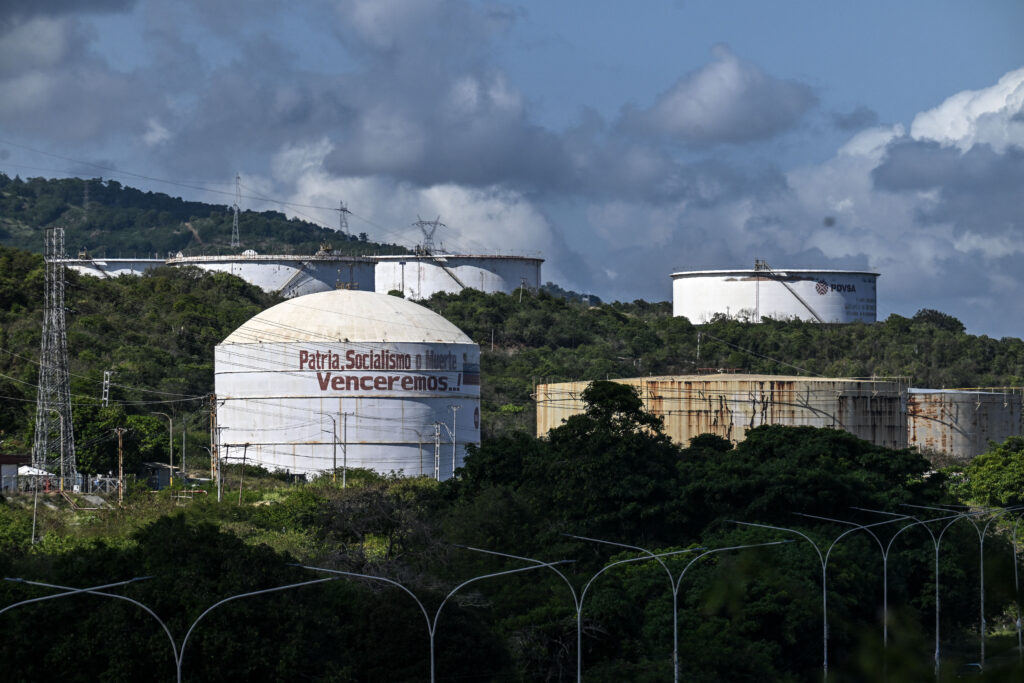


There is a sense of deja vu in the jungles of South America to the Trump Administration’s calls for private security contractors to protect the entrance of U.S. oil companies to Venezuela.
Countries in the region have experienced paramilitary violence that has played out repeatedly when private, foreign-backed militias vie for dominance in the lawless countryside. Sometimes they’re paid to protect bananas or cattle or any commodity for consumers in wealthy nations.
Oil companies commonly use security contractors around the world to protect vulnerable infrastructure like pipelines. But Venezuela presents a unique tinderbox of conditions: from the recent removal, prosecution and imprisonment of its president by U.S. special forces, to the oil riches that lie beneath it and the layered patchwork of armed groups that control the ungoverned nation.
“Private security agencies operating in that kind of environment will behave much the way that they behave in war zones,” said Phil Gunson, a Caracas-based senior analyst with the International Crisis Group. “They will shoot first and ask questions afterwards.”
Residents in Venezuela’s neighbor, Colombia, have almost endless tales to tell about the human rights abuses of private security groups that have protected oil companies and other interests from rural insurgencies during decades of conflict. Contractors protect indefensible pipelines. Rebels sabotage pipelines. Contractors root out perpetrators through brutal inquisitions of local communities that often have come to resemble war.
Venezuela already ranks near the bottom of virtually every public safety index, Gunson said. The only thing preventing its slide into civil war, as Colombia did in the 20th century, is a quasi-feudal system of criminal franchises that tie the country’s hierarchy of armed groups to the central government in Caracas. Although Venezuelan president Nicolas Maduro now sits in a U.S. jail, his ruling regime remains in Caracas as the keystone of this precarious arrangement.
If the regime falls, “the prospects for violent chaos—protracted, low-intensity warfare—are quite high,” Gunson said. “Its a nightmare scenario to me.”
Trump wants U.S. oil companies to rebuild the oil production infrastructure in Venezuela, which sits atop the largest proven oil reserves in the world. U.S. officials have signaled intent to work with the Venezuelan government following Maduro’s removal, and Caracas appears willing to cooperate, notwithstanding the anti-imperialist zeal of the party’s late founder, Hugo Chavez.
U.S. oil companies initially met Trump’s call for a revitalization of Venezuela with muted skepticism. Exxon CEO Darren Woods called Venezuela “uninvestible,” given the magnitude of the task in a prohibitive security environment. Last week, CNN reported that the Trump Administration, wary of using U.S. troops, issued a request for information from private security contractors to support operations in Venezuela.
After Maduro’s capture, the U.S. installed his vice president and former oil minister, Delcy Rodriguez, as the nation’s leader. But it remains unclear if her regime can maintain control over the country’s armed groups, called colectivos, while also working with the U.S.
“Surely a faction of the colectivos, sooner or later, will rise up against the government,” said Ronal Rodriguez, spokesperson for the Observatory on Venezuela at Rosario University in Bogota, Colombia. “Their loyalty to Delcy Rodriquez is uncertain because obviously many of the interests of these groups clash with the interests of the United States.”
Colectivos have rebelled against the government before, he said, and not all of them are fully government-aligned. This structure dates back to the 2000s, when Chavez faced disloyalty from the Venezuelan military and began arming civic organizations to defend his movement. Later, Rodriguez said, the government granted territorial franchises to the collectives where they ruled crudely in cooperation with local governors, mayors and even priests.
Furthermore, a Marxist insurgent group from Colombia called the National Liberation Army or ELN holds vast territory in southwestern Venezuela by invitation from the government in Caracas, which was unable to secure the territory itself from a feud between criminal organizations. All this has created a situation where many private security contractors already operate throughout the country, protecting the interests of wealthy businesses or individuals.
“Colombia, sadly, is a country that provides many of those contractors,” Rodriguez said.
In Colombia, decades of fighting have produced a plethora of armed organizations with shifting identities and allegiances, from communist guerrillas, drug cartels and insurgent farmers to private militias and paramilitary death squads. Parties drew funding from the drug trade as well as U.S. military assistance.
Colombia is the top recipient of U.S. military aid in Latin America. The funding from all sources has left the area awash with weapons and in experience in both insurgent and anti-insurgent warfare.
“There’s a great recruiting ground in that region,” said Jennifer Holmes, a researcher who has studied paramilitary violence in Colombia and is now a dean at the University of Texas at Dallas. “You’ve got a lot of guns for hire.”
Paramilitaries, like other armed groups, typically start with purely political or professional motivations, Holmes said.
But personal conflicts, anger, resentment and greed can quickly take over. Feuds develop. The domineering strength of security groups opens up lucrative opportunities in illicit economies.
“You can get paid to protect, but there’s a great side income that can rapidly become better than your day job. There’s lots of temptations,” said Holmes.
Oil companies play one small part in this story, which stretches back at least a century to the private militias that protected the lands and interests of banana plantations and cattle ranches. Many business interests have funded paramilitary violence since.
It’s the money in oil, Colombia’s top legal export, that enables oil companies to employ security details so prolifically. (The annual export value of blackmarket cocaine is estimated to exceed oil.)
In southwestern Colombia, indigenous organizers last year told Inside Climate News how armed groups prevented communities from speaking out about environmental destruction caused by Canadian oil companies drilling on their land.
“If you talk, they will kill you,” said an indigenous elder, Matias Redri, in an interview in October.
In Venezuela, the potential for an oil industry reboot remains in doubt. Hundreds of millions of dollars of investment will be required to rebuild the infrastructure to exploit its fossil wealth, and it isn’t clear that oil majors are up to the task.
If their security details do sweep into the oilfields of Venezuela, they could just be a few more among the county’s already vibrant landscape of scrappy militant organizations. However, with powerful foreign backers, these new groups may carry exceptionally large guns.
If they are positioned to dominate, the temptations of power could be close at mind without any government to stand in the way.
“It’s a lawless society. There is widespread impunity,” said Gunson, the analyst in Caracas. “With guns and impunity it’s only a short step to crime.”
About This Story
Perhaps you noticed: This story, like all the news we publish, is free to read. That’s because Inside Climate News is a 501c3 nonprofit organization. We do not charge a subscription fee, lock our news behind a paywall, or clutter our website with ads. We make our news on climate and the environment freely available to you and anyone who wants it.
That’s not all. We also share our news for free with scores of other media organizations around the country. Many of them can’t afford to do environmental journalism of their own. We’ve built bureaus from coast to coast to report local stories, collaborate with local newsrooms and co-publish articles so that this vital work is shared as widely as possible.
Two of us launched ICN in 2007. Six years later we earned a Pulitzer Prize for National Reporting, and now we run the oldest and largest dedicated climate newsroom in the nation. We tell the story in all its complexity. We hold polluters accountable. We expose environmental injustice. We debunk misinformation. We scrutinize solutions and inspire action.
Donations from readers like you fund every aspect of what we do. If you don’t already, will you support our ongoing work, our reporting on the biggest crisis facing our planet, and help us reach even more readers in more places?
Please take a moment to make a tax-deductible donation. Every one of them makes a difference.
Thank you,

Dylan Baddour
Reporter, Austin
Dylan Baddour covers the energy sector and environmental justice in Texas. Born in Houston, he’s worked the business desk at the Houston Chronicle, covered the U.S.-Mexico border for international outlets and reported for several years from Colombia for media like The Washington Post, BBC News and The Atlantic. He also spent two years investigating armed groups in Latin America for the global security department at Facebook before returning to Texas journalism. Baddour holds bachelor’s degrees in journalism and Latin American studies from the University of Texas at Austin. He has lived in Argentina, Kazakhstan and Colombia and speaks fluent Spanish.