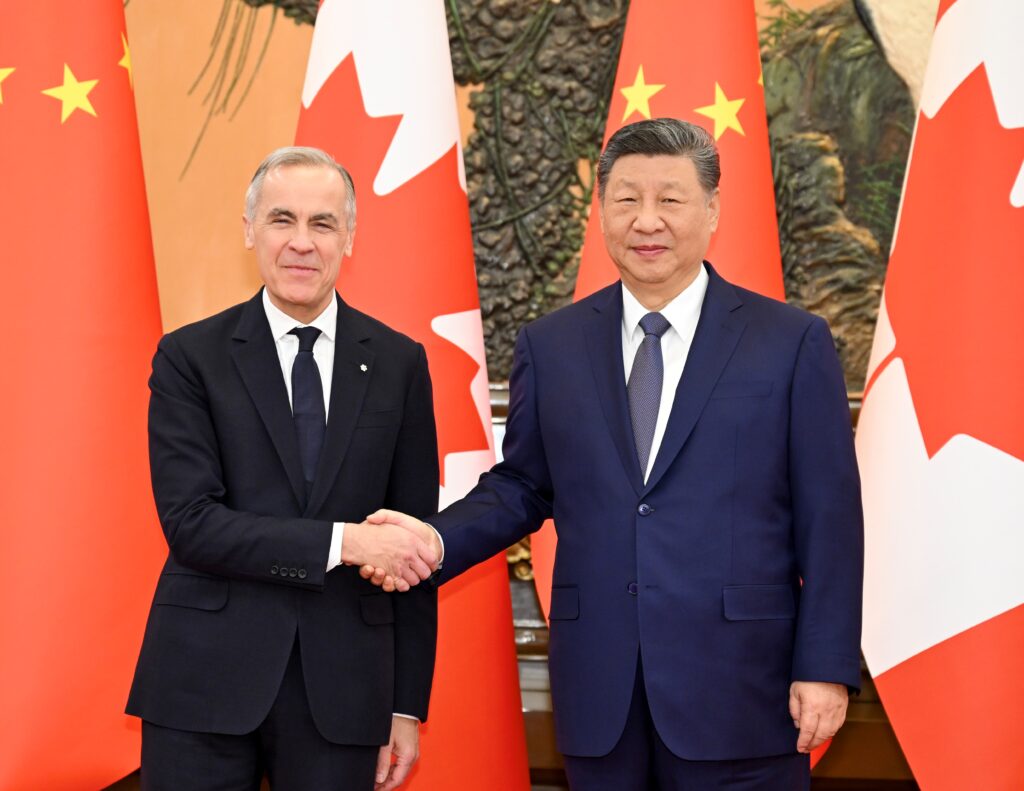


Canadian Prime Minister Mark Carney gave a searing speech on Tuesday in Davos, Switzerland, about “the rupture in the world order” and Canada’s role in whatever comes next.
A few days earlier, he signaled Canada’s path with the announcement of a trade agreement with China, which included reducing Canada’s tariff on Chinese-made electric vehicles from 100 percent to 6.1 percent.
If I were a U.S. auto executive, I would greet this news with dread. China is the world’s leader in EV manufacturing and technology and Canada is the leading export market for U.S.-made cars and light trucks.
Tariffs have kept most Chinese-made models out of the United States, but China is almost everywhere else, including Mexico and now Canada. This, along with the broader strains in trade relations with Mexico and Canada, is a bad sign for the U.S. auto industry.
The danger for U.S. automakers is that they will fade from being global players and focus more on selling to buyers in this country, while China asserts itself and the world moves toward electrification. This is already happening, although the specifics vary between U.S. companies such as Ford, General Motors and Tesla.
George Whitcombe, an auto industry analyst for Benchmark Mineral Intelligence, a research firm based in the United Kingdom, explained to me that Canada was already trying to move away from its reliance on the United States because of the Trump administration’s aggressive, unpredictable trade policy decisions.
“The damage has already been done in many senses in the breakdown of that trade relationship,” he said.
He said the EV transition in Canada so far has been led by U.S. automakers selling their vehicles into Canada, which means lots of SUVs and other large vehicles and few low-cost options. The arrival of Chinese EVs may mean new brands and models that are smaller and have low sticker prices.
Let’s step back and get a sense of what we’re talking about with the North American EV market.
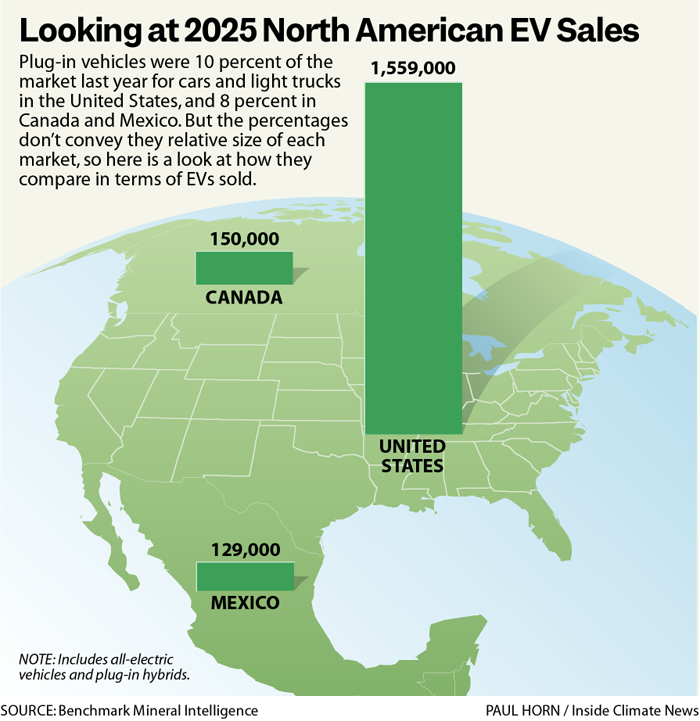
Last year, automakers and dealers sold 1,559,000 EVs in the United States, including all-electric models and plug-in hybrids, according to Benchmark. The Canadian and Mexican markets were much smaller, with 150,000 and 129,000 EVs sold, respectively.
EVs’ market share was 10 percent of cars and light trucks sold in the United States, and 8 percent in both Canada and Mexico.
Market share has grown the fastest in Mexico, rising from 1 percent in 2023, and much of the increase was driven by Chinese EVs.
China’s share of the Mexican EV market grew from 24 percent in 2023 to 80 percent in 2024 and 89 percent in 2025. BYD, the China-based company that is the world’s largest EV maker, was the market leader, accounting for about two-thirds of all EVs sold in Mexico last year, according to Benchmark.
Right now, Canada imports nearly all of its EVs. Two exceptions are the plug-in hybrid version of the Chrysler Pacifica minivan and the all-electric Dodge Charger, both of which are made by Stellantis.
Canada placed a 100 percent tariff on Chinese EVs in 2024, around the same time the United States did, as part of an effort to protect jobs at auto plants in both countries. Before that, companies selling Chinese-made EVs in Canada included Geely, which is based in China and owns the Volvo and Polestar brands, and Tesla, which is U.S.-based and has a factory in China.
Tesla and Geely could sidestep some tariffs by selling models that weren’t made in China, such as Volvo’s models from its factories in Sweden and the United States.
Now that tariffs have been reduced, Geely may be best positioned to boost its presence, Whitcombe said. The company already has a network of Volvo and Polestar dealerships, which makes it easier to add other brands, such as Zeekr and Geely, although the company has not discussed its plans.
BYD would have to start from scratch if it wants to enter Canada, but its growth in Mexico and other countries demonstrates an ability to quickly build a following in new markets. BYD didn’t respond to an email seeking comment on its plans.
But before we look ahead to China’s potential to make significant inroads in Canada, it’s important to review the terms of the trade deal. The reduced tariff rate applies only to the first 49,000 China-made EVs sold in Canada per year, which serves as a cap that would prevent these imports from suddenly dominating the market.
Carney’s office describes the agreement as the first step toward closer ties that will include, within three years, joint ventures between Canadian and Chinese companies that could lead to manufacturing jobs in Canada.
“Canada and China are both strong advocates of multilateralism,” the prime minister’s office said in a statement. “As a key pillar of this partnership, we will deepen our engagement on improved global governance.”
It is difficult not to view this as Canada cozying up to another superpower, amid strained relations with the United States. President Donald Trump has talked of annexing Canada and making it the 51st state and he has sent economic shockwaves through the country with ever-changing tariff declarations.
“I think the Canadian government generally would like to keep building automobiles with U.S. producers under [the U.S.-Mexico Canada Agreement], but the uncertainty that President Trump’s tariff threats and speculation about the end of USMCA is a problem for Canada,” said Christopher Worswick, an economics professor at Carleton University in Ottawa.
Worswick said the agreement makes economic sense for Canada, mainly because China is agreeing to reduce tariffs for products it imports from Canada, such as canola oil. But he also thinks that security concerns, including evidence of Chinese interference inCanada’s elections, highlight the risk of closer ties.
None of this is good for U.S. automakers, who have long had a reliable partner in Canada as a host for manufacturing plants and a population used to buying cars from U.S. brands.
This story is funded by readers like you.
Our nonprofit newsroom provides award-winning climate coverage free of charge and advertising. We rely on donations from readers like you to keep going. Please donate now to support our work.
Donate Now
Last week, General Motors CEO Mary Barra spoke to reporters about how her company has adjusted to deal with the Trump administration’s changes to fuel economy standards and its cancellation of tax credits for buying EVs.
“We had to make some fairly significant changes,” she said about the cuts her company has made to EV investments.
Despite this, she remains confident that EVs are the future of the industry, or “the end game” as she put it.
“It will take longer without the incentives, but I still think we’ll get there over time,” she said about the transition to EVs in this country.
But by then, Canadian consumers may be out of the habit of shopping for GM brands such as Chevrolet or Cadillac, and used to shopping for BYD or Zeekr.
Other stories about the energy transition to take note of this week:
Visiting Moss Landing, One Year Later: A gigantic fire at Moss Landing Energy Storage Facility caused damage to people and property in the community and raised concerns about the safety of battery storage systems. On the one-year anniversary of the fire, residents feel like their questions remain largely unanswered, as my colleague Claire Barber reports for ICN. But she notes that the design of the battery plant, with stacks of equipment stored indoors, was unusual and may have contributed to the fire risk, so there aren’t many other facilities like it with similar risks.
Trump’s Davos Speech Had a Wildly Inaccurate Digression About Energy: The major takeaway from President Donald Trump’s speech on Wednesday was his statement that he’s not planning to order a military invasion of Greenland. But he also had comments on energy, including his view that relying on wind energy is folly and his claim that U.S. energy prices have fallen. Rebecca Elliott of The New York Times summarizes the comments as “not grounded in reality.”
The U.S. Has Only Spent 2 Percent of Funding for EV Charging: Four years ago, Congress appropriated $4.4 billion for a program to build EV chargers, and only 2 percent of that funding has been spent, as David Ferris reports for E&E News. The slow rollout of the program was due to a long wait for the Biden administration to approve rules, followed by delays as the Trump administration tried to cancel funding, only for a court to restore it.
Inside Clean Energy is ICN’s weekly bulletin of news and analysis about the energy transition. Send news tips and questions to [email protected].
About This Story
Perhaps you noticed: This story, like all the news we publish, is free to read. That’s because Inside Climate News is a 501c3 nonprofit organization. We do not charge a subscription fee, lock our news behind a paywall, or clutter our website with ads. We make our news on climate and the environment freely available to you and anyone who wants it.
That’s not all. We also share our news for free with scores of other media organizations around the country. Many of them can’t afford to do environmental journalism of their own. We’ve built bureaus from coast to coast to report local stories, collaborate with local newsrooms and co-publish articles so that this vital work is shared as widely as possible.
Two of us launched ICN in 2007. Six years later we earned a Pulitzer Prize for National Reporting, and now we run the oldest and largest dedicated climate newsroom in the nation. We tell the story in all its complexity. We hold polluters accountable. We expose environmental injustice. We debunk misinformation. We scrutinize solutions and inspire action.
Donations from readers like you fund every aspect of what we do. If you don’t already, will you support our ongoing work, our reporting on the biggest crisis facing our planet, and help us reach even more readers in more places?
Please take a moment to make a tax-deductible donation. Every one of them makes a difference.
Thank you,

Dan Gearino
Reporter, Clean Energy
Dan Gearino covers the business and policy of renewable energy and utilities, often with an emphasis on the midwestern United States. He is the main author of ICN’s Inside Clean Energy newsletter. He came to ICN in 2018 after a nine-year tenure at The Columbus Dispatch, where he covered the business of energy. Before that, he covered politics and business in Iowa and in New Hampshire. He grew up in Warren County, Iowa, just south of Des Moines, and lives in Columbus, Ohio.