

EL PASO—In October 2025, local officials celebrated the groundbreaking of a 1-gigawatt, $1.5 billion data center for the tech giant Meta.
El Paso Electric had previously stated that existing infrastructure would support the data center and that Meta was looking to tap into a new solar farm. El Paso gets more than 300 days a year of sun, hence its nickname, the Sun City.
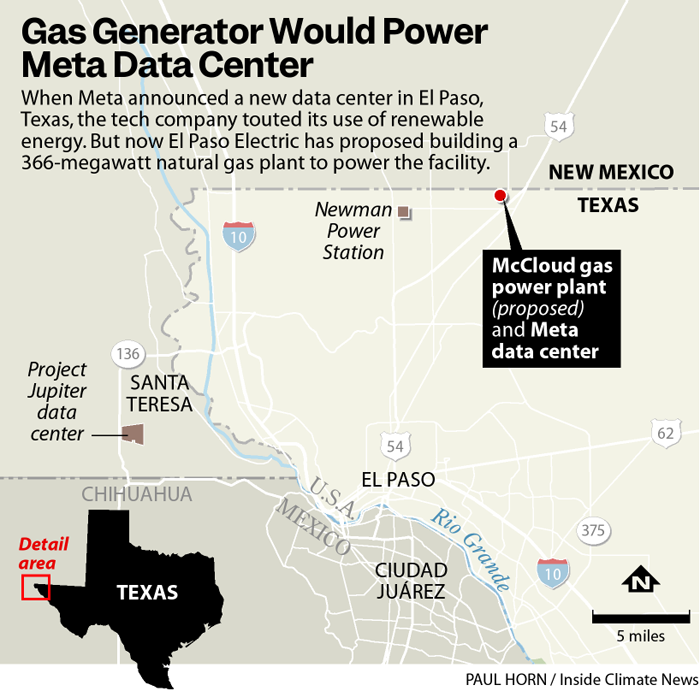
So it came as a shock to many El Pasoans that the electric utility is instead seeking approval for a 366-megawatt natural gas plant, called the McCloud facility, to power the data center. Advocates in El Paso worry that a new gas plant could drive up utility rates, worsen the region’s air pollution problem and set back efforts to transition to renewable energy.
The Sembrando Esperanza Coalition, an El Paso economic and environmental justice group, is calling for the city, county and utilities to terminate their contracts with Meta.
“We were not told that El Paso Electric would be building a power plant powered by fossil fuels,” said Coalition organizer Verónica Carbajal. “To the contrary, we were told that Meta is going green and would rely on renewable energy. When we looked at the contracts ourselves, we realized that was an illusion.”
El Paso, population 700,000, is consistently ranked among the worst cities for ozone, or smog, in the nation. Existing water sources in the desert city are already stretched thin. Another data center, called Project Jupiter, is being developed across the state line in Santa Teresa, New Mexico, and will be fueled by natural gas. Taiwan-based Wiwynn Corp. has also announced a data center in the nearby town of Socorro, Texas. The data center build-out comes as both El Paso Electric and the city water utility are seeking rate increases.
“El Paso Electric’s obligation is to reliably serve every customer who requests service, including large employers bringing jobs and economic activity to the region,” said utility spokesperson Jacob Reyes. “In this case, the customer requested and is funding a natural gas resource as the fastest available option to meet a large, time-sensitive power need. At the same time, Meta has stated that its data center will be matched with 100 percent clean and renewable energy, consistent with its public sustainability commitments.”
Meta has invested in renewable energy projects in states where it operates data centers, including Texas. Meta did not respond to questions and El Paso Electric did not respond to questions about how energy will be “matched” for the new data center.
The data center is expected to employ about 100 people after construction is complete. Agreements with the city only require 50 full-time jobs.
The city has intervened to weigh in on the utility’s application to the Public Utility Commission (PUC) for the power plant. As an intervenor, the city will be able to make legal arguments and file testimony during PUC proceedings for the application. A city spokesperson did not respond to requests for comment.
“The company has made public commitments to power their project with renewable energy sources including on-site solar generation, and I think they need to be held to those commitments,” El Paso Councilman Chris Canales told Inside Climate News. “As the data center industry has shifted over the last few years toward larger and more intensive projects, I have definitely started to have a lot more concerns, as I think the public has as well.”
City Deal with Meta Face Scrutiny
The City of El Paso entered an agreement with Wurldwide LLC, a Meta affiliate, in December 2023 to provide financial incentives for a data center on a 1,000-acre property in Northeast El Paso.
The incentive package would abate city property taxes to entice the company to build in El Paso. Under the agreement, if the company invested $800 million, the city would abate up to 80 percent of property taxes for 15 years. El Paso County also offered property tax abatement. The El Paso Times reported these incentives could be worth up to $110 million.
The deal also stated that while the company was exploring alternative energy sources, including solar, it “shall not be obligated to pursue” these energy sources.
Meta subsequently decided to increase its investment to $1.5 billion as the AI industry grew. The tech giant officially announced the deal in October 2025. Once operational, the data center would be the largest power user in El Paso.
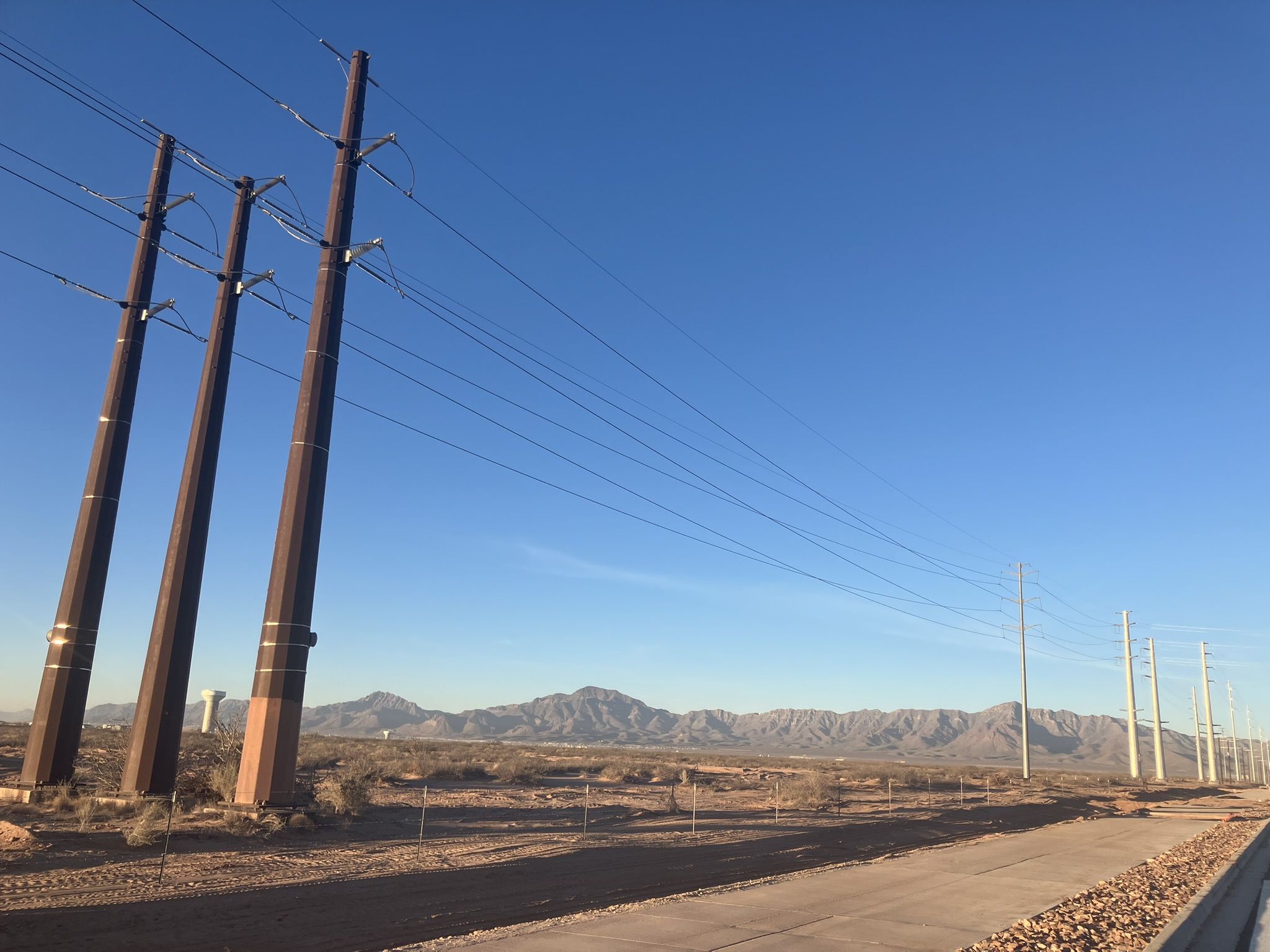
Last year, El Paso Electric quietly submitted paperwork to the PUC to build the natural gas power plant for Meta. The McCloud gas plant will be exclusively connected to the data center for the first five years, according to regulatory filings. Then it would be connected to the broader El Paso Electric transmission system. Meta would be responsible for all the costs during the first five years.
The regulatory filing states that large-scale solar and battery storage could “theoretically” supply the data center’s power, but “such an installation would require thousands of acres adjacent to the Data Center site which are not available.”
The filing goes on to say that larger-frame gas turbines could also supply the site but would take too long to procure.
The plant will require approvals from both the PUC and the Texas Commission on Environmental Quality. If approved, it is expected to be operational by 2027.
The Meta power plant would increase the share of natural gas in El Paso Electric’s portfolio. El Paso Electric has committed to 80 percent carbon-free energy by 2035 and 100 percent by 2045. El Paso Electric did not respond to questions about how it would achieve its carbon-free energy targets while expanding natural gas generation.
As of 2024, the utility supplied 41.7 percent carbon-free energy. Nuclear power, which is non-renewable, makes up 37 percent of that share, while solar contributed only 4.7 percent, according to the utility’s 2024 sustainability report.
“El Paso Electric continues to expand renewable generation, electrification programs, load management efforts and community solar while responding to rapid load growth, evolving policy conditions and customer priorities, particularly affordability and reliability,” the spokesperson said.
While El Paso receives abundant sunshine, the city is connected by pipelines to the Permian Basin oil and gas fields, some 200 miles east. Gas producers see a potential bonanza in the energy demand from data centers.
Matthew Rodriguez, an organizer with the El Paso environmental justice organization Amanecer People’s Project, said that the power demands of the Meta data center represent a “massive step backward” for El Paso Electric’s sustainability commitments.
“This basically wipes out all the progress [El Paso Electric] has supposedly made in the last five years,” he said.
The City of El Paso also submitted a climate action plan to the Environmental Protection Agency in December aiming to cut emissions 50 percent by 2030 and reach net zero by 2050.
Councilman Canales said that the city did not anticipate the utility’s application to build a new gas power plant. “As such, the impact of this newly proposed gas plant is not considered in the Climate Action Plan, and in my opinion it would run contrary to the City’s goals,” he said.
Local advocates are angered by the mixed messages about the data center.
“What’s really distressing about the Meta power plant is the lack of transparency, both from Meta, El Paso Electric and our elected officials,” said Carbajal of Sembrando Esperanza. “We suspected that this would happen, but we’re disappointed that no one notified the community” about the power plant.
El Paso Electric CEO Kelly Tomblin told the El Paso Times in 2024 that Meta requires its data center to be powered by solar or other renewables. Then during a rate case hearing before the Public Utility Commission of Texas in 2025, an El Paso Electric representative said that the Meta data center would likely be powered by solar, according to El Paso Matters.
At an industry conference in Las Cruces this month, CEO Tomblin struck a different tone. She questioned the efficacy of renewables to power data centers.
This story is funded by readers like you.
Our nonprofit newsroom provides award-winning climate coverage free of charge and advertising. We rely on donations from readers like you to keep going. Please donate now to support our work.
Donate Now
“Unfortunately, it wants power around the clock, and it’s hard to do that with just renewables and storage,” she said, according to Albuquerque Business First.
Carbajal said the Sembrando Esperanza Coalition has repeatedly asked for assurances that data centers would not drive up electric rates for El Pasoans. The group intervened in El Paso Electric’s rate case and is now calling for the city and utilities to terminate contracts with Meta.
Councilman Canales said that he doubts the majority of the council would be interested in terminating the contract “given the massive amount of tax revenue that the project will bring in.”
“That said, if we continue to see deviations from Meta’s public commitments, then I hope the City Council will take notice,” he said.
Carjabal is also concerned about water consumption at the proposed power plant. El Paso Electric is already one of the city’s biggest water consumers at its existing power plants.
“Meta’s Data Center in El Paso, Texas is not obligated to protect local residents,” a Sembrando Esperanza handout states. “To the contrary, El Pasoans will be subsidizing one of the richest companies in the world.”
Amanecer’s Rodriguez called the city’s agreements with Meta “a bad deal.”
“This is not benefitting anybody in El Paso,” Rodriguez said. “Only Meta benefits.”
About This Story
Perhaps you noticed: This story, like all the news we publish, is free to read. That’s because Inside Climate News is a 501c3 nonprofit organization. We do not charge a subscription fee, lock our news behind a paywall, or clutter our website with ads. We make our news on climate and the environment freely available to you and anyone who wants it.
That’s not all. We also share our news for free with scores of other media organizations around the country. Many of them can’t afford to do environmental journalism of their own. We’ve built bureaus from coast to coast to report local stories, collaborate with local newsrooms and co-publish articles so that this vital work is shared as widely as possible.
Two of us launched ICN in 2007. Six years later we earned a Pulitzer Prize for National Reporting, and now we run the oldest and largest dedicated climate newsroom in the nation. We tell the story in all its complexity. We hold polluters accountable. We expose environmental injustice. We debunk misinformation. We scrutinize solutions and inspire action.
Donations from readers like you fund every aspect of what we do. If you don’t already, will you support our ongoing work, our reporting on the biggest crisis facing our planet, and help us reach even more readers in more places?
Please take a moment to make a tax-deductible donation. Every one of them makes a difference.
Thank you,

Martha Pskowski
Reporter, El Paso, Texas
Martha Pskowski covers climate change and the environment in Texas from her base in El Paso. She was previously an environmental reporter at the El Paso Times. She began her career as a freelance journalist in Mexico, reporting for outlets including The Guardian and Yale E360. Martha has a B.A. in Environmental Studies from Hampshire College and a master’s degree in Journalism and Latin American Studies from New York University. She is a former Fulbright research fellow in Mexico. Martha can be reached on Signal at psskow.33.