

A US research team has successfully wirelessly charged a heavy-duty electric truck while it was travelling at full motorway speeds, in a seemingly important milestone for global efforts to build electrified highways.
Engineers at Purdue University demonstrated the technology this autumn on a quarter-mile testbed in Indiana, developed in partnership with the state’s Department of Transportation (INDOT). Using a Cummins electric semi-tractor, the team proved that “dynamic wireless power transfer” can deliver the high power levels required by HGVs without the vehicle ever needing to stop (“dynamic” refers to the fact of vehicles being in motion).
The roadway, embedded with transmitter coils beneath the concrete surface, transferred 190 kW of power to the moving truck at 65 mph. For comparison, researchers noted that 200 kW is roughly the electricity consumption of 100 average homes.
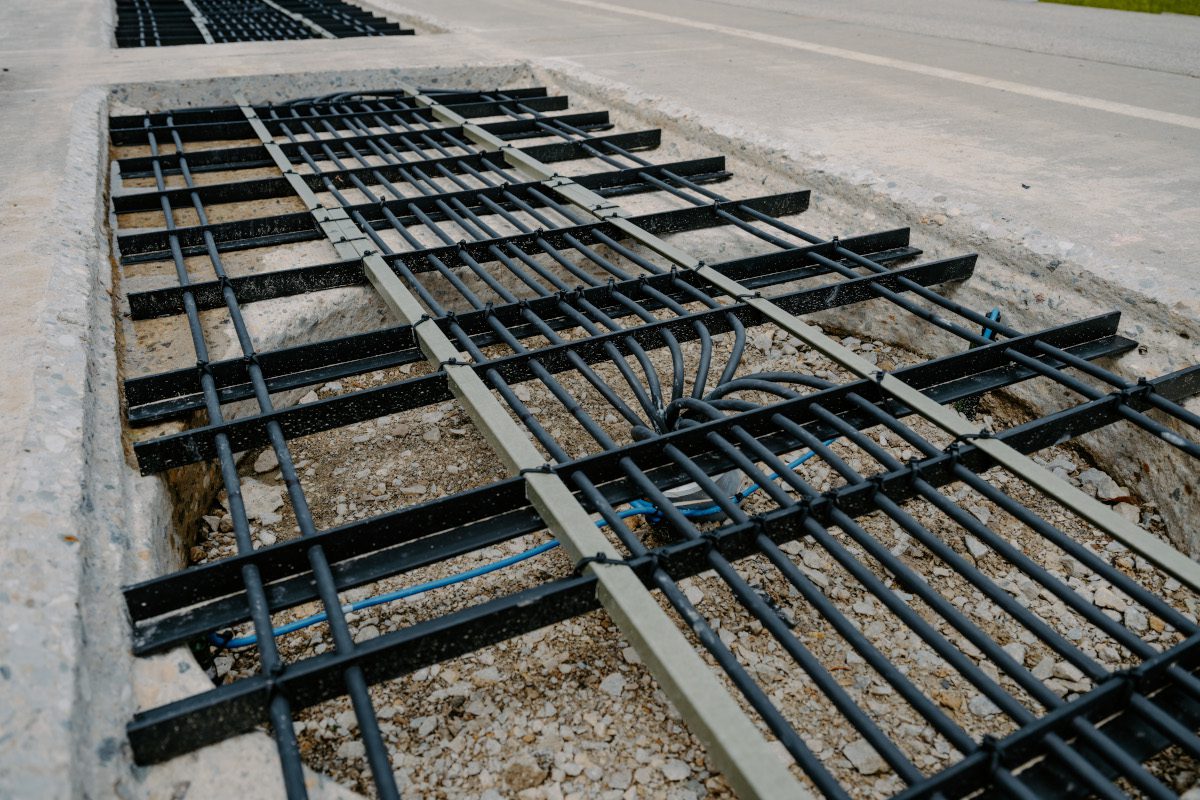
A few other states and countries have also begun testing roads designed to enable dynamic wireless power transfer. But making this possible for highways — and particularly for semis and other heavy-duty vehicles — is a unique challenge. Because vehicles travel so much faster on highways than city roads, they need to be charged at higher power levels.
Professor Nadia Gkritza, who leads the project at Purdue, said the trial shows that powering large commercial vehicles wirelessly “is not just technically feasible but could be a practical and scalable solution for real-world highway transportation.”
The team also partnered with AECOM; White Construction, Inc.; and PC Krause and Associates, Inc. on developing and implementing various parts of the system.
A technology for all vehicles
While wireless charging roads have appeared in pilot schemes in Europe, the US and Israel, most have focused on lower-power applications for cars or buses. Purdue’s system is one of the first designed specifically for long-haul trucks — the segment that demands the highest charging power.
By designing for HGV requirements, the system could easily handle lighter vehicles, the team said. Reducing battery sizes for lorries could cut costs, increase freight capacity and remove one of the biggest barriers to fleet electrification. Lighter battery packs could also bring down costs for consumer EVs, easing range anxiety concerns.
“This is a system designed to work for the heaviest class of trucks all the way down to passenger vehicles,” said research assistant professor Aaron Brovont.
How it works
The system the researchers designed allows highway pavement to provide power to EVs similarly to how smartphones use magnetic fields to wirelessly charge when placed on a pad. Transmitter coils embedded in the road surface send energy to a receiver coil mounted under the truck. Unlike other designs, which require multiple small coils on trailers to meet high power demands, Purdue said its approach uses a single high-capacity receiver placed under the tractor unit, “greatly simplifying the overall system”.
“Transferring power through a magnetic field at these relatively large distances is challenging,” said Professor Dionysios Aliprantis. “And what makes it more challenging is doing it for a heavy-duty vehicle moving at power levels thousands of times higher than what smartphones receive.”
Toward an industry standard for electrified motorways
The project is part of a multiyear collaboration between Purdue and INDOT that feeds into ASPIRE, a US research centre focused on electrified transportation infrastructure. The team is now contributing to efforts to develop industry standards for dynamic wireless charging — a critical step before any region could consider large-scale deployment.
In April, the Purdue team received the Technology Innovation Award at the IEEE PES Energy and Policy Forum Innovation Showcase for their work on this system.