

When a derecho slammed into the Duane Arnold nuclear plant in 2020, Diana Lokenvitz had time for exactly one glance out her window.
A wall of clouds had poured in from the west, swallowing Palo, Iowa, in darkness. “It was like it was pitch black night,” the senior systems engineer at the plant recalled.
Then, the alarm began to sound.
Within seconds of the storm hitting the plant, 130-mile-per-hour winds had severed all six of its external power lines, triggering an automatic emergency shutdown.
Backup diesel generators roared to life, and large control rods slid into the reactor core to halt the fission reaction driving the plant’s energy production.
With the reactor core still dangerously hot, safety systems kicked in to help stabilize the reactor and vent excess heat, a process that lasted for hours.
“It wasn’t until we went outside afterwards that we realized that the cooling towers were gone,” Lokenvitz recalled.
Twelve water-cooling towers once watched over the plant like two rows of soldiers, releasing steam from water used to cool the nuclear reactor. The storm toppled them.
The derecho, a thunderstorm characterized by high wind gusts spanning several hundred miles, had swept across the Midwest, causing widespread power outages and catastrophic damage to buildings, trees and millions of acres of crops.
After 45 years of operation, the Duane Arnold Energy Center was shut down. The plant was already scheduled for decommissioning within months, leaving little time or financial incentive to repair the storm-damaged facility.
An initial analysis by the federal Nuclear Regulatory Commission’s (NRC) Division of Risk Analysis estimated there had been a one-in-1,000 chance of damage to the nuclear core at Duane Arnold during the derecho. The incident was one of only two “important precursors” to a severe accident in the U.S. between 2015 and 2024, the second-highest risk level that can be assigned to an event at a nuclear plant, the NRC told Inside Climate News. There were no “significant precursors,” the highest risk level event, during that period.
The final NRC analysis, published in March 2021, provided a slightly lower probability of core damage but noted that the risk of a station blackout during the derecho was “particularly high.”
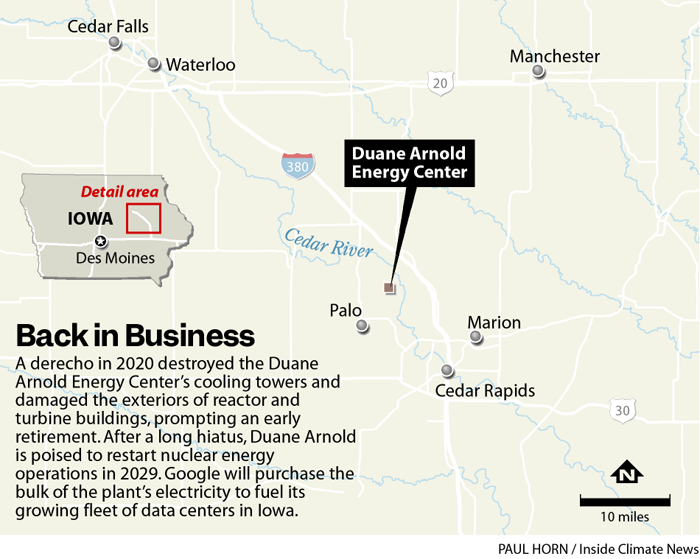
Duane Arnold has sat dormant since 2020, but with a power purchasing agreement between the Florida-based owner, NextEra Energy, and Google, which is expanding its fleet of data centers in Iowa, the plant is now slated for a 2029 reopening.
Early this year, NextEra Energy notified the NRC that it would begin the regulatory process to restart the power plant.
In the fall, NextEra unveiled a partnership with Google, which already operates several data center buildings in Council Bluffs and is currently building a data center campus outside Cedar Rapids, about 12 miles from Duane Arnold.
The tech giant has agreed to help cover recommissioning costs and to purchase the bulk of Duane Arnold’s energy output for 25 years. The two companies “also signed an agreement to explore the development of new nuclear generation to be deployed in the U.S.,” the Oct. 27 press release announced.
“The plant will provide more than 600 MW of clean, safe, ‘always-on’ nuclear energy to the regional grid,” Google wrote in a statement following the NextEra announcement.
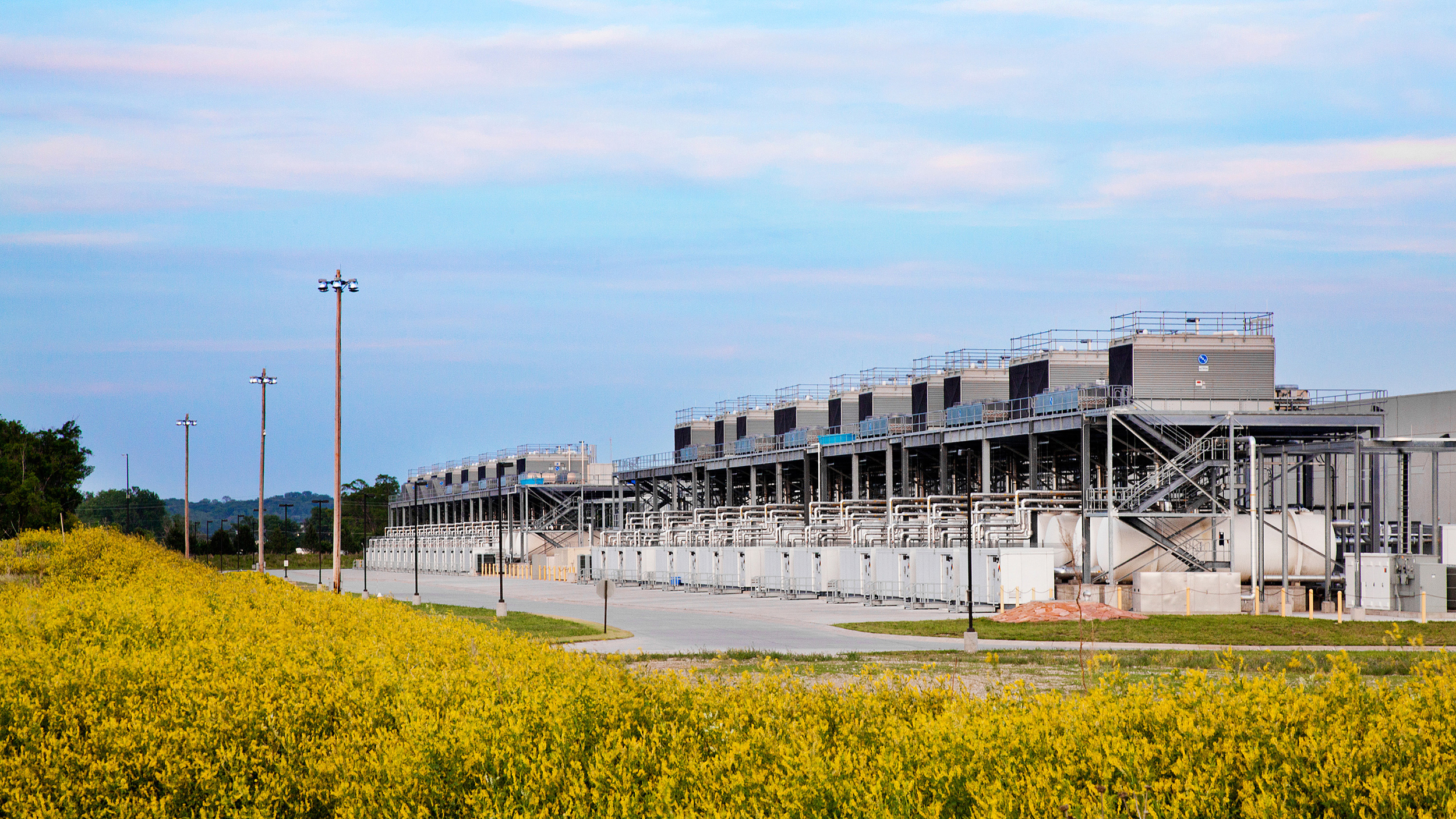
Operators say that improvements to the original plant design, including additional backup diesel generators and cooling towers with greater wind resistance, will enhance its resilience to future severe weather events. That resilience is key, as the threat of extreme storms to nuclear power in Iowa is likely to grow.
The warming of the Gulf of Mexico has driven more moisture northward into Iowa’s atmosphere, increasing the frequency and severity of weather events, including heavy rains, windstorms, tornadoes and hail.
In 2024 alone, Iowa experienced a record 155 tornadoes, topping the previous record of 146 tornadoes set just three years earlier, in 2021.
The National Oceanic and Atmospheric Administration (NOAA) tracked weather and climate disasters with losses exceeding $1 billion in the state from 1980 to 2024. In that time, the state saw slightly less than two storms a year where damage estimates were higher than $1 billion, after adjusting the numbers for inflation. The average for the most recent five-year period was 5.4 events per year. (President Donald Trump’s cuts to the NOAA budget mean that the agency has stopped tracking billion-dollar disasters.)
This story is funded by readers like you.
Our nonprofit newsroom provides award-winning climate coverage free of charge and advertising. We rely on donations from readers like you to keep going. Please donate now to support our work.
Donate Now
Duane Arnold officials have stressed that none of the plant’s critical nuclear components suffered damage during the 2020 derecho. “The plant was safe throughout the entire event,” Matt Ohloff, a spokesman for NextEra, said of the emergency shutdown.
However, NRC reports following the incident noted damage to both safety- and non-safety- related structures.
In addition to the collapsed cooling towers, the storm damaged Duane Arnold’s reactor and turbine buildings, including the “secondary containment” system, which serves as a second line of protection against radioactive release in the event of a meltdown.
Ten hours into the emergency cooldown at Duane Arnold, the system responsible for cooling the two diesel generators began to show signs of wear. Storm debris had clogged the system, and not enough water was flowing to cool the generator. Operators bypassed the strainer, keeping the generator operable.
The most likely pathway to dangerous reactor core damage at Duane Arnold during the derecho would have been the failure of both backup generators, resulting in a station blackout, the NRC analysis concluded.
Even with heightened risk of damage to the nuclear core, a great deal more would have had to go wrong for Duane Arnold to reach meltdown or radiation release, said Adam Stein, director of the Nuclear Energy Innovation program at the Breakthrough Institute, a nonpartisan and nonprofit global research center.
“This was one of the most significant safety events in U.S. nuclear history and yet it was not significantly dangerous to the public,” said Stein. “That speaks to the robustness of these plants.”
NRC licensing requires reactor buildings to be built to withstand “tornado missiles,” or large objects colliding at high speeds, Stein added. “They are literally designed to withstand these kinds of events safely,” he said.
Still, NextEra plans to increase weather-related safety measures at the reopened Duane Arnold plant.
“We do look at those events and try to garner lessons learned and ask, what could make the plant even safer than it is?” said NextEra consultant Michael Davis at a public information meeting held in Cedar Rapids by the Iowa Utilities Commission on Nov. 13.
The company is considering installing a third diesel generator to provide additional backup power, and will also design Duane Arnold’s replacement water-cooling towers with a higher wind resistance threshold, said Davis.
Google representatives did not respond to questions about whether the damage incurred at Duane Arnold during the 2020 derecho raised any concerns for nuclear safety during severe weather events.
The NRC safety requirements mandate that applicants “consider the most severe meteorologic and seismic conditions known in the proposed area,” when selecting reactor sites, an NRC representative wrote in a statement to Inside Climate News.
“It’s important to understand that nuclear plants are built to withstand extreme environmental hazards and that the NRC requires plants to maintain redundant systems, components and programs to be able to mitigate loss of off-site power events,” the NRC added.
Lokenvitz, the former Duane Arnold engineer, views the plant’s reopening as a sort of resurrection. If the facility hadn’t already been slated for decommissioning when the derecho struck, Duane Arnold would have been rebuilt and continued to produce power, she said.
“That plant operated exactly as designed. It was just the perfect storm.”
About This Story
Perhaps you noticed: This story, like all the news we publish, is free to read. That’s because Inside Climate News is a 501c3 nonprofit organization. We do not charge a subscription fee, lock our news behind a paywall, or clutter our website with ads. We make our news on climate and the environment freely available to you and anyone who wants it.
That’s not all. We also share our news for free with scores of other media organizations around the country. Many of them can’t afford to do environmental journalism of their own. We’ve built bureaus from coast to coast to report local stories, collaborate with local newsrooms and co-publish articles so that this vital work is shared as widely as possible.
Two of us launched ICN in 2007. Six years later we earned a Pulitzer Prize for National Reporting, and now we run the oldest and largest dedicated climate newsroom in the nation. We tell the story in all its complexity. We hold polluters accountable. We expose environmental injustice. We debunk misinformation. We scrutinize solutions and inspire action.
Donations from readers like you fund every aspect of what we do. If you don’t already, will you support our ongoing work, our reporting on the biggest crisis facing our planet, and help us reach even more readers in more places?
Please take a moment to make a tax-deductible donation. Every one of them makes a difference.
Thank you,

Anika Jane Beamer
Reporter, Iowa
Anika Jane Beamer covers the environment and climate change in Iowa, with a particular focus on water, soil and CAFOs. A lifelong Midwesterner, she writes about changing ecosystems from one of the most transformed landscapes on the continent. She holds a master’s degree in science writing from the Massachusetts Institute of Technology as well as a bachelor’s degree in biology and Spanish from Grinnell College. She is a former Outrider Fellow at Inside Climate News and was named a Taylor-Blakeslee Graduate Fellow by the Council for the Advancement of Science Writing.