

The Trump administration unveiled a significant rollback of the Biden administration’s national fuel economy standards on Wednesday to make it easier for automakers to build and sell gas-powered cars.
The termination would undo standards put in place by then-President Joe Biden in 2022 that now require carmakers to average 50.4 miles per gallon across their passenger cars and light trucks by the 2031 model year.
The National Highway Traffic Safety Administration (NHTSA) estimates that the new Trump proposed standards, which will exclude electric vehicles, will achieve an average fuel economy of 34.5 miles per gallon by model year 2031, effectively returning to what was in place during Trump’s first term.
The repeal of the Biden-era standards, which will trigger a lengthy rulemaking process, is intended to reduce production costs for American automakers and curb costs for new car customers, President Donald Trump said in the Oval Office. He was joined by executives from Ford, General Motors and Stellantis, who thanked him for proposing the repeal.
“It was ridiculous, very expensive, it put tremendous upward pressure on car prices,” Trump said Wednesday. “Today we’re taking one more step to kill the green new scam.”
But opponents of the measure say repealing fuel economy standards will raise costs for drivers and slash progress made in reducing dangerous air pollution that causes tens of thousands of premature deaths annually across the country, research shows. It’s expected that consumer advocates and transportation experts will present oral and written testimony to oppose any cuts to current standards during the proposed rulemaking’s public comment period.
Gina McCarthy, a former Environmental Protection Agency (EPA) administrator and White House national climate advisor, said rolling back these standards not only creates more pollution but will enable China to overtake the U.S. auto industry in the global car market through dominance in electric vehicle manufacturing.
“If there’s one thing you can count on, it’s that this administration will never act in the best interest of our health or the environment,” McCarthy stated on Wednesday. “The rest of the world will continue to innovate and create cleaner cars that people want to buy and drive, while we’re forced to sit in our clunkers, paying more for gas and pumping out more tailpipe emissions.”
But major U.S. automakers are grateful for the rollback. Stellantis CEO Antonio Filosa said the company appreciated the administration’s realignment with “real world market conditions” as part of the administration’s wider vision for a growing U.S. automotive industry. Ford CEO Jim Farley said repealing the standards was the right move for a lot of reasons.
“Today is a victory for common sense and affordability,” Farley said. “We were number two last year in EV sales, we were number three in hybrids and we’re the leading brand for combustion. We believe that people should be able to make a choice.”
The rollback will allow Ford to invest in more affordable vehicles in the U.S., Farley said.
The standards revision comes nearly a year after Transportation Secretary Sean Duffy ordered the NHTSA to immediately start rulemaking around rescinding or replacing what are called the Corporate Average Fuel Economy (CAFE) standards for cars, SUVs and heavy-duty pickups and vans. Federal law mandates improved gas mileage for American vehicles.
In June, the NHTSA said the prior administration wrongly considered electric vehicles when establishing future mileage requirements. Duffy said that federal law considers only combustion engines in establishing fuel standards, and that by including electric vehicles and hybrid cars, the Biden administration created a standard that combustion engine cars could not attain and required the carmakers to trade for carbon credits.
“These rules are going to allow the automakers to make vehicles that Americans want to purchase, not vehicles that Joe Biden and [former transportation secretary Pete] Buttigieg want them to build,” Duffy said.
The proposed standards would also eliminate the CAFE credit trading program starting in model year 2028, according to the U.S. Department of Transportation. The agency said the credit system allowed companies with large EV lineups to generate and sell excess credits, effectively subsidizing EV manufacturers while increasing compliance costs for companies producing gas-powered vehicles.
EVs’ market share in the U.S. is expected to remain at 8 percent through 2026, the same as it was in 2024, according to a recent forecast from AutoPacific, a research firm. It’s a decrease from the firm’s estimate last year, when it predicted that the market share for EVs would reach 11 percent in 2025 and 15 percent in 2026.
The Biden fuel economy standards set forth by the NHTSA reported the rule would save Americans more than $23 billion in fuel costs while also reducing pollution.
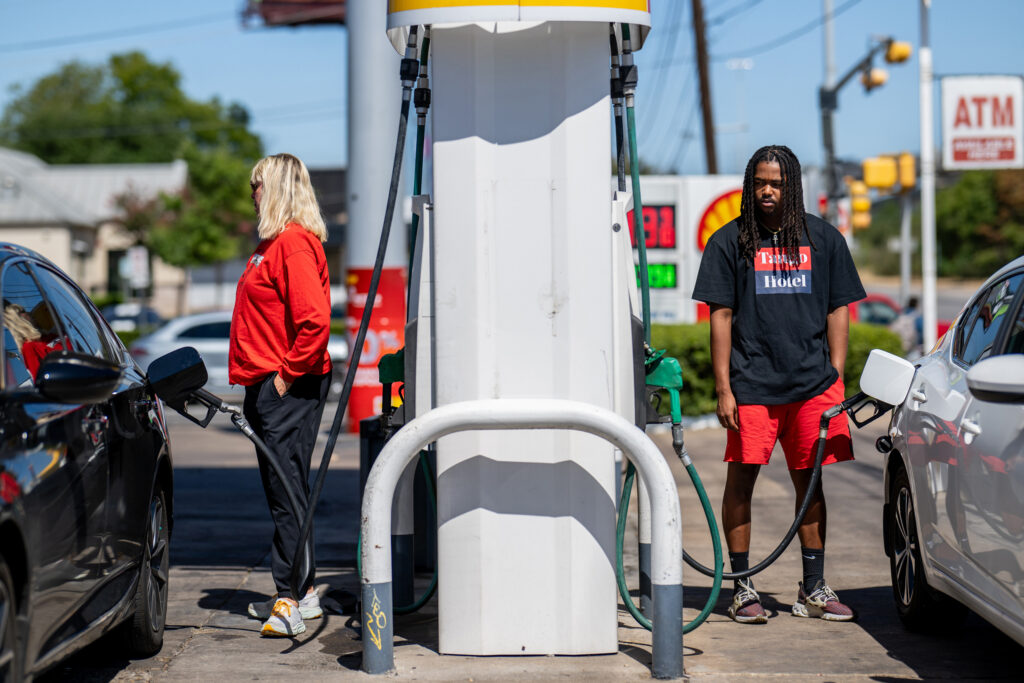
Jason Schwartz, the legal director at the Institute for Policy Integrity at New York University School of Law, said rescinding these standards will not only cost consumers at the pump, but weaken the nation’s vulnerability to gas price shocks. “NHTSA’s proposed repeal will further pinch the wallets of consumers who are already stretched thin,” Schwartz said in a statement.
The move to dismantle these requirements is the latest in a broader effort by the Trump administration to reverse Biden climate and environmental regulations and undo policies Trump said has resulted in an “EV mandate.”
Trump has also called for eliminating subsidies and other measures boosting electric vehicles, stripped federal tax credits from EV purchasers and sought to revoke California’s long-standing ability to set its own emission limits.
The administration has also proposed repealing the 2009 endangerment finding, which would rescind all greenhouse gas emissions regulations for motor vehicles and engines. The endangerment finding is a formal declaration by the EPA, later affirmed by the U.S. Supreme Court, stating that greenhouse gases pose a threat to public health. The finding allows for greenhouse gases to be regulated under the Clean Air Act, the country’s primary federal law to control air pollution.
If the endangerment finding is ultimately repealed, it would be the largest deregulatory action in American history, according to the EPA.
Congress first established the CAFE standards in 1975 largely in response to the 1973 OPEC oil embargo, when the average vehicle got about 13 miles to the gallon. These standards are often credited for reducing American reliance on imported oil and driving investments into domestic manufacturing of more efficient vehicle models.
Strong auto standards are the most effective way to cut pollution and oil use, said Dan Becker, the director of the Center for Biological Diversity’s Safe Climate Transport Campaign. The U.S. is the world’s biggest consumer of oil—consuming 20 percent of the world’s petroleum.
“The cure for pollution and high gas costs is strong fuel economy standards, not killing them as a favor to the president’s Big Oil, Big Auto and OPEC golf buddies,” Becker said. “Trump’s action will feed America’s destructive use of oil, while hamstringing us in the green tech race against Chinese and other foreign carmakers.”
About This Story
Perhaps you noticed: This story, like all the news we publish, is free to read. That’s because Inside Climate News is a 501c3 nonprofit organization. We do not charge a subscription fee, lock our news behind a paywall, or clutter our website with ads. We make our news on climate and the environment freely available to you and anyone who wants it.
That’s not all. We also share our news for free with scores of other media organizations around the country. Many of them can’t afford to do environmental journalism of their own. We’ve built bureaus from coast to coast to report local stories, collaborate with local newsrooms and co-publish articles so that this vital work is shared as widely as possible.
Two of us launched ICN in 2007. Six years later we earned a Pulitzer Prize for National Reporting, and now we run the oldest and largest dedicated climate newsroom in the nation. We tell the story in all its complexity. We hold polluters accountable. We expose environmental injustice. We debunk misinformation. We scrutinize solutions and inspire action.
Donations from readers like you fund every aspect of what we do. If you don’t already, will you support our ongoing work, our reporting on the biggest crisis facing our planet, and help us reach even more readers in more places?
Please take a moment to make a tax-deductible donation. Every one of them makes a difference.
Thank you,

Arcelia Martin
Reporter, Texas Renewables
Arcelia Martin is an award-winning journalist at Inside Climate News. She covers renewable energy in Texas from her base in Dallas. Before joining ICN in 2025, Arcelia was a staff writer at The Dallas Morning News and at The Tennessean. Originally from San Diego, California, she’s a graduate of Gonzaga University and Columbia University Graduate School of Journalism.