

Ever since the first draft of the “One Big Beautiful Bill Act” appeared in the House, renewable energy trade groups have been trying to make sense of language intended to stop tax credits from going to a “prohibited foreign entity.”
The House version of the budget reconciliation measure could be read as saying that a renewable energy development, EV battery factory and many other projects are ineligible for tax credits if just one bolt comes from a Chinese company, or if any entity in a product’s supply chain has ties to China.
It’s understandable why this provision got less attention than others. After all, this is a bill that stabs the clean energy economy in the front, with rapid cancellations of consumer-facing tax credits and an accelerated phaseout of credits for new factories and other investment. The “prohibited foreign entity” language was more like a stab in the back.
I expected the Senate to fix some of the problems with language regarding foreign entities. But the Senate Finance Committee’s version of the bill does little to address the concerns, although it does clarify some minor technical points, according to Seth Hanlon, a senior fellow at the Tax Law Center at New York University School of Law.
We’re hiring!
Please take a look at the new openings in our newsroom.
See jobs
He co-wrote an analysis of the bill last week, soon after the Senate version was released, and he has closely studied the foreign entity rules. Previously he worked as deputy assistant secretary for tax and climate policy at the Treasury Department during the Biden administration and as senior tax counsel for the Democratic staff of the House Budget Committee.
Here is our conversation, edited for length and clarity.
DAN GEARINO: What is a foreign entity of concern? When someone uses that term, what are they talking about?
SETH HANLON: First, just a technical point: Neither the House or Senate bill use the term “foreign entity of concern.” They create their own definitions called “prohibited foreign entities,” which reference prior foreign-entity-of-concern provisions. But I think it’s important to note they’re their own definitions, and they’re much, much broader than the prior definitions of foreign entity of concern. So, people are calling these the foreign entity concern provisions, but they’re way beyond that.
But at the core, there are four covered nations, which are China, Iran, North Korea and Russia, but we don’t have many economic ties with those other three countries, so this is really ostensibly about China.
GEARINO: What do you think this foreign entity language is trying to accomplish?

HANLON: The purpose is to prevent Chinese entities from benefiting from the tax credits. In other words, to prevent tax dollars from subsidizing Chinese entities.
[But the bills] create countless trip wires, where any very attenuated connection or transaction or relationship with, not the government of China, but any person or company associated with China, could potentially trip up one of the restrictions. It’s just extreme overkill.
GEARINO: What’s the enforcement mechanism? So let’s say I’m a company that has made an investment. Who would determine that I have run afoul of these rules?
HANLON: First, taxpayers have to file their tax returns under, obviously, penalties of perjury, so they will need to make their own determination with their advisors in advance. And there are also lenders, investors and their auditors. All want to know whether the company is complying with the rules. Then, on the back end, the IRS, if the company’s audited, could take back the tax credit, or deny the tax credit and potentially impose penalties on top of that.
GEARINO: Is compliance expensive, or is it just a hassle?
HANLON: Yes, it’s expensive. Yes, it’s a hassle. But I think the real problem, in both the House and Senate bill, is there are things that the taxpayer is essentially being asked to affirm that are based on information that it does not even have access to. For example, business relationships of suppliers that are two steps upstream from the actual developer or manufacturer claiming the credit.
Practically speaking, as these bills are written, there’s no way to have sufficient confidence that one is compliant because the rules are just so extensive and get at such attenuated factors that the taxpayers themselves won’t have the information they need.
This story is funded by readers like you.
Our nonprofit newsroom provides award-winning climate coverage free of charge and advertising. We rely on donations from readers like you to keep going. Please donate now to support our work.
Donate Now
GEARINO: Does every single component in a project need to comply with this rule? So, if one bolt in a factory doesn’t comply, does that mean the whole project is ineligible?
HANLON: The text is so ambiguous that yes, it can be read to require the taxpayer to look upstream to every single nut or bolt or subcomponent, and determine whether they’re produced by a prohibited foreign entity, which, practically speaking, will be impossible.
In the Senate bill, there’s a percentage threshold, so 1 percent wouldn’t kick you out, but the problem is you wouldn’t even know how to determine whether it’s 1 percent or 10 percent or more, because it may be largely based on information that the taxpayer would have no access to.
GEARINO: Clean energy advocacy groups and trade associations were flagging the foreign-entity-of-concern language as this poison pill that halts investment. Is that right?
HANLON: Yes, but, I think, if anything, much of industry has not realized how extreme and how much of a poison pill the language in the Senate bill is.
Other stories about the energy transition to take note of this week:
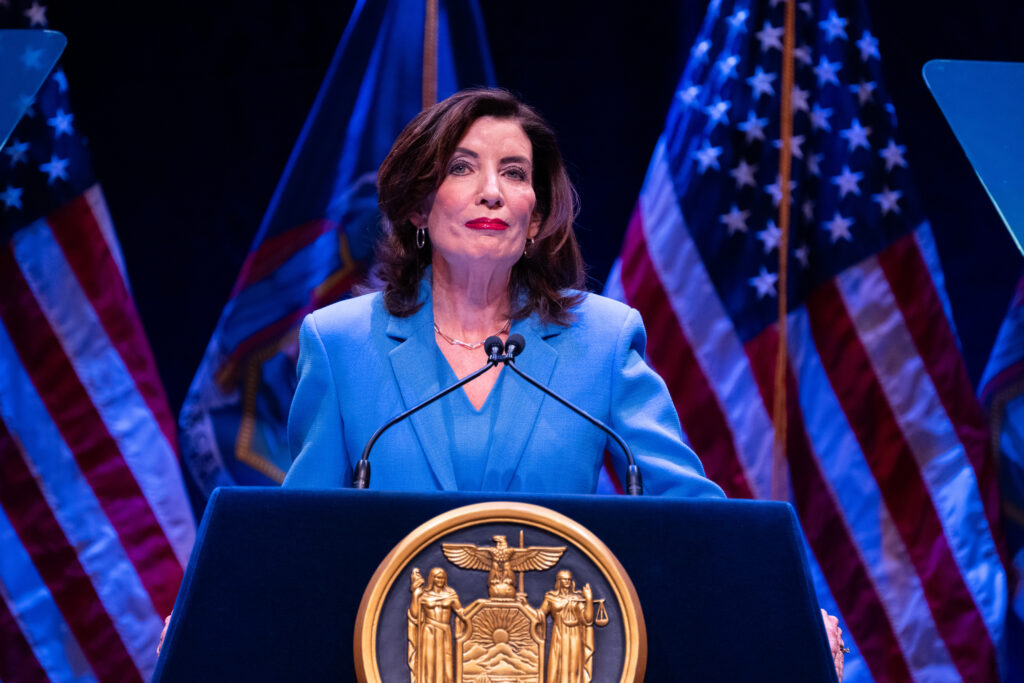
New York’s Governor Announces Plan to Build Nuclear Plant: New York Gov. Kathy Hochul has directed a state agency to develop a nuclear plant, the first nuclear plant to be built in New York in decades, as Philip Marcelo reports for The Associated Press. Hochul said the state needs to secure its energy independence to continue to attract large manufacturers at a time when old fossil fuel plants are reaching the end of their lives. We don’t know the plant’s location or have a timeline for construction, but the announcement is a sign of growing interest in nuclear power.
LG Completes Battery Plant Expansion in Michigan: LG Energy Solution is now making batteries for energy storage systems at its plant in Holland, Michigan, following an expansion to an existing plant that focused on EV batteries, as Julian Spector reports for Canary Media. The company, which is part of the major Korean battery maker, has said the new production lines will have the capacity to make 16.5 gigawatt-hours of lithium iron phosphate battery cells per year. Lithium iron phosphate, known as LFP, has grown in popularity for energy storage and EVs because of lower costs compared to other battery chemistries. The LG factory is likely the largest in the United States making this kind of battery.
BloombergNEF Cuts Forecast for U.S. Electric Vehicle Sales: Shifting policies are among the reasons that BloombergNEF has reduced its forecast for passenger EV sales in the United States. The research firm said it now expects U.S. sales to rise from 1.6 million this year to 4.1 million by 2030 and to make up 27 percent of passenger car sales by the end of the decade, as Robert Walton reports for Utility Dive. This is different from last year, when the firm said EVs would be 48 percent of sales in 2030. The big shift is mainly due to policy changes, including an expectation that Congress will pass a repeal of consumer tax credits for buying EVs and the repeal of California’s ability to set its own tailpipe emissions standards.
Tesla’s Robotaxi Launches in Austin, Gets Regulators’ Attention for Violating Traffic Laws: Tesla has begun a limited introduction of its self-driving taxis in Austin, Texas, with pre-selected customers able to get rides in a limited area of the city and with a human driver on board in case of emergency. Videos on social media have shown examples of the vehicles violating traffic laws, including a botched left turn into the wrong lane. Karoline Leonard writes for the Austin American-Statesman about the rollout and about how the National Highway Traffic Safety Administration said it is aware of the incidents and “will take any necessary actions to protect road safety.”
Inside Clean Energy is ICN’s weekly bulletin of news and analysis about the energy transition. Send news tips and questions to [email protected].
About This Story
Perhaps you noticed: This story, like all the news we publish, is free to read. That’s because Inside Climate News is a 501c3 nonprofit organization. We do not charge a subscription fee, lock our news behind a paywall, or clutter our website with ads. We make our news on climate and the environment freely available to you and anyone who wants it.
That’s not all. We also share our news for free with scores of other media organizations around the country. Many of them can’t afford to do environmental journalism of their own. We’ve built bureaus from coast to coast to report local stories, collaborate with local newsrooms and co-publish articles so that this vital work is shared as widely as possible.
Two of us launched ICN in 2007. Six years later we earned a Pulitzer Prize for National Reporting, and now we run the oldest and largest dedicated climate newsroom in the nation. We tell the story in all its complexity. We hold polluters accountable. We expose environmental injustice. We debunk misinformation. We scrutinize solutions and inspire action.
Donations from readers like you fund every aspect of what we do. If you don’t already, will you support our ongoing work, our reporting on the biggest crisis facing our planet, and help us reach even more readers in more places?
Please take a moment to make a tax-deductible donation. Every one of them makes a difference.
Thank you,

Dan Gearino
Reporter, Clean Energy
Dan Gearino covers the business and policy of renewable energy and utilities, often with an emphasis on the midwestern United States. He is the main author of ICN’s Inside Clean Energy newsletter. He came to ICN in 2018 after a nine-year tenure at The Columbus Dispatch, where he covered the business of energy. Before that, he covered politics and business in Iowa and in New Hampshire. He grew up in Warren County, Iowa, just south of Des Moines, and lives in Columbus, Ohio.