


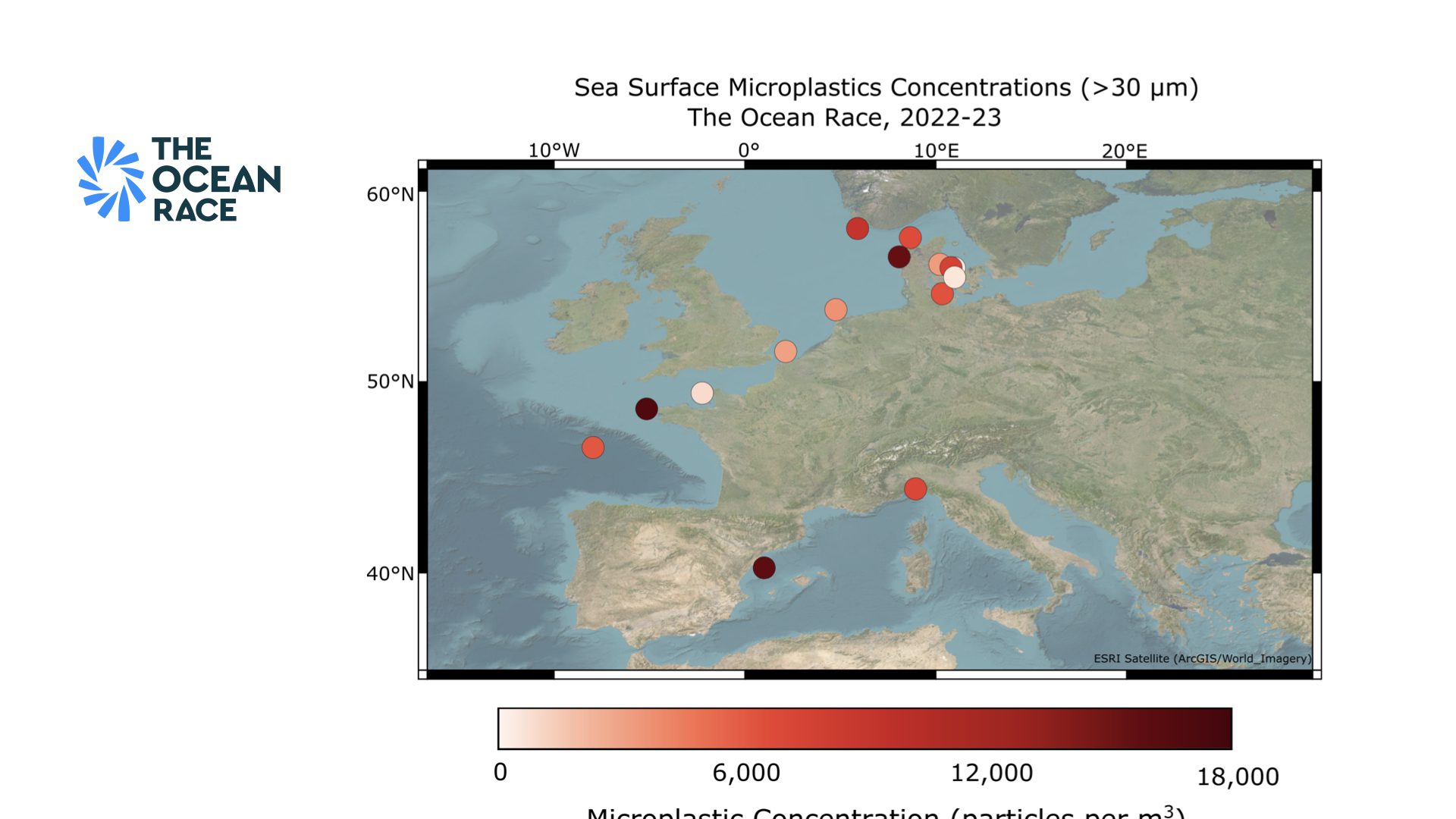
Three of the world’s top five hotspots for marine microplastic pollution are in Europe, according to new data collected by sailors and teams competing in The Ocean Race. During the global sailing competition last year, water samples were collected from the Atlantic Ocean, southern Indian and Pacific Oceans, the Southern Ocean, and in seas around Europe1. Every sample gathered during the 60,000km long Race contained microplastics, with high concentrations found in some of the most remote parts of the planet, several thousand kilometres from land.
Cutting edge sampling and analysis methods meant that scientists were able to examine microplastics as tiny as 0.03 millimetres – 10 times smaller than traditional methods allow. This detailed view led to the discovery of a high number of microplastics: on average, 4,789 per cubic metre of water. The greatest concentration (26,334) was found close to South Africa, followed by the edge of the English Channel close to Brest, France (17,184), then another point close to South Africa (14,976) followed by the Balearic Sea (14,970) and in the North Sea offshore Denmark (14,457). Microplastics captured ranged from 0.03 millimetres to 4.6 millimetres in size.
As well as providing valuable insights on the spread of plastic pollution in the ocean, samples were analysed to determine the type of plastic product that they originated from. Scientists from the National Oceanography Centre (UK) and University of Rhode Island (USA) discovered that, on average, 71% of the microplastics in the samples were microfibers. According to the report, these fibers, from materials such as polyester, are released into the environment from washing machines (through wastewater), dryers (into the air), direct shedding from clothing, degradation of textiles littered in the environment and from discarded fishing gear.
This snapshot on the state of microplastics in the ocean is being shared during a week of crucial meetings aimed at tackling the plastic pollution crisis. During the Intergovernmental Negotiating Committee, in the Republic of Korea, representatives from UN member countries are gathering to develop international laws on plastic pollution.
Victoria Fulfer, who undertook the research for the University of Rhode Island and is now a Microplastics Scientist at the 5 Gyres Institute said: “These results mark a significant development in the global studies of ocean microplastics. For the first time, we have been able to measure tiny particles, as small as 0.03 millimetres, and determine not just their prevalence, but also identify the type of product that they originated from.
“We were shocked to discover such high numbers of microplastics. Less is known about these tiny particles, but there is potential that smaller microplastics will be more harmful to marine life and human health, as very small microplastics are capable of penetrating cells and tissues. Worldwide sampling efforts, like those conducted by The Ocean Race, are key to refining global models of microplastic pollution distribution and identifying new pollution hotspots.”
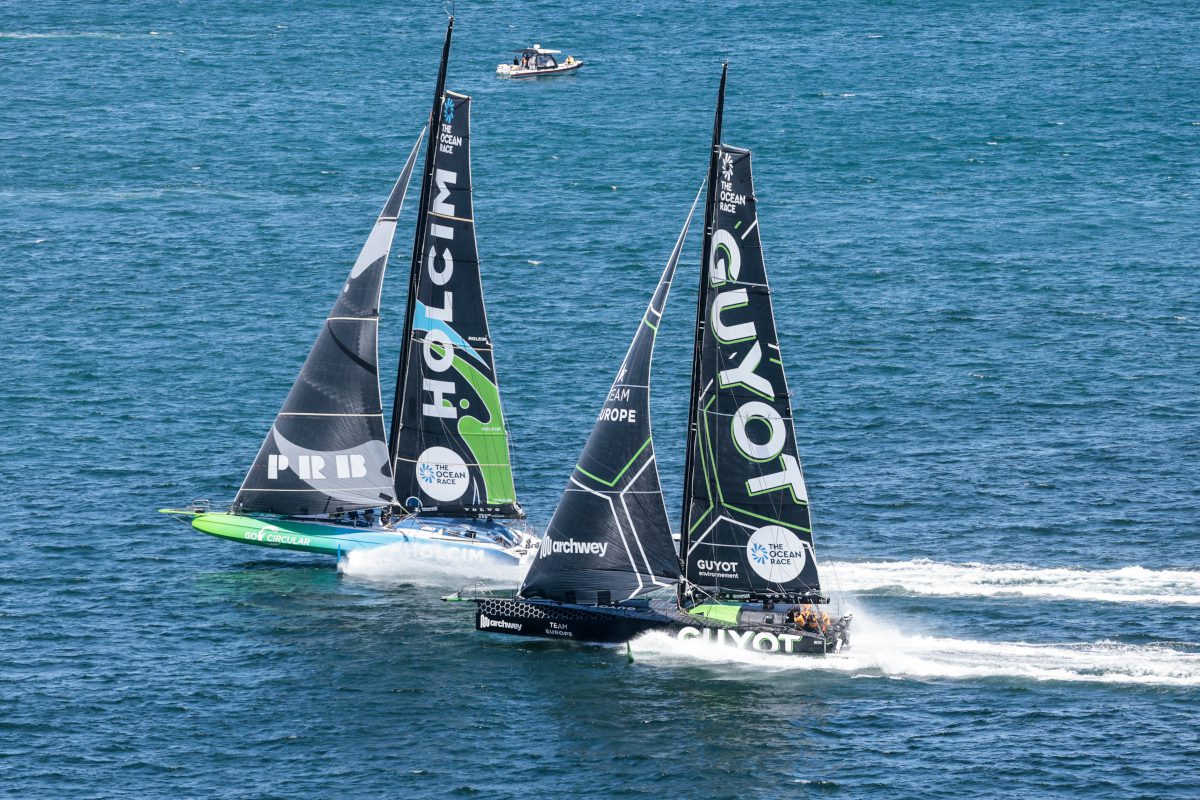
Data gathered during The Ocean Race 2022-23 was collected by two 60-foot foiling International Monohull Open Class Association (IMOCA) sailing vessels (GUYOT environnement – Team Europe and Team Holcim – PRB), using an onboard Sampling Unit: a special filter system designed to collect plastic particles (between 0.03mm and 5mm). The unit works by drawing water in and through filters over a two hour period to capture the microplastics. New samples were taken each day by the sailors and provided to the National Oceanography Centre for analysis, with support from the University of Rhode Island.
Richard Brisius, Race Chairman for The Ocean Race said: “As sailors, for many years we have shared our experiences of seeing a growing amount of plastic debris in remote parts of the planet. Now, through our science programme, we have the data to back this up.
“There is no doubt that marine plastic is having a devastating effect. Microplastics have been found in species throughout the ocean, from plankton to whales, and we are consuming them ourselves in our food. If urgent action isn’t taken by the Intergovernmental Negotiating Committee this week, global plastic waste could almost triple, reaching around 1.2 billion tonnes by 20602. We can turn this around, but we must act now.”
National Oceanography Centre (UK) is a Scientific Collaborator of The Ocean Race, reflecting the two organisations dedication to using the Race’s platform to accelerate ocean science.
The Ocean Race is also contributing scientific data to the Ocean Decade Odyssey project, which is an endorsed Project of the UN Decade of Ocean Science for Sustainable Development (2021-2030) supporting efforts to reverse the cycle of decline in ocean health and create improved conditions for sustainable development of the ocean.
Notes
[1] Data was collected during the 60,000km long Race route. This edition of the race did not include Asia and data was not collected during leg 1 (Alicante to Cape Verde). For leg 2 (Cape Verde to South Africa), microplastic data was collected for particles larger than 0.1 millimetres.
[2] Intergovernmental Negotiating Committee on Plastic Pollution | UNEP – UN Environment Programme
The project acknowledges funding by the EU-MINKE project Metrology for Integrated Marine Management and Knowledge-Transfer Network. Grant agreement ID: 101008724; which made the analysis of the microplastics data at NOC possible.